BTemplates.com

Powered by Blogger.

Pageviews past week

Quantum mechanics

Auto News

artificial intelligence

About Me

Recommend us on Google!

Information Technology

Popular Posts

Showing posts with label artificial intelligence. Show all posts

Saturday, February 11, 2023

The Rise of Artificial Intelligence: Understanding its Applications and Impacts


Artificial Intelligence (AI) is a branch of computer science that deals with the creation of intelligent machines that work and react like human beings. It has become a critical tool in a wide range of industries, including healthcare, finance, manufacturing, retail, and many others. AI technology has made significant progress in recent years, and it is changing the way businesses and individuals interact with technology.

AI is based on the idea that machines can learn from experience, recognize patterns in data, and make decisions. There are two main types of AI: narrow or weak AI, which is designed to perform a specific task, and general or strong AI, which has the ability to perform any intellectual task that a human can. The most common forms of AI include machine learning, natural language processing (NLP), computer vision, and robotics.

Machine learning is a type of AI that enables computers to learn from data, identify patterns, and make predictions. It is used in a variety of applications, including recommendation systems, image and speech recognition, and fraud detection. NLP is a branch of AI that focuses on the interaction between computers and human language. It is used in applications such as chatbots, language translation, and sentiment analysis.

Computer vision, another form of AI, is the ability of computers to interpret and understand visual information from the world, such as images and videos. This technology is used in a wide range of applications, including object recognition, facial recognition, and autonomous vehicles. Robotics is the field of AI that deals with the design, construction, operation, and use of robots. It is used in manufacturing, healthcare, and other industries to automate tasks and increase efficiency.

AI has the potential to revolutionize the way we live and work, and it has already begun to do so. It is helping businesses to make better decisions, improve customer experiences, and increase efficiency. It is also being used to solve complex problems in healthcare, such as disease diagnosis and drug discovery. However, as with any new technology, there are also concerns about the potential consequences of AI, including job loss and privacy issues.

In conclusion, AI is a rapidly evolving technology that has the potential to bring about significant changes in the way we live and work. While there are certainly challenges to be addressed, the benefits of AI are undeniable, and its impact on society and the global economy will only continue to grow in the years to come. 

Tuesday, July 16, 2013

Computer as Smart as a 4-Year-Old? Researchers IQ Test New Artificial Intelligence System


Artificial and natural knowledge researchers at the University of Illinois at Chicago have IQ-tested one of the best available artificial intelligence systems to see how intelligent it really is.

Artificial and natural knowledge researchers at the University of Illinois at Chicago have IQ-tested one of the best available artificial intelligence systems to see how intelligent it really is.
Artificial and natural knowledge researchers IQ-tested 
one of the best available artificial intelligence systems 
and learned that it's about as smart as the average 
4-year-old. (Credit: © Spofi / Fotolia)
Turns out it's about as smart as the average 4-year-old, they will report July 17 at the U.S. Artificial Intelligence Conference in Bellevue, Wash.

The UIC team put ConceptNet 4, an artificial intelligence system developed at M.I.T., through the verbal portions of the Weschsler Preschool and Primary Scale of Intelligence Test, a standard IQ assessment for young children.

They found ConceptNet 4 has the average IQ of a young child. But unlike most children, the machine's scores were very uneven across different portions of the test.

"If a child had scores that varied this much, it might be a symptom that something was wrong," said Robert Sloan, professor and head of computer science at UIC, and lead author on the study.

Sloan said ConceptNet 4 did very well on a test of vocabulary and on a test of its ability to recognize similarities.

"But ConceptNet 4 did dramatically worse than average on comprehension­the 'why' questions," he said.

One of the hardest problems in building an artificial intelligence, Sloan said, is devising a computer program that can make sound and prudent judgment based on a simple perception of the situation or facts-the dictionary definition of commonsense.

Commonsense has eluded AI engineers because it requires both a very large collection of facts and what Sloan calls implicit facts-things so obvious that we don't know we know them. A computer may know the temperature at which water freezes, but we know that ice is cold.

"All of us know a huge number of things," said Sloan. "As babies, we crawled around and yanked on things and learned that things fall. We yanked on other things and learned that dogs and cats don't appreciate having their tails pulled." Life is a rich learning environment.

"We're still very far from programs with commonsense-AI that can answer comprehension questions with the skill of a child of 8," said Sloan. He and his colleagues hope the study will help to focus attention on the "hard spots" in AI research.

Study coauthors are UIC professors Stellan Ohlsson of psychology and Gyorgy Turan of mathematics, statistics and computer science; and UIC mathematical computer science undergraduate student Aaron Urasky.

The study was supported by award N00014-09-1-0125 from the Office of Naval Research and grant CCF-0916708 from the National Science Foundation.

Wednesday, June 26, 2013

Video Game Tech Used to Steer Cockroaches On Autopilot


North Carolina State University researchers are using video game technology to remotely control cockroaches on autopilot, with a computer steering the cockroach through a controlled environment. The researchers are using the technology to track how roaches respond to the remote control, with the goal of developing ways that roaches on autopilot can be used to map dynamic environments -- such as collapsed buildings.

North Carolina State University researchers are using video game technology to remotely control cockroaches on autopilot, with a computer steering the cockroach through a controlled environment.
North Carolina State University researchers are using video game technology to remotely control cockroaches on autopilot, with a computer steering the cockroach through a controlled environment. (Credit: Alper Bozkurt)

The researchers have incorporated Microsoft's motion-sensing Kinect system into an electronic interface developed at NC State that can remotely control cockroaches. The researchers plug in a digitally plotted path for the roach, and use Kinect to identify and track the insect's progress. The program then uses the Kinect tracking data to automatically steer the roach along the desired path.

The program also uses Kinect to collect data on how the roaches respond to the electrical impulses from the remote-control interface. This data will help the researchers fine-tune the steering parameters needed to control the roaches more precisely.

"Our goal is to be able to guide these roaches as efficiently as possible, and our work with Kinect is helping us do that," says Dr. Alper Bozkurt, an assistant professor of electrical and computer engineering at NC State and co-author of a paper on the work.

"We want to build on this program, incorporating mapping and radio frequency techniques that will allow us to use a small group of cockroaches to explore and map disaster sites," Bozkurt says. "The autopilot program would control the roaches, sending them on the most efficient routes to provide rescuers with a comprehensive view of the situation."

The roaches would also be equipped with sensors, such as microphones, to detect survivors in collapsed buildings or other disaster areas. "We may even be able to attach small speakers, which would allow rescuers to communicate with anyone who is trapped," Bozkurt says.

Bozkurt's team had previously developed the technology that would allow users to steer cockroaches remotely, but the use of Kinect to develop an autopilot program and track the precise response of roaches to electrical impulses is new.

The interface that controls the roach is wired to the roach's antennae and cerci. The cerci are sensory organs on the roach's abdomen, which are normally used to detect movement in the air that could indicate a predator is approaching -- causing the roach to scurry away. But the researchers use the wires attached to the cerci to spur the roach into motion. The wires attached to the antennae send small charges that trick the roach into thinking the antennae are in contact with a barrier and steering them in the opposite direction.

The paper, "Kinect-based System for Automated Control of Terrestrial Insect Biobots," will be presented at the Remote Controlled Insect Biobots Minisymposium at the 35th Annual International Conference of the IEEE Engineering in Medicine and Biology Society July 4 in Osaka, Japan. Lead author of the paper is NC State undergraduate Eric Whitmire. Co-authors are Bozkurt and NC State graduate student Tahmid Latif. The research was supported by the National Science Foundation.

Tuesday, June 18, 2013

A Robot That Runs Like a Cat


Thanks to its legs, whose design faithfully reproduces feline morphology, EPFL's four-legged "cheetah-cub robot" has the same advantages as its model: it is small, light and fast. Still in its experimental stage, the robot will serve as a platform for research in locomotion and biomechanics.

This is cheetah-cub, a compliant quadruped robot.
(Credit: (c) EPFL)
Even though it doesn't have a head, you can still tell what kind of animal it is: the robot is definitely modeled upon a cat. Developed by EPFL's Biorobotics Laboratory (Biorob), the "cheetah-cub robot," a small-size quadruped prototype robot, is described in an article appearing today in the International Journal of Robotics Research. The purpose of the platform is to encourage research in biomechanics; its particularity is the design of its legs, which make it very fast and stable. Robots developed from this concept could eventually be used in search and rescue missions or for exploration.

This robot is the fastest in its category, namely in normalized speed for small quadruped robots under 30Kg. During tests, it demonstrated its ability to run nearly seven times its body length in one second. Although not as agile as a real cat, it still has excellent auto-stabilization characteristics when running at full speed or over a course that included disturbances such as small steps. In addition, the robot is extremely light, compact, and robust and can be easily assembled from materials that are inexpensive and readily available. 


Faithful reproduction

The machine's strengths all reside in the design of its legs. The researchers developed a new model with this robot, one that is based on the meticulous observation and faithful reproduction of the feline leg. The number of segments -- three on each leg -- and their proportions are the same as they are on a cat. Springs are used to reproduce tendons, and actuators -- small motors that convert energy into movement -- are used to replace the muscles.

"This morphology gives the robot the mechanical properties from which cats benefit, that's to say a marked running ability and elasticity in the right spots, to ensure stability," explains Alexander Sprowitz, a Biorob scientist. "The robot is thus naturally more autonomous."

Sized for a search


According to Biorob director Auke Ijspeert, this invention is the logical follow-up of research the lab has done into locomotion that included a salamander robot and a lamprey robot. "It's still in the experimental stages, but the long-term goal of the cheetah-cub robot is to be able to develop fast, agile, ground-hugging machines for use in exploration, for example for search and rescue in natural disaster situations. Studying and using the principles of the animal kingdom to develop new solutions for use in robots is the essence of our research."

Wednesday, June 12, 2013

Brain-Computer Interfaces: Just Wave a Hand


Small electrodes placed on or inside the brain allow patients to interact with computers or control robotic limbs simply by thinking about how to execute those actions. This technology could improve communication and daily life for a person who is paralyzed or has lost the ability to speak from a stroke or neurodegenerative disease.

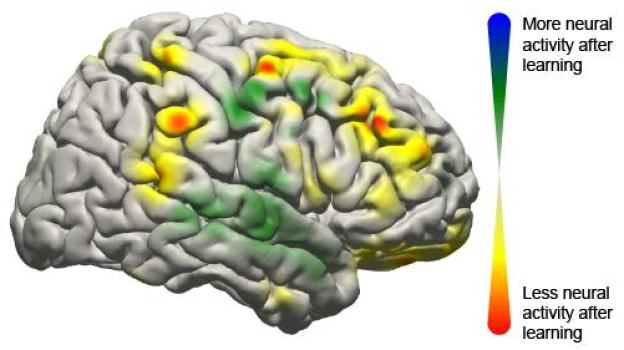
This image shows the changes that took place in the brain for all patients participating in the study using a brain-computer interface. Changes in activity were distributed widely throughout the brain.
This image shows the changes that took place in the brain for all patients participating in the study using a brain-computer interface. Changes in activity were distributed widely throughout the brain. (Credit: Jeremiah Wander, UW)
Now, University of Washington researchers have demonstrated that when humans use this technology -- called a brain-computer interface -- the brain behaves much like it does when completing simple motor skills such as kicking a ball, typing or waving a hand. Learning to control a robotic arm or a prosthetic limb could become second nature for people who are paralyzed.

"What we're seeing is that practice makes perfect with these tasks," said Rajesh Rao, a UW professor of computer science and engineering and a senior researcher involved in the study. "There's a lot of engagement of the brain's cognitive resources at the very beginning, but as you get better at the task, those resources aren't needed anymore and the brain is freed up."

Rao and UW collaborators Jeffrey Ojemann, a professor of neurological surgery, and Jeremiah Wander, a doctoral student in bioengineering, published their results online June 10 in the Proceedings of the National Academy of Sciences.

In this study, seven people with severe epilepsy were hospitalized for a monitoring procedure that tries to identify where in the brain seizures originate. Physicians cut through the scalp, drilled into the skull and placed a thin sheet of electrodes directly on top of the brain. While they were watching for seizure signals, the researchers also conducted this study.

The patients were asked to move a mouse cursor on a computer screen by using only their thoughts to control the cursor's movement. Electrodes on their brains picked up the signals directing the cursor to move, sending them to an amplifier and then a laptop to be analyzed. Within 40 milliseconds, the computer calculated the intentions transmitted through the signal and updated the movement of the cursor on the screen.

Researchers found that when patients started the task, a lot of brain activity was centered in the prefrontal cortex, an area associated with learning a new skill. But after often as little as 10 minutes, frontal brain activity lessened, and the brain signals transitioned to patterns similar to those seen during more automatic actions.

"Now we have a brain marker that shows a patient has actually learned a task," Ojemann said. "Once the signal has turned off, you can assume the person has learned it."

While researchers have demonstrated success in using brain-computer interfaces in monkeys and humans, this is the first study that clearly maps the neurological signals throughout the brain. The researchers were surprised at how many parts of the brain were involved.

"We now have a larger-scale view of what's happening in the brain of a subject as he or she is learning a task," Rao said. "The surprising result is that even though only a very localized population of cells is used in the brain-computer interface, the brain recruits many other areas that aren't directly involved to get the job done."

Several types of brain-computer interfaces are being developed and tested. The least invasive is a device placed on a person's head that can detect weak electrical signatures of brain activity. Basic commercial gaming products are on the market, but this technology isn't very reliable yet because signals from eye blinking and other muscle movements interfere too much.

A more invasive alternative is to surgically place electrodes inside the brain tissue itself to record the activity of individual neurons. Researchers at Brown University and the University of Pittsburgh have demonstrated this in humans as patients, unable to move their arms or legs, have learned to control robotic arms using the signal directly from their brain.

The UW team tested electrodes on the surface of the brain, underneath the skull. This allows researchers to record brain signals at higher frequencies and with less interference than measurements from the scalp. A future wireless device could be built to remain inside a person's head for a longer time to be able to control computer cursors or robotic limbs at home.

"This is one push as to how we can improve the devices and make them more useful to people," Wander said. "If we have an understanding of how someone learns to use these devices, we can build them to respond accordingly."

The research team, along with the National Science Foundation's Engineering Research Center for Sensorimotor Neural Engineering headquartered at the UW, will continue developing these technologies.

This research was funded by the National Institutes of Health, the NSF, the Army Research Office and the Keck Foundation. 


Share this story on Facebook, Twitter, and Google

Tuesday, June 21, 2011

Genius of Einstein, Fourier key to new humanlike computer vision


Two new techniques for computer-vision technology mimic how humans perceive three-dimensional shapes by instantly recognizing objects no matter how they are twisted or bent, an advance that could help machines see more like people.
This graphic illustrates a new computer-vision technology
that builds on the basic physics and mathematical equations
related to how heat diffuses over surfaces. The technique
mimics how humans perceive three-dimensional shapes
by instantly recognizing objects no matter how they are
twisted or bent, an advance that could help machines see
more like people. Here, a "heat mean signature" of a human
hand model is used to perceive the six segments of the
overall shape and define the fingertips. (Purdue University
image/Karthik Ramani and Yi Fang)

The techniques, called heat mapping and heat distribution, apply mathematical methods to enable machines to perceive three-dimensional objects, said Karthik Ramani, Purdue University's Donald W. Feddersen Professor of Mechanical Engineering.

"Humans can easily perceive 3-D shapes, but it's not so easy for a computer," he said. "We can easily separate an object like a hand into its segments - the palm and five fingers - a difficult operation for computers."

Both of the techniques build on the basic physics and mathematical equations related to how heat diffuses over surfaces.

"Albert Einstein made contributions to diffusion, and 18th century physicist Jean Baptiste Joseph Fourier developed Fourier's law, used to derive the heat equation," Ramani said. "We are standing on the shoulders of giants in creating the algorithms for these new approaches using the heat equation."

As heat diffuses over a surface it follows and captures the precise contours of a shape. The system takes advantage of this "intelligence of heat," simulating heat flowing from one point to another and in the process characterizing the shape of an object, he said.

Findings will be detailed in two papers being presented during the IEEE Computer Vision and Pattern Recognition conference on June 21-23 in Colorado Springs. The paper was written by Ramani, Purdue doctoral students Yi Fang and Mengtian Sun, and Minhyong Kim, a professor of pure mathematics at the University College London.

A major limitation of existing methods is that they require "prior information" about a shape in order for it to be analyzed.
Researchers developing a new machine-vision technique tested
their method on certain complex shapes, including the human form
or a centaur – a mythical half-human, half-horse creature. The heat
mapping allows a computer to recognize the objects no matter how
the figures are bent or twisted and is able to ignore "noise" introduced
by imperfect laser scanning or other erroneous data. (Purdue University
image/Karthik Ramani and Yi Fang)

"For example, in order to do segmentation you have to tell the computer ahead of time how many segments the object has," Ramani said. "You have to tell it that you are expecting, say, 10 segments or 12 segments."

The new methods mimic the human ability to properly perceive objects because they don't require a preconceived idea of how many segments exist.

"We are trying to come as close as possible to human segmentation," Ramani said. "A hot area right now is unsupervised machine learning. This means a machine, such as a robot, can perceive and learn without having any previous training. We are able to estimate the segmentation instead of giving a predefined number of segments."


The work is funded partially by the National Science Foundation. A patent on the technology is pending.

The methods have many potential applications, including a 3-D search engine to find mechanical parts such as automotive components in a database; robot vision and navigation; 3-D medical imaging; military drones; multimedia gaming; creating and manipulating animated characters in film production; helping 3-D cameras to understand human gestures for interactive games; contributing to progress of areas in science and engineering related to pattern recognition; machine learning; and computer vision.

The heat-mapping method works by first breaking an object into a mesh of triangles, the simplest shape that can characterize surfaces, and then calculating the flow of heat over the meshed object. The method does not involve actually tracking heat; it simulates the flow of heat using well-established mathematical principles, Ramani said.

Heat mapping allows a computer to recognize an object, such as a hand or a nose, no matter how the fingers are bent or the nose is deformed and is able to ignore "noise" introduced by imperfect laser scanning or other erroneous data.

"No matter how you move the fingers or deform the palm, a person can still see that it's a hand," Ramani said. "But for a computer to say it's still a hand is going to be hard. You need a framework - a consistent, robust algorithm that will work no matter if you perturb the nose and put noise in it or if it's your nose or mine."

The method accurately simulates how heat flows on the object while revealing its structure and distinguishing unique points needed for segmentation by computing the "heat mean signature." Knowing the heat mean signature allows a computer to determine the center of each segment, assign a "weight" to specific segments and then define the overall shape of the object.

"Being able to assign a weight to segments is critical because certain points are more important than others in terms of understanding a shape," Ramani said. "The tip of the nose is more important than other points on the nose, for example, to properly perceive the shape of the nose or face, and the tips of the fingers are more important than many other points for perceiving a hand."

In temperature distribution, heat flow is used to determine a signature, or histogram, of the entire object.

"A histogram is a two-dimensional mapping of a three-dimensional shape," Ramani said. "So, no matter how a dog bends or twists, it gives you the same signature."

The temperature distribution technique also uses a triangle mesh to perceive 3-D shapes. Both techniques, which could be combined in the same system, require modest computer power and recognize shapes quickly, he said.

"It's very efficient and very compact because you're just using a two-dimensional histogram," Ramani said. "Heat propagation in a mesh happens very fast because the mathematics of matrix computations can be done very quickly and well."

The researchers tested their method on certain complex shapes, including hands, the human form or a centaur, a mythical half-human, half-horse creature.

Sources: Karthik Ramani, 765-494-5725, ramani@purdue.edu

Yi Fang, fang4@purdue.edu

Note to Journalists: The papers are available by contacting Emil Venere, Purdue News Service, at 765-494-4709, venere@purdue.edu


Friday, September 24, 2010

Brain Coprocessors The need for operating systems to help brains and machines work together.


The last few decades have seen a surge of invention of technologies that enable the observation or perturbation of information in the brain. Functional MRI, which measures blood flow changes associated with brain activity, is being explored for purposes as diverse as lie detection, prediction of human decision making, and assessment of language recovery after stroke.

Implanted electrical stimulators, which enable control of neural circuit activity, are borne by hundreds of thousands of people to treat conditions such as deafness, Parkinson's disease, and obsessive-compulsive disorder. And new methods, such as the use of light to activate or silence specific neurons in the brain, are being widely utilized by researchers to reveal insights into how to control neural circuits to achieve therapeutically useful changes in brain dynamics. We are entering a neurotechnology renaissance, in which the toolbox for understanding the brain and engineering its functions is expanding in both scope and power at an unprecedented rate.

This toolbox has grown to the point where the strategic utilization of multiple neurotechnologies in conjunction with one another, as a system, may yield fundamental new capabilities, both scientific and clinical, beyond what they can offer alone. For example, consider a system that reads out activity from a brain circuit, computes a strategy for controlling the circuit so it enters a desired state or performs a specific computation, and then delivers information into the brain to achieve this control strategy. Such a system would enable brain computations to be guided by predefined goals set by the patient or clinician, or adaptively steered in response to the circumstances of the patient's environment or the instantaneous state of the patient's brain.

Some examples of this kind of "brain coprocessor" technology are under active development, such as systems that perturb the epileptic brain when a seizure is electrically observed, and prosthetics for amputees that record nerves to control artificial limbs and stimulate nerves to provide sensory feedback. Looking down the line, such system architectures might be capable of very advanced functions--providing just-in-time information to the brain of a patient with dementia to augment cognition, or sculpting the risk-taking profile of an addiction patient in the presence of stimuli that prompt cravings.

Given the ever-increasing number of brain readout and control technologies available, a generalized brain coprocessor architecture could be enabled by defining common interfaces governing how component technologies talk to one another, as well as an "operating system" that defines how the overall system works as a unified whole--analogous to the way personal computers govern the interaction of their component hard drives, memories, processors, and displays. Such a brain coprocessor platform could facilitate innovation by enabling neuroengineers to focus on neural prosthetics at an algorithmic level, much as a computer programmer can work on a computer at a conceptual level without having to plan the fate of every individual bit. In addition, if new technologies come along, e.g., a new kind of neural recording technology, they could be incorporated into a system, and in principle rapidly coupled to existing computation and perturbation methods, without requiring the heavy readaptation of those other components.

Developing such brain coprocessor architectures would take some work--in particular, it would require technologies standardized enough, or perhaps open enough, to be interoperable in a variety of combinations. Nevertheless, much could be learned from developing relatively simple prototype systems. For example, recording technologies by themselves can report brain activity, but cannot fully attest to the causal contribution that the observed brain activity makes to a specific behavioral or clinical outcome; control technologies can input information into neural targets, but by themselves their outcomes might be difficult to interpret due to endogenous neural information and unobserved neural processing. These scientific issues can be disambiguated by rudimentary brain coprocessors, built with readily available off-the-shelf components, that use recording technologies to assess how a given neural circuit perturbation alters brain dynamics. Such explorations may begin to reveal principles governing how best to control a circuit--revealing the neural targets and control strategies that most efficaciously lead to a goal brain state or behavioral effect, and thus pointing the way to new therapeutic strategies. Miniature, implantable brain coprocessors might be able to support new kinds of personalized medicine, for example continuously adapting a neural control strategy to the goals, state, environment, and history of an individual patient--important powers, given the dynamic nature of many brain disorders.

In the future, the computational module of a brain coprocessor may be powerful enough to assist in high-level human cognition or complex decision making. Of course, the augmentation of human intelligence has been one of the key goals of computer engineers for well over half a century. Indeed, if we relax the definition of brain coprocessor just a bit, so as not to require direct physical access to the brain, many consumer technologies being developed today are converging upon brain coprocessor-like architectures. A large number of new technologies are attempting to discover information useful to a user and to deliver this information to the user in real time. Also, these discovery and delivery processes are increasingly shaped by the environment (e.g., location) and history (e.g., social interactions, searches) of the user. Thus we are seeing a departure from the classical view (as initially anticipated by early thinkers about human-machine symbiosis such as J. C. R. Licklider) in which computers receive goals from humans, perform defined computations, and then provide the results back to humans.

Of course, giving machines the authority to serve as proactive human coprocessors, and allowing them to capture our attention with their computed priorities, has to be considered carefully, as anyone who has lost hours due to interruption by a slew of social-network updates or search-engine alerts can attest. How can we give the human brain access to increasingly proactive coprocessing technologies without losing sight of our overarching goals? One idea is to develop and deploy metrics that allow us to evaluate the IQ of a human plus a coprocessor, working together--evaluating the performance of collaborating natural and artificial intelligences in a broad battery of problem-solving contexts. After all, humans with Internet-based brain coprocessors (e.g., laptops running Web browsers) may be more distractible if the goals include long, focused writing tasks, but they may be better at synthesizing data broadly from disparate sources; a given brain coprocessor configuration may be good for some problems but bad for others. Thinking of emerging computational technologies as brain coprocessors forces us to think about them in terms of the impacts they have on the brain, positive and negative, and importantly provides a framework for thoughtfully engineering their direct, as well as their emergent, effects.

Sunday, August 8, 2010

Artificial Bee Eye Gives Insight Into Insects’ Visual World


Despite their tiny brains, bees have remarkable navigation capabilities based on their vision. Now scientists have recreated a light-weight imaging system mimicking a honeybee's field of view, which could change the way we build mobile robots and small flying vehicles.

Bee eye view. (Credit: Image courtesy of Institute 
of Physics)

New research published Aug. 6 in IOP Publishing's Bioinspiration & Biomimetics, describes how the researchers from the Center of Excellence 'Cognitive Interaction Technology' at Bielefeld University, Germany, have built an artificial bee eye, complete with fully functional camera, to shed light on the insects' complex sensing, processing and navigational skills.

Consisting of a light-weight mirror-lens combination attached to a USB video camera, the artificial eye manages to achieve a field of vision comparable to that of a bee. In combining a curved reflective surface that is built into acrylic glass with lenses covering the frontal field, the bee eye camera has allowed the researchers to take unique images showing the world from an insect's viewpoint.

In the future, the researchers hope to include UV to fully reflect a bee's colour vision, which is important to honeybees for flower recognition and discrimination and also polarisation vision, which bees use for orientation. They also hope to incorporate models of the subsequent neural processing stages.

As the researchers write, "Despite the discussed limitations of our model of the spatial resolution of the honeybees compound eyes, we are confident that it is useful for many purposes, e.g. for the simulation of bee-like agents in virtual environments and, in combination with presented imaging system, for testing bee-inspired visual navigation strategies on mobile robots."

Wednesday, June 9, 2010

How the Brain Recognizes Objects


Researchers at MIT's McGovern Institute for Brain Research have developed a new mathematical model to describe how the human brain visually identifies objects. The model accurately predicts human performance on certain visual-perception tasks, which suggests that it's a good indication of what actually happens in the brain, and it could also help improve computer object-recognition systems.
Image
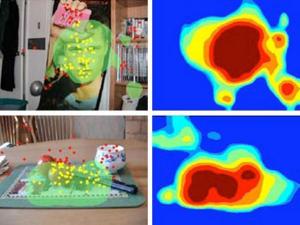
A new computational model of how the primate brain 
recognizes objects creates a map of "interesting" features 
(right) for a given image. The model's predictions of which 
parts of the image will attract a viewer's attention 
(green clouds, left) accord well with experimental data 
(yellow and red dots). 
(Credit: Images courtesy of Sharat Chikkerur)

The model was designed to reflect neurological evidence that in the primate brain, object identification -- deciding what an object is -- and object location -- deciding where it is -- are handled separately. "Although what and where are processed in two separate parts of the brain, they are integrated during perception to analyze the image," says Sharat Chikkerur, lead author on a paper appearing this week in the journal Vision Research, which describes the work. "The model that we have tries to explain how this information is integrated."

The mechanism of integration, the researchers argue, is attention. According to their model, when the brain is confronted by a scene containing a number of different objects, it can't keep track of all of them at once. So instead it creates a rough map of the scene that simply identifies some regions as being more visually interesting than others. If it's then called upon to determine whether the scene contains an object of a particular type, it begins by searching -- turning its attention toward -- the regions of greatest interest.

Chikkerur and Tomaso Poggio, the Eugene McDermott Professor in the Department of Brain and Cognitive Sciences and at the Computer Science and Artificial Intelligence Laboratory, together with graduate student Cheston Tan and former postdoc Thomas Serre, implemented the model in software, then tested its predictions against data from experiments with human subjects. The subjects were asked first to simply regard a street scene depicted on a computer screen, then to count the cars in the scene, and then to count the pedestrians, while an eye-tracking system recorded their eye movements. The software predicted with great accuracy which regions of the image the subjects would attend to during each task.

The software's analysis of an image begins with the identification of interesting features -- rudimentary shapes common to a wide variety of images. It then creates a map that depicts which features are found in which parts of the image. But thereafter, shape information and location information are processed separately, as they are in the brain.

The software creates a list of all the interesting features in the feature map, and from that, it creates another list, of all the objects that contain those features. But it doesn't record any information about where or how frequently the features occur.

At the same time, it creates a spatial map of the image that indicates where interesting features are to be found, but not what sorts of features they are.

It does, however, interpret the "interestingness" of the features probabilistically. If a feature occurs more than once, its interestingness is spread out across all the locations at which it occurs. If another feature occurs at only one location, its interestingness is concentrated at that one location.

Mathematically, this is a natural consequence of separating information about objects' identity and location and interpreting the results probabilistically. But it ends up predicting another aspect of human perception, a phenomenon called "pop out." A human subject presented with an image of, say, one square and one star will attend to both objects about equally. But a human subject presented an image of one square and a dozen stars will tend to focus on the square.

Like a human asked to perform a visual-perception task, the software can adjust its object and location models on the fly. If the software is asked to identify only the objects at a particular location in the image, it will cross off its list of possible objects any that don't contain the features found at that location.

By the same token, if it's asked to search the image for a particular kind of object, the interestingness of features not found in that object will go to zero, and the interestingness of features found in the object will increase proportionally. This is what allows the system to predict the eye movements of humans viewing a digital image, but it's also the aspect of the system that could aid the design of computer object-recognition systems. A typical object-recognition system, when asked to search an image for multiple types of objects, will search through the entire image looking for features characteristic of the first object, then search through the entire image looking for features characteristic of the second object, and so on. A system like Poggio and Chikkerur's, however, could limit successive searches to just those regions of the image that are likely to have features of interest.

Funding: DARPA, the Honda Research Institute USA, NEC, Sony and the Eugene McDermott Foundation

Saturday, April 17, 2010

Electronic 'Nose' Can Predict Pleasantness of Novel Odors


Weizmann Institute scientists have 'trained' an electronic system to be able to predict the pleasantness of novel odors, just like a human would perceive them -- turning the popular notion that smell is completely personal and culture-specific on its head. In research published in PLoS Computational Biology, the scientists argue that the perception of an odor's pleasantness is innately hard-wired to its molecular structure, and it is only within specific contexts that personal or cultural differences are made apparent.
Electronic Nose
Scientists have 'trained' an electronic system to
be able to predict the pleasantness of novel odors, 
just like a human would perceive them. 
(Credit: iStockphoto/Sharon Dominick)

These findings have important implications for automated environmental toxicity and malodor monitoring, fast odor screening in the perfume industry, and provide a critical building block for the Holy Grail of sense technology -- transmitting scent digitally.

Over the last decade, electronic devices, commonly known as electronic noses or 'eNoses,' have been developed to be able to detect and recognize odors. The main component of an eNose is an array of chemical sensors. As an odor passes through the eNose, its molecular features stimulate the sensors in such a way as to produce a unique electrical pattern -- an 'odor fingerprint' -- that characterizes that specific odor. Like a sniffer dog, an eNose first needs to be trained with odor samples so as to build a database of reference. Then the instrument can recognize new samples of those odors by comparing the odor's fingerprint to those contained in its database.

But unlike humans, if eNoses are presented with a novel odor whose fingerprint has not already been recorded in their database, they are unable to classify or recognize it.

So a team of Weizmann scientists, led by Dr. Rafi Haddad, then a graduate student of Prof. Noam Sobel of the Neurobiology Department and co-supervisor Prof. David Harel of the Computer Science and Applied Mathematics Department, together with their colleague Abebe Medhanie of the Neurobiology Department, and Dr. Yehudah Roth of the Edith Wolfson Medical Center, Holon, decided to approach this issue from a different perspective. Rather than train an eNose to recognize a particular odor, they trained it to estimate the odor along a particular perceptual axis. The axis they chose was odorant pleasantness. In other words, they trained their eNose to predict whether an odor would be perceived as pleasant or unpleasant, or anywhere in between.

To achieve this, the scientists first asked a group of native Israelis to rate the pleasantness of a selection of odors according to a 30-point scale ranging from 'very pleasant' to 'very unpleasant.' From this dataset, they developed an 'odor pleasantness' algorithm, which they then programmed into the eNose. The scientists then got the eNose to predict the pleasantness of a completely new set of odors not contained in their database against the ratings provided by a completely different group of native Israelis. The scientists found that the eNose was able to generalize and rate the pleasantness of novel odors it never smelled before, and these ratings were about 80% similar to those of naive human raters who had not participated in the eNose training phase. Moreover, if the odors were simply categorized as either 'pleasant' or 'unpleasant,' as opposed to being rated on a scale, it achieved an accuracy of 99%.

But these findings still don't determine whether olfactory perception is culture-specific or not. With this in mind, the scientists decided to test eNose predictions against a group of recent immigrants to Israel from Ethiopia. The results showed that the eNose's ability to predict the pleasantness of novel odors against the native Ethipoians' ratings was just as good, even though it was 'tuned' to the pleasantness of odors as perceived by native Israelis. In other words, even though different odors have different meanings across cultures, the eNose performed equally well across these populations. This suggests a fundamental cross-cultural similarity in odorant pleasantness.

Sobel comments: "Being able to predict whether a person who we never tested before would like a specific odorant, no matter their cultural background, provides evidence that odor pleasantness is a fundamental biological property, and that certain aspects of molecular structure are what determine whether an odor is pleasant or not.' So how are cultural differences accounted for? 'We believe that culture influences the perception of olfactory pleasantness mostly in particular contexts. To stress this point, many may wonder how the French can like the smell of their cheese, when most find the smell quite repulsive. We believe that it is not that the French think the smell is pleasant per se, they merely think it is a sign of good cheese. However, if the smell was presented out of context in a jar, then the French would probably rate the odor just as unpleasant as anyone else would."

The scientists' findings that odor perception is hard-wired to molecular structure and their design of an eNose that is able to classify new odors could provide new methods for odor screening and environmental monitoring, and may, in the future, allow for the digital transmission of smell to scent-enable movies, games and music to provide a more immersive and captivating experience.

Prof. Noam Sobel's research is supported by the Nella and Leon Benoziyo Center for Neurosciences; the J&R Foundation; and Regina Wachter, New York. This research was funded by an FP7 grant from the European Research Council awarded to Noam Sobel.

Wednesday, March 24, 2010

TalkTalk - the Search Engine of the Future


After a lot of hush-hush for several years the much longed for search engine TalkTalk was presented to the press this week. One day talking basically made me speechless; the future has never looked brighter in finding information.

TalkTalk will open to the public next week and this service will be something that you will use more than you can imagine. For the first time you can not only talk to the search engine, you can discuss with it what you are looking for.

If you want to know more about the oil price, TalkTalk asks if you want to know the current oil price, the development of the oil price, or news related to the oil price. You say that you want to read news about it and TalkTalk asks you if you prefer a certain source (information that is stored for you if you want). TalkTalk then direct you to your source, or let you have the latest news related to the oil price in order from the most respected sources.

If you are looking for a certain person, you say his name, and TalkTalk will ask you what you know about him, is he alive, where is he working, is he publicly known etc. Then it asks you what you want to know and easily guide you to a website to find the information. This has made the search possible for a person named Gary Smith which has been impossible through previous search services.

Compared to other search services that uses a certain algorithm to provide data from a search, the artificial intelligence behind TalkTalk is said to easily spot if a certain source is aiming to deceive the searcher. TalkTalk also evaluates and stores every given reply and discussion, to learn how to give even more precise answers. How well this will work in the long run is yet to be seen, but thousands of people have challenged TalkTalk to tune it in before the launch, and the quality is remarkably good.

The first talking search engine saw the light of day more than 30 years ago and was called Speegle. It could read you the results from a written search on the Internet, and was more for the visually handicapped. TalkTalk is there for you 24/7 just a phone call away and on the Internet.

So far, TalkTalk can not read the information from a certain source to you by phone, if it is not in the public domain or freely available. There are currently negotiations to find an arrangment for this, but it would most likely be difficult due to copyright, and to secure an income for the publisher.

TalkTalk is also set to answer questions directly where there is a definite answer. So I called the phone service and it replied "TalkTalk, how may I help you?" I said "Which is the most populous nation in the world?" and before I was ready to take down the answer, it replied "India...anything else?"

Several new features are in the works, licensed from the same artificial intelligence technology. It is more detailed services like how to repair your car, a joker that have thousands of jokes to cheer you up, and the giant project to let everyone have access to a therapist with the same knowledge about the human mind as any experienced therapist.

TalkTalk is accessible over Internet and also by phone for all major territories, even though it only talks English. There are no plans to add other languages in the near future, most likely beacuse the giant investments needed. When you are tired of asking TalkTalk all your questions, just ask, "Where is TalkTalk?" and you will get an answer that will make you leave it with a smile on your lips.

Argument: Artificial intelligence will develop during year 2020-2030 and by then the computers are at the same level as the human brain. Today search engines are used frequently all over the world, and combined with artificial intelligence you will have a friend to talk to that can either give you answers to all the questions you have, or direct you to them.

Questions: What other services can use artificial intelligence? How will education change in the future if basically all knowledge is just a phone call away?

This news Publish in future : Year 2035

Wednesday, January 13, 2010

'Wet' Computing Systems to Boost Processing Power


A new kind of information processing technology inspired by chemical processes in living systems is being developed by researchers at the University of Southampton.

Sketch of artificial wet neuronal networks. (Credit: Image courtesy of University of Southampton)

Dr Maurits de Planque and Dr Klaus-Peter Zauner at the University's School of Electronics and Computer Science (ECS) are working on a project which has just received €1.8 from the European Union's Future and Emerging Technologies (FET) Proactive Initiatives, which recognises ground-breaking work which has already demonstrated important potential.

Friday, August 28, 2009

'Plasmobot': Scientists To Design First Robot Using Mould


Scientists at the University of the West of England are to design the first ever biological robot using mould.


Plasmodium used in the research.
(Credit: Image courtesy of University of the West of England)

Researchers have received a Leverhulme Trust grant worth £228,000 to develop the amorphous non-silicon biological robot, plasmobot, using plasmodium, the vegetative stage of the slime mould Physarum polycephalum, a commonly occurring mould which lives in forests, gardens and most damp places in the UK. The Leverhulme Trust funded research project aims to design the first every fully biological (no silicon components) amorphous massively-parallel robot.


This project is at the forefront of research into unconventional computing. Professor Andy Adamatzky, who is leading the project, says their previous research has already proved the ability of the mould to have computational abilities.


Professor Adamatzky explains, “Most people’s idea of a computer is a piece of hardware with software designed to carry out specific tasks. This mould, or plasmodium, is a naturally occurring substance with its own embedded intelligence. It propagates and searches for sources of nutrients and when it finds such sources it branches out in a series of veins of protoplasm. The plasmodium is capable of solving complex computational tasks, such as the shortest path between points and other logical calculations. Through previous experiments we have already demonstrated the ability of this mould to transport objects. By feeding it oat flakes, it grows tubes which oscillate and make it move in a certain direction carrying objects with it. We can also use light or chemical stimuli to make it grow in a certain direction.


“This new plasmodium robot, called plasmobot, will sense objects, span them in the shortest and best way possible, and transport tiny objects along pre-programmed directions. The robots will have parallel inputs and outputs, a network of sensors and the number crunching power of super computers. The plasmobot will be controlled by spatial gradients of light, electro-magnetic fields and the characteristics of the substrate on which it is placed. It will be a fully controllable and programmable amorphous intelligent robot with an embedded massively parallel computer.”


This research will lay the groundwork for further investigations into the ways in which this mould can be harnessed for its powerful computational abilities.


Professor Adamatzky says that there are long term potential benefits from harnessing this power, “We are at the very early stages of our understanding of how the potential of the plasmodium can be applied, but in years to come we may be able to use the ability of the mould for example to deliver a small quantity of a chemical substance to a target, using light to help to propel it, or the movement could be used to help assemble micro-components of machines. In the very distant future we may be able to harness the power of plasmodia within the human body, for example to enable drugs to be delivered to certain parts of the human body. It might also be possible for thousands of tiny computers made of plasmodia to live on our skin and carry out routine tasks freeing up our brain for other things. Many scientists see this as a potential development of amorphous computing, but it is purely theoretical at the moment.”


Professor Adamatzky has recently edited and had published by Springer, ‘Artificial Life Models in Hardware’ aimed at students and researchers of robotics. The book focuses on the design and real-world implementation of artificial life robotic devices and covers a range of hopping, climbing, swimming robots, neural networks and slime mould and chemical brains.


If you like this post, buy me a Pittza at $1!
Reblog this post [with Zemanta]

Saturday, April 4, 2009

I think, therefore I, robot


Human researchers have developed their mechanical counterparts: ‘robo-scientists’ that can think independently,

Two separate teams of researchers, reporting on Thursday in the journal Science, said that they had created machines that could reason, formulate theories and discover scientific knowledge on their own, marking a major advance in the field of artificial intelligence.

Such “robo-scientists” could be put to work unravelling complex biological systems, designing new drugs, modelling the world’s climate or understanding the cosmos.

For the moment, though, they are performing more humble tasks...

Meet Adam: The first robot scientist to make an independent discovery

A robot developed by UK scientists, which can think up scientific theories and test them with almost no human help, has ushered in a new era in artificial intelligence.

In tests, the machine – named Adam – was able to identify previously unknown genetic processes in baker’s yeast.

It produced hypotheses about how certain genes should work and devised tests to prove its ideas were right.

Professor Ross King of Aberystwyth University, Wales – who helped create Adam – said: “This is the first time we believe such a system has discovered novel scientific knowledge. We are very excited about it.”

The robot takes up 15 square metres of space at the university and is equipped with an arm and a range of devices, including an automated freezer and an incubator.

“It is not the management and analysis of complex data that is the big deal about Adam. What’s amazing is the ability of the machine to reason with those data and make proposals about how a living thing works,” said Stephen Oliver, who co-authored the study on the project.

A second robot, called Eve, will work alongside it to help find new medicines for diseases such as malaria.

Professor Douglas Kell, whose biotech group BBSRC funded the research, said: “Computers play a fundamental role in the scientific process, which is becoming increasingly automated, for instance, in drug design and DNA sequencing.”

“Ultimately, we hope to have teams of human and robot scientists working together in labs,” King said.

Although Adam’s discoveries were simple, experts believe future models may one day rival Albert Einstein for genius.

King said: “I wouldn’t rule out the possibility, but it probably wouldn’t be in my lifetime.”


If you like this post, buy me a beer at $3!
Reblog this post [with Zemanta]