BTemplates.com

Powered by Blogger.

Pageviews past week

Quantum mechanics

Auto News

artificial intelligence

About Me

Recommend us on Google!

Information Technology

Popular Posts

Showing posts with label Computer Science. Show all posts

Saturday, February 11, 2023

The Rise of Artificial Intelligence: Understanding its Applications and Impacts


Artificial Intelligence (AI) is a branch of computer science that deals with the creation of intelligent machines that work and react like human beings. It has become a critical tool in a wide range of industries, including healthcare, finance, manufacturing, retail, and many others. AI technology has made significant progress in recent years, and it is changing the way businesses and individuals interact with technology.

AI is based on the idea that machines can learn from experience, recognize patterns in data, and make decisions. There are two main types of AI: narrow or weak AI, which is designed to perform a specific task, and general or strong AI, which has the ability to perform any intellectual task that a human can. The most common forms of AI include machine learning, natural language processing (NLP), computer vision, and robotics.

Machine learning is a type of AI that enables computers to learn from data, identify patterns, and make predictions. It is used in a variety of applications, including recommendation systems, image and speech recognition, and fraud detection. NLP is a branch of AI that focuses on the interaction between computers and human language. It is used in applications such as chatbots, language translation, and sentiment analysis.

Computer vision, another form of AI, is the ability of computers to interpret and understand visual information from the world, such as images and videos. This technology is used in a wide range of applications, including object recognition, facial recognition, and autonomous vehicles. Robotics is the field of AI that deals with the design, construction, operation, and use of robots. It is used in manufacturing, healthcare, and other industries to automate tasks and increase efficiency.

AI has the potential to revolutionize the way we live and work, and it has already begun to do so. It is helping businesses to make better decisions, improve customer experiences, and increase efficiency. It is also being used to solve complex problems in healthcare, such as disease diagnosis and drug discovery. However, as with any new technology, there are also concerns about the potential consequences of AI, including job loss and privacy issues.

In conclusion, AI is a rapidly evolving technology that has the potential to bring about significant changes in the way we live and work. While there are certainly challenges to be addressed, the benefits of AI are undeniable, and its impact on society and the global economy will only continue to grow in the years to come. 

Tuesday, July 16, 2013

Computer as Smart as a 4-Year-Old? Researchers IQ Test New Artificial Intelligence System


Artificial and natural knowledge researchers at the University of Illinois at Chicago have IQ-tested one of the best available artificial intelligence systems to see how intelligent it really is.

Artificial and natural knowledge researchers at the University of Illinois at Chicago have IQ-tested one of the best available artificial intelligence systems to see how intelligent it really is.
Artificial and natural knowledge researchers IQ-tested 
one of the best available artificial intelligence systems 
and learned that it's about as smart as the average 
4-year-old. (Credit: © Spofi / Fotolia)
Turns out it's about as smart as the average 4-year-old, they will report July 17 at the U.S. Artificial Intelligence Conference in Bellevue, Wash.

The UIC team put ConceptNet 4, an artificial intelligence system developed at M.I.T., through the verbal portions of the Weschsler Preschool and Primary Scale of Intelligence Test, a standard IQ assessment for young children.

They found ConceptNet 4 has the average IQ of a young child. But unlike most children, the machine's scores were very uneven across different portions of the test.

"If a child had scores that varied this much, it might be a symptom that something was wrong," said Robert Sloan, professor and head of computer science at UIC, and lead author on the study.

Sloan said ConceptNet 4 did very well on a test of vocabulary and on a test of its ability to recognize similarities.

"But ConceptNet 4 did dramatically worse than average on comprehension­the 'why' questions," he said.

One of the hardest problems in building an artificial intelligence, Sloan said, is devising a computer program that can make sound and prudent judgment based on a simple perception of the situation or facts-the dictionary definition of commonsense.

Commonsense has eluded AI engineers because it requires both a very large collection of facts and what Sloan calls implicit facts-things so obvious that we don't know we know them. A computer may know the temperature at which water freezes, but we know that ice is cold.

"All of us know a huge number of things," said Sloan. "As babies, we crawled around and yanked on things and learned that things fall. We yanked on other things and learned that dogs and cats don't appreciate having their tails pulled." Life is a rich learning environment.

"We're still very far from programs with commonsense-AI that can answer comprehension questions with the skill of a child of 8," said Sloan. He and his colleagues hope the study will help to focus attention on the "hard spots" in AI research.

Study coauthors are UIC professors Stellan Ohlsson of psychology and Gyorgy Turan of mathematics, statistics and computer science; and UIC mathematical computer science undergraduate student Aaron Urasky.

The study was supported by award N00014-09-1-0125 from the Office of Naval Research and grant CCF-0916708 from the National Science Foundation.

Thursday, June 20, 2013

A Battery Made of Wood?


A sliver of wood coated with tin could make a tiny, long-lasting, efficient and environmentally friendly battery.

A sliver of wood coated with tin could make a tiny, long-lasting, efficient and environmentally friendly battery.
Close-up image of wood fibers. "Wood fibers that make up a tree once held mineral-rich water, and so are ideal for storing liquid electrolytes, making them not only the base but an active part of the battery," Liangbing Hu said. (Credit: Image courtesy of University of Maryland)
But don't try it at home yet -- the components in the battery tested by scientists at the University of Maryland are a thousand times thinner than a piece of paper. Using sodium instead of lithium, as many rechargeable batteries do, makes the battery environmentally benign. Sodium doesn't store energy as efficiently as lithium, so you won't see this battery in your cell phone -- instead, its low cost and common materials would make it ideal to store huge amounts of energy at once, such as solar energy at a power plant.

Existing batteries are often created on stiff bases, which are too brittle to withstand the swelling and shrinking that happens as electrons are stored in and used up from the battery. Liangbing Hu, Teng Li and their team found that wood fibers are supple enough to let their sodium-ion battery last more than 400 charging cycles, which puts it among the longest lasting nanobatteries.

"The inspiration behind the idea comes from the trees," said Hu, an assistant professor of materials science. "Wood fibers that make up a tree once held mineral-rich water, and so are ideal for storing liquid electrolytes, making them not only the base but an active part of the battery."

Lead author Hongli Zhu and other team members noticed that after charging and discharging the battery hundreds of times, the wood ended up wrinkled but intact. Computer models showed that that the wrinkles effectively relax the stress in the battery during charging and recharging, so that the battery can survive many cycles.

"Pushing sodium ions through tin anodes often weaken the tin's connection to its base material," said Li, an associate professor of mechanical engineering. "But the wood fibers are soft enough to serve as a mechanical buffer, and thus can accommodate tin's changes. This is the key to our long-lasting sodium-ion batteries."

The team's research was supported by the University of Maryland and the U.S. National Science Foundation.

Wednesday, June 12, 2013

Brain-Computer Interfaces: Just Wave a Hand


Small electrodes placed on or inside the brain allow patients to interact with computers or control robotic limbs simply by thinking about how to execute those actions. This technology could improve communication and daily life for a person who is paralyzed or has lost the ability to speak from a stroke or neurodegenerative disease.

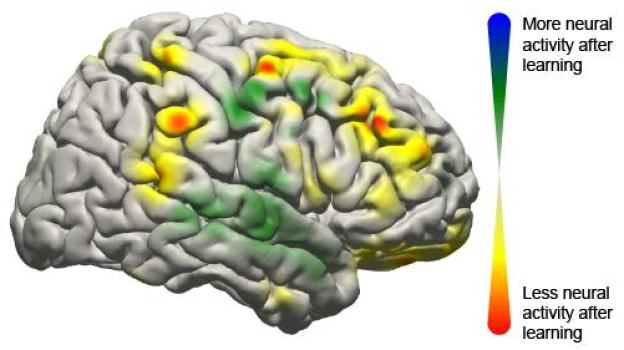
This image shows the changes that took place in the brain for all patients participating in the study using a brain-computer interface. Changes in activity were distributed widely throughout the brain.
This image shows the changes that took place in the brain for all patients participating in the study using a brain-computer interface. Changes in activity were distributed widely throughout the brain. (Credit: Jeremiah Wander, UW)
Now, University of Washington researchers have demonstrated that when humans use this technology -- called a brain-computer interface -- the brain behaves much like it does when completing simple motor skills such as kicking a ball, typing or waving a hand. Learning to control a robotic arm or a prosthetic limb could become second nature for people who are paralyzed.

"What we're seeing is that practice makes perfect with these tasks," said Rajesh Rao, a UW professor of computer science and engineering and a senior researcher involved in the study. "There's a lot of engagement of the brain's cognitive resources at the very beginning, but as you get better at the task, those resources aren't needed anymore and the brain is freed up."

Rao and UW collaborators Jeffrey Ojemann, a professor of neurological surgery, and Jeremiah Wander, a doctoral student in bioengineering, published their results online June 10 in the Proceedings of the National Academy of Sciences.

In this study, seven people with severe epilepsy were hospitalized for a monitoring procedure that tries to identify where in the brain seizures originate. Physicians cut through the scalp, drilled into the skull and placed a thin sheet of electrodes directly on top of the brain. While they were watching for seizure signals, the researchers also conducted this study.

The patients were asked to move a mouse cursor on a computer screen by using only their thoughts to control the cursor's movement. Electrodes on their brains picked up the signals directing the cursor to move, sending them to an amplifier and then a laptop to be analyzed. Within 40 milliseconds, the computer calculated the intentions transmitted through the signal and updated the movement of the cursor on the screen.

Researchers found that when patients started the task, a lot of brain activity was centered in the prefrontal cortex, an area associated with learning a new skill. But after often as little as 10 minutes, frontal brain activity lessened, and the brain signals transitioned to patterns similar to those seen during more automatic actions.

"Now we have a brain marker that shows a patient has actually learned a task," Ojemann said. "Once the signal has turned off, you can assume the person has learned it."

While researchers have demonstrated success in using brain-computer interfaces in monkeys and humans, this is the first study that clearly maps the neurological signals throughout the brain. The researchers were surprised at how many parts of the brain were involved.

"We now have a larger-scale view of what's happening in the brain of a subject as he or she is learning a task," Rao said. "The surprising result is that even though only a very localized population of cells is used in the brain-computer interface, the brain recruits many other areas that aren't directly involved to get the job done."

Several types of brain-computer interfaces are being developed and tested. The least invasive is a device placed on a person's head that can detect weak electrical signatures of brain activity. Basic commercial gaming products are on the market, but this technology isn't very reliable yet because signals from eye blinking and other muscle movements interfere too much.

A more invasive alternative is to surgically place electrodes inside the brain tissue itself to record the activity of individual neurons. Researchers at Brown University and the University of Pittsburgh have demonstrated this in humans as patients, unable to move their arms or legs, have learned to control robotic arms using the signal directly from their brain.

The UW team tested electrodes on the surface of the brain, underneath the skull. This allows researchers to record brain signals at higher frequencies and with less interference than measurements from the scalp. A future wireless device could be built to remain inside a person's head for a longer time to be able to control computer cursors or robotic limbs at home.

"This is one push as to how we can improve the devices and make them more useful to people," Wander said. "If we have an understanding of how someone learns to use these devices, we can build them to respond accordingly."

The research team, along with the National Science Foundation's Engineering Research Center for Sensorimotor Neural Engineering headquartered at the UW, will continue developing these technologies.

This research was funded by the National Institutes of Health, the NSF, the Army Research Office and the Keck Foundation. 


Share this story on Facebook, Twitter, and Google

Monday, April 1, 2013

Biological Transistor Enables Computing Within Living Cells


When Charles Babbage prototyped the first computing machine in the 19th century, he imagined using mechanical gears and latches to control information. ENIAC, the first modern computer developed in the 1940s, used vacuum tubes and electricity. Today, computers use transistors made from highly engineered semiconducting materials to carry out their logical operations.
Artist's rendering of cells
Artist's rendering of cells. (Credit: © Jezper / Fotolia)
And now a team of Stanford University bioengineers has taken computing beyond mechanics and electronics into the living realm of biology. In a paper to be published March 28 in Science, the team details a biological transistor made from genetic material -- DNA and RNA -- in place of gears or electrons. The team calls its biological transistor the "transcriptor."

"Transcriptors are the key component behind amplifying genetic logic -- akin to the transistor and electronics," said Jerome Bonnet, PhD, a postdoctoral scholar in bioengineering and the paper's lead author.

The creation of the transcriptor allows engineers to compute inside living cells to record, for instance, when cells have been exposed to certain external stimuli or environmental factors, or even to turn on and off cell reproduction as needed.

"Biological computers can be used to study and reprogram living systems, monitor environments and improve cellular therapeutics," said Drew Endy, PhD, assistant professor of bioengineering and the paper's senior author.

The biological computer

In electronics, a transistor controls the flow of electrons along a circuit. Similarly, in biologics, a transcriptor controls the flow of a specific protein, RNA polymerase, as it travels along a strand of DNA.

"We have repurposed a group of natural proteins, called integrases, to realize digital control over the flow of RNA polymerase along DNA, which in turn allowed us to engineer amplifying genetic logic," said Endy.

Using transcriptors, the team has created what are known in electrical engineering as logic gates that can derive true-false answers to virtually any biochemical question that might be posed within a cell.

They refer to their transcriptor-based logic gates as "Boolean Integrase Logic," or "BIL gates" for short.

Transcriptor-based gates alone do not constitute a computer, but they are the third and final component of a biological computer that could operate within individual living cells.

Despite their outward differences, all modern computers, from ENIAC to Apple, share three basic functions: storing, transmitting and performing logical operations on information.

Last year, Endy and his team made news in delivering the other two core components of a fully functional genetic computer. The first was a type of rewritable digital data storage within DNA. They also developed a mechanism for transmitting genetic information from cell to cell, a sort of biological Internet.

It all adds up to creating a computer inside a living cell.

Boole's gold

Digital logic is often referred to as "Boolean logic," after George Boole, the mathematician who proposed the system in 1854. Today, Boolean logic typically takes the form of 1s and 0s within a computer. Answer true, gate open; answer false, gate closed. Open. Closed. On. Off. 1. 0. It's that basic. But it turns out that with just these simple tools and ways of thinking you can accomplish quite a lot.

"AND" and "OR" are just two of the most basic Boolean logic gates. An "AND" gate, for instance, is "true" when both of its inputs are true -- when "a" and "b" are true. An "OR" gate, on the other hand, is true when either or both of its inputs are true.

In a biological setting, the possibilities for logic are as limitless as in electronics, Bonnet explained. "You could test whether a given cell had been exposed to any number of external stimuli -- the presence of glucose and caffeine, for instance. BIL gates would allow you to make that determination and to store that information so you could easily identify those which had been exposed and which had not," he said.

By the same token, you could tell the cell to start or stop reproducing if certain factors were present. And, by coupling BIL gates with the team's biological Internet, it is possible to communicate genetic information from cell to cell to orchestrate the behavior of a group of cells.

"The potential applications are limited only by the imagination of the researcher," said co-author Monica Ortiz, a PhD candidate in bioengineering who demonstrated autonomous cell-to-cell communication of DNA encoding various BIL gates.

Building a transcriptor

To create transcriptors and logic gates, the team used carefully calibrated combinations of enzymes -- the integrases mentioned earlier -- that control the flow of RNA polymerase along strands of DNA. If this were electronics, DNA is the wire and RNA polymerase is the electron.

"The choice of enzymes is important," Bonnet said. "We have been careful to select enzymes that function in bacteria, fungi, plants and animals, so that bio-computers can be engineered within a variety of organisms."

On the technical side, the transcriptor achieves a key similarity between the biological transistor and its semiconducting cousin: signal amplification.

With transcriptors, a very small change in the expression of an integrase can create a very large change in the expression of any two other genes.

To understand the importance of amplification, consider that the transistor was first conceived as a way to replace expensive, inefficient and unreliable vacuum tubes in the amplification of telephone signals for transcontinental phone calls. Electrical signals traveling along wires get weaker the farther they travel, but if you put an amplifier every so often along the way, you can relay the signal across a great distance. The same would hold in biological systems as signals get transmitted among a group of cells.

"It is a concept similar to transistor radios," said Pakpoom Subsoontorn, a PhD candidate in bioengineering and co-author of the study who developed theoretical models to predict the behavior of BIL gates. "Relatively weak radio waves traveling through the air can get amplified into sound."

Public-domain biotechnology

To bring the age of the biological computer to a much speedier reality, Endy and his team have contributed all of BIL gates to the public domain so that others can immediately harness and improve upon the tools.

"Most of biotechnology has not yet been imagined, let alone made true. By freely sharing important basic tools everyone can work better together," Bonnet said.

Saturday, June 9, 2012

Quantum Computers Move Closer to Reality, Thanks to Highly Enriched and Highly Purified Silicon


The quantum computer is a futuristic machine that could operate at speeds even more mind-boggling than the world's fastest super-computers.

SFU physicist Mike Thewalt and grad student Kamyar Saeedi with a sample of highly isotopically enriched silicon - its unique properties could advance quantum computing. (Credit: Image courtesy of Simon Fraser University)
SFU physicist Mike Thewalt and grad student Kamyar 
Saeedi with a sample of highly isotopically enriched silicon - 
its unique properties could advance quantum computing. 
(Credit: Image courtesy of Simon Fraser University)

Research involving physicist Mike Thewalt of Simon Fraser University offers a new step towards making quantum computing a reality, through the unique properties of highly enriched and highly purified silicon.

Quantum computers right now exist pretty much in physicists' concepts, and theoretical research. There are some basic quantum computers in existence, but nobody yet can build a truly practical one -- or really knows how.

Such computers will harness the powers of atoms and sub-atomic particles (ions, photons, electrons) to perform memory and processing tasks, thanks to strange sub-atomic properties.

What Thewalt and colleagues at Oxford University and in Germany have found is that their special silicon allows processes to take place and be observed in a solid state that scientists used to think required a near-perfect vacuum.

And, using this 28Si they have extended to three minutes -- from a matter of seconds -- the time in which scientists can manipulate, observe and measure the processes.

"It's by far a record in solid-state systems," Thewalt says. "If you'd asked people a few years ago if this was possible, they'd have said no. It opens new ways of using solid-state semi-conductors such as silicon as a base for quantum computing.

"You can start to do things that people thought you could only do in a vacuum. What we have found, and what wasn't anticipated, are the sharp spectral lines (optical qualities) in the 28Silicon we have been testing. It's so pure, and so perfect. There's no other material like it."

But the world is still a long way from practical quantum computers, he notes.

Quantum computing is a concept that challenges everything we know or understand about today's computers.

Your desktop or laptop computer processes "bits" of information. The bit is a fundamental unit of information, seen by your computer has having a value of either "1" or "0."

That last paragraph, when written in Word, contains 181 characters including spaces. In your home computer, that simple paragraph is processed as a string of some 1,448 "1"s and "0"s.

But in the quantum computer, the "quantum bit" (also known as a "qubit") can be both a "1" and a "0" -- and all values between 0 and 1 -- at the same time.

Says Thewalt: "A classical 1/0 bit can be thought of as a person being either at the North or South Pole, whereas a qubit can be anywhere on the surface of the globe -- its actual state is described by two parameters similar to latitude and longitude."

Make a practical quantum computer with enough qubits available and it could complete in minutes calculations that would take today's super-computers years, and your laptop perhaps millions of years.

The work by Thewalt and his fellow researchers opens up yet another avenue of research and application that may, in time, lead to practical breakthroughs in quantum computing.

Thursday, July 21, 2011

Breakthrough in Quantum Computing: Researchers Develop System That Resists 'Quantum Bug'


Scientists have taken the next major step toward quantum computing, which will use quantum mechanics to revolutionize the way information is processed.
Quantum computing uses quantum bits, or qubits, to 
encode information. (Credit: © Anterovium / Fotolia)

Quantum computers will capitalize on the mind-bending properties of quantum particles to perform complex calculations that are impossible for today's traditional computers.

Using high magnetic fields, Susumu Takahashi, assistant professor in the USC Dornsife College of Letters, Arts and Sciences, and his colleagues managed to suppress decoherence, which is one of the key stumbling blocks in quantum computing.

"High magnetic fields reduce the level of the noises in the surroundings, so they can constrain the decoherence very efficiently," Takahashi said. Decoherence has been described as a "quantum bug" that destroys fundamental properties that quantum computers would rely on.

This research will appear in the online version of Nature magazine on June 20.

Quantum computing uses quantum bits, or qubits, to encode information in the form of ones and zeros. Unlike a traditional computer that uses traditional bits, a quantum computer takes advantage of the fact seemingly impossible fact that qubits can exist in multiple states at the same time, which is called "superposition."

While can a bit can represent either a one or a zero, a qubit can represent a one and a zero at the same time due to superposition. This allows for simultaneous processing of calculations in a truly parallel system, skyrocketing computing ability.

Though the concepts underpinning quantum computing are not new, problems such as decoherence have hindered the construction of a fully functioning quantum computer.

Think of decoherence as a form of noise or interference, knocking a quantum particle out of superposition -- robbing it of that special property that makes it so useful. If a quantum computer relies on a quantum particle's ability to be both here and there, then decoherence is the frustrating phenomenon that causes a quantum particle to be either here or there.

The researchers calculated all sources of decoherence in his experiment as a function of temperature, magnetic field, and by nuclear isotopic concentrations, and suggested the optimum condition to operate qubits, reducing decoherence by approximately 1,000 times.

Qubits in his experiment lasted about 500 microseconds at the optimum condition -- ages, relatively speaking.

Decoherence in qubit systems falls into two general categories. One is an intrinsic decoherence caused by constituents in the qubit system, and the other is an extrinsic decoherence caused by imperfections of the system, for example, impurities and defects.

In their study, Takahashi and his colleagues investigated single crystals of molecular magnets. Because of their purity, molecular eliminate the extrinsic decoherence, allowing researchers to calculate intrinsic decoherence precisely.

"For the first time we've been able to predict and control all the environmental decoherence mechanisms in a very complex system -- in this case a large magnetic molecule," said Phil Stamp, UBC professor of physics and astronomy and director of the Pacific Institute of Theoretical Physics.

Using crystalline molecular magnets allowed researchers to build qubits out of multiple quantum particles, rather than a single quantum object -- the way most proto-quantum computers are built at the moment.

"This will obviously increase signals from the qubit drastically, so the detection of the qubit in the molecular magnets is much easier," Takahashi said.

Takahashi conducted his research as a project scientist in the Institute of Terahertz Science and Technology and Department of Physics at the University of California Santa Barbara and analyzed the data while at UCSB and USC. Takahashi has been in the USC Dornsife College since 2010.

Research for the article was performed in collaboration with Phil Stamp and Igor Tupitsyn of the University of British Columbia, Johan van Tol of Florida State University, and David Hendrickson of UC San Diego.

This work was supported by the National Science Foundation, the W. M. Keck Foundation, the Pacific Institute of Theoretical Physics at UBC, by the Natural Sciences and Engineering Research Council of Canada, the Canadian Institute for Advanced Research and the USC startup funds.


Tuesday, July 12, 2011

Computer learns language by playing games


Computers are great at treating words as data: Word-processing programs let you rearrange and format text however you like, and search engines can quickly find a word anywhere on the Web. But what would it mean for a computer to actually understand the meaning of a sentence written in ordinary English -- or French, or Urdu, or Mandarin?
"Civilization" is a strategy game in which players build
empires by, among other things, deciding where to
found cities and deploy armies. Image courtesy of
Sid Meier's Civilization V

One test might be whether the computer could analyze and follow a set of instructions for an unfamiliar task. And indeed, in the last few years, researchers at MIT’s Computer Science and Artificial Intelligence Lab have begun designing artificial-intelligence systems that do exactly that, with surprisingly good results.

In 2009, at the annual meeting of the Association for Computational Linguistics (ACL), researchers in the lab of Regina Barzilay, associate professor of computer science and electrical engineering, took the best-paper award for a system that generated scripts for installing a piece of software on a Windows computer by reviewing instructions posted on Microsoft’s help site. At this year’s ACL meeting, Barzilay, her graduate student S. R. K. Branavan and David Silver of University College London applied a similar approach to a more complicated problem: learning to play “Civilization,” a computer game in which the player guides the development of a city into an empire across centuries of human history. When the researchers augmented an artificial-intelligence system so that it could use a player’s manual to guide the development of a game-playing strategy, its rate of victory jumped from 46 percent to 79 percent.

Starting from scratch

“Games are used as a test bed for artificial-intelligence techniques simply because of their complexity,” says Branavan, who was first author on both ACL papers. “Every action that you take in the game doesn’t have a predetermined outcome, because the game or the opponent can randomly react to what you do. So you need a technique that can handle very complex scenarios that react in potentially random ways.”

Moreover, Barzilay says, game manuals have “very open text. They don’t tell you how to win. They just give you very general advice and suggestions, and you have to figure out a lot of other things on your own.” Relative to an application like the software-installing program, Branavan explains, games are “another step closer to the real world.”


The extraordinary thing about Barzilay and Branavan’s system is that it begins with virtually no prior knowledge about the task it’s intended to perform or the language in which the instructions are written. It has a list of actions it can take, like right-clicks or left-clicks, or moving the cursor; it has access to the information displayed on-screen; and it has some way of gauging its success, like whether the software has been installed or whether it wins the game. But it doesn’t know what actions correspond to what words in the instruction set, and it doesn’t know what the objects in the game world represent.

So initially, its behavior is almost totally random. But as it takes various actions, different words appear on screen, and it can look for instances of those words in the instruction set. It can also search the surrounding text for associated words, and develop hypotheses about what actions those words correspond to. Hypotheses that consistently lead to good results are given greater credence, while those that consistently lead to bad results are discarded.

Proof of concept

In the case of software installation, the system was able to reproduce 80 percent of the steps that a human reading the same instructions would execute. In the case of the computer game, it won 72 percent more frequently than a version of the same system that didn’t use the written instructions as input, and 27 percent more frequently than a more sophisticated system that used additional artificial-intelligence techniques to improve its performance.

“If you’d asked me beforehand if I thought we could do this yet, I’d have said no,” says Eugene Charniak, University Professor of Computer Science at Brown University. “You are building something where you have very little information about the domain, but you get clues from the domain itself.”

Charniak points out that when the MIT researchers presented their work at the ACL meeting, some members of the audience argued that more sophisticated machine-learning systems would have performed better than the ones to which the researchers compared their system. But, Charniak adds, “it’s not completely clear to me that that’s really relevant. Who cares? The important point is that this was able to extract useful information from the manual, and that’s what we care about.”

Most computer games as complex as “Civilization” include algorithms that allow players to play against the computer, rather than against other people; the games’ programmers have to develop the strategies for the computer to follow and write the code that executes them. Barzilay and Branavan say that, in the near term, their system could make that job much easier, automatically creating algorithms that perform better than the hand-designed ones.

But the main purpose of the project, which was supported by the National Science Foundation, was to demonstrate that computer systems that learn the meanings of words through exploratory interaction with their environments are a promising subject for further research. And indeed, Barzilay and her students have begun to adapt their meaning-inferring algorithms to work with robotic systems. 

This story is republished courtesy of MIT News (http://web.mit.edu/newsoffice/), a popular site that covers news about MIT research, innovation and teaching.

More information: Research paper: http://people.csai … rs/civ11.pdf


Related articles

  • Genius of Einstein, Fourier key to new humanlike computer vision (sciencentechnologyupdates.com)


  • Artificial Grammar Reveals Inborn Language Sense, Study Shows (sciencentechnologyupdates.com)


  • Faster Computer Graphics: Digitally Mimicking Photographic Blur Caused by Moving Objects (sciencentechnologyupdates.com)


  • Ultimate Energy Efficiency:Computers to Use Million Times Less Energy? (sciencentechnologyupdates.com)


  • Study brings brain-like computing a step closer to reality (sciencentechnologyupdates.com)

  • Monday, July 11, 2011

    U of T researchers build an antenna for light


    University of Toronto researchers have derived inspiration from the photosynthetic apparatus in plants to engineer a new generation of nanomaterials that control and direct the energy absorbed from light.

    Their findings are reported in a forthcoming issue of Nature Nanotechnology, which will be released on July 10, 2011.

    The U of T researchers, led by Professors Shana Kelley and Ted Sargent, report the construction of what they term "artificial molecules."

    "Nanotechnologists have for many years been captivated by quantum dots – particles of semiconductor that can absorb and emit light efficiently, and at custom-chosen wavelengths," explained co-author Kelley, a Professor at the Leslie Dan Faculty of Pharmacy, the Department of Biochemistry in the Faculty of Medicine, and the Department of Chemistry in the Faculty of Arts & Science. "What the community has lacked – until now – is a strategy to build higher-order structures, or complexes, out of multiple different types of quantum dots. This discovery fills that gap."

    The team combined its expertise in DNA and in semiconductors to invent a generalized strategy to bind certain classes of nanoparticles to one another.

    "The credit for this remarkable result actually goes to DNA: its high degree of specificity – its willingness to bind only to a complementary sequence – enabled us to build rationally-engineered, designer structures out of nanomaterials," said Sargent, a Professor in The Edward S. Rogers Sr. Department of Electrical & Computer Engineering at the University of Toronto, who is also the Canada Research Chair in Nanotechnology. "The amazing thing is that our antennas built themselves – we coated different classes of nanoparticles with selected sequences of DNA, combined the different families in one beaker, and nature took its course. The result is a beautiful new set of self-assembled materials with exciting properties."


    Traditional antennas increase the amount of an electromagnetic wave – such as a radio frequency – that is absorbed, and then funnel that energy to a circuit. The U of T nanoantennas instead increased the amount of light that is absorbed and funneled it to a single site within their molecule-like complexes. This concept is already used in nature in light harvesting antennas, constituents of leaves that make photosynthesis efficient. "Like the antennas in radios and mobile phones, our complexes captured dispersed energy and concentrated it to a desired location. Like the light harvesting antennas in the leaves of a tree, our complexes do so using wavelengths found in sunlight," explained Sargent.

    "Professors Kelley and Sargent have invented a novel class of materials with entirely new properties. Their insight and innovative research demonstrates why the University of Toronto leads in the field of nanotechnology," said Professor Henry Mann, Dean of the Leslie Dan Faculty of Pharmacy.

    "This is a terrific piece of work that demonstrates our growing ability to assemble precise structures, to tailor their properties, and to build in the capability to control these properties using external stimuli," noted Paul S. Weiss, Fred Kavli Chair in NanoSystems Sciences at UCLA and Director of the California NanoSystems Institute.

    Kelley explained that the concept published in today's Nature Nanotechnology paper is a broad one that goes beyond light antennas alone.

    "What this work shows is that our capacity to manipulate materials at the nanoscale is limited only by human imagination. If semiconductor quantum dots are artificial atoms, then we have rationally synthesized artificial molecules from these versatile building blocks."

    Saturday, July 9, 2011

    Power from the Air: Device Captures Ambient Electromagnetic Energy to Drive Small Electronic Devices


    Researchers have discovered a way to capture and harness energy transmitted by such sources as radio and television transmitters, cell phone networks and satellite communications systems. By scavenging this ambient energy from the air around us, the technique could provide a new way to power networks of wireless sensors, microprocessors and communications chips.
    Georgia Tech School of Electrical and Computer Engineering
    professor Manos Tentzeris holds a sensor (left) and an
    ultra-broadband spiral antenna for wearable energy-
    scavenging applications. Both were printed on paper using
    inkjet technology. (Credit: Georgia Tech Photo: Gary Meek)

    "There is a large amount of electromagnetic energy all around us, but nobody has been able to tap into it," said Manos Tentzeris, a professor in the Georgia Tech School of Electrical and Computer Engineering who is leading the research. "We are using an ultra-wideband antenna that lets us exploit a variety of signals in different frequency ranges, giving us greatly increased power-gathering capability."

    Tentzeris and his team are using inkjet printers to combine sensors, antennas and energy scavenging capabilities on paper or flexible polymers. The resulting self powered wireless sensors could be used for chemical, biological, heat and stress sensing for defense and industry; radio frequency identification (RFID) tagging for manufacturing and shipping, and monitoring tasks in many fields including communications and power usage.

    A presentation on this energy scavenging technology was given July 6 at the IEEE Antennas and Propagation Symposium in Spokane, Wash. The discovery is based on research supported by multiple sponsors, including the National Science Foundation, the Federal Highway Administration and Japan's New Energy and Industrial Technology Development Organization (NEDO).

    Communications devices transmit energy in many different frequency ranges, or bands. The team's scavenging devices can capture this energy, convert it from AC to DC, and then store it in capacitors and batteries. The scavenging technology can take advantage presently of frequencies from FM radio to radar, a range spanning 100 megahertz (MHz) to 15 gigahertz (GHz) or higher.

    Scavenging experiments utilizing TV bands have already yielded power amounting to hundreds of microwatts, and multi-band systems are expected to generate one milliwatt or more. That amount of power is enough to operate many small electronic devices, including a variety of sensors and microprocessors.

    And by combining energy scavenging technology with supercapacitors and cycled operation, the Georgia Tech team expects to power devices requiring above 50 milliwatts. In this approach, energy builds up in a battery-like supercapacitor and is utilized when the required power level is reached.

    The researchers have already successfully operated a temperature sensor using electromagnetic energy captured from a television station that was half a kilometer distant. They are preparing another demonstration in which a microprocessor-based microcontroller would be activated simply by holding it in the air.

    Exploiting a range of electromagnetic bands increases the dependability of energy scavenging devices, explained Tentzeris, who is also a faculty researcher in the Georgia Electronic Design Center at Georgia Tech. If one frequency range fades temporarily due to usage variations, the system can still exploit other frequencies.

    The scavenging device could be used by itself or in tandem with other generating technologies. For example, scavenged energy could assist a solar element to charge a battery during the day. At night, when solar cells don't provide power, scavenged energy would continue to increase the battery charge or would prevent discharging.

    Utilizing ambient electromagnetic energy could also provide a form of system backup. If a battery or a solar-collector/battery package failed completely, scavenged energy could allow the system to transmit a wireless distress signal while also potentially maintaining critical functionalities.

    The researchers are utilizing inkjet technology to print these energy scavenging devices on paper or flexible paper-like polymers -- a technique they already using to produce sensors and antennas. The result would be paper-based wireless sensors that are self powered, low cost and able to function independently almost anywhere.


    To print electrical components and circuits, the Georgia Tech researchers use a standard materials inkjet printer. However, they add what Tentzeris calls "a unique in house recipe" containing silver nanoparticles and/or other nanoparticles in an emulsion. This approach enables the team to print not only RF components and circuits, but also novel sensing devices based on such nanomaterials as carbon nanotubes.

    When Tentzeris and his research group began inkjet printing of antennas in 2006, the paper-based circuits only functioned at frequencies of 100 or 200 MHz, recalled Rushi Vyas, a graduate student who is working with Tentzeris and graduate student Vasileios Lakafosis on several projects.

    "We can now print circuits that are capable of functioning at up to 15 GHz -- 60 GHz if we print on a polymer," Vyas said. "So we have seen a frequency operation improvement of two orders of magnitude."

    The researchers believe that self-powered, wireless paper-based sensors will soon be widely available at very low cost. The resulting proliferation of autonomous, inexpensive sensors could be used for applications that include:
    • Airport security: Airports have both multiple security concerns and vast amounts of available ambient energy from radar and communications sources. These dual factors make them a natural environment for large numbers of wireless sensors capable of detecting potential threats such as explosives or smuggled nuclear material.
    • Energy savings: Self-powered wireless sensing devices placed throughout a home could provide continuous monitoring of temperature and humidity conditions, leading to highly significant savings on heating and air conditioning costs. And unlike many of today's sensing devices, environmentally friendly paper-based sensors would degrade quickly in landfills.
    • Structural integrity: Paper or polymer-based sensors could be placed throughout various types of structures to monitor stress. Self powered sensors on buildings, bridges or aircraft could quietly watch for problems, perhaps for many years, and then transmit a signal when they detected an unusual condition.
    • Food and perishable material storage and quality monitoring: Inexpensive sensors on foods could scan for chemicals that indicate spoilage and send out an early warning if they encountered problems.
    • Wearable bio-monitoring devices: This emerging wireless technology could become widely used for autonomous observation of patient medical issues.

    Sunday, May 8, 2011

    Scientists Afflict Computers With 'Schizophrenia' to Better Understand the Human Brain


    Computer networks that can't forget fast enough can 
    show symptoms of a kind of virtual schizophrenia, 
    giving researchers further clues to the inner workings 
    of schizophrenic brains, researchers have found. 
    (Credit: © Nikolai Sorokin / Fotolia)
    Computer networks that can't forget fast enough can show symptoms of a kind of virtual schizophrenia, giving researchers further clues to the inner workings of schizophrenic brains, researchers at The University of Texas at Austin and Yale University have found.

    The researchers used a virtual computer model, or "neural network," to simulate the excessive release of dopamine in the brain. They found that the network recalled memories in a distinctly schizophrenic-like fashion.

    Their results were published in April in Biological Psychiatry.

    "The hypothesis is that dopamine encodes the importance-the salience-of experience," says Uli Grasemann, a graduate student in the Department of Computer Science at The University of Texas at Austin. "When there's too much dopamine, it leads to exaggerated salience, and the brain ends up learning from things that it shouldn't be learning from."

    The results bolster a hypothesis known in schizophrenia circles as the hyperlearning hypothesis, which posits that people suffering from schizophrenia have brains that lose the ability to forget or ignore as much as they normally would. Without forgetting, they lose the ability to extract what's meaningful out of the immensity of stimuli the brain encounters. They start making connections that aren't real, or drowning in a sea of so many connections they lose the ability to stitch together any kind of coherent story.

    The neural network used by Grasemann and his adviser, Professor Risto Miikkulainen, is called DISCERN. Designed by Miikkulainen, DISCERN is able to learn natural language. In this study it was used to simulate what happens to language as the result of eight different types of neurological dysfunction. The results of the simulations were compared by Ralph Hoffman, professor of psychiatry at the Yale School of Medicine, to what he saw when studying human schizophrenics.

    In order to model the process, Grasemann and Miikkulainen began by teaching a series of simple stories to DISCERN. The stories were assimilated into DISCERN's memory in much the way the human brain stores information-not as distinct units, but as statistical relationships of words, sentences, scripts and stories.

    "With neural networks, you basically train them by showing them examples, over and over and over again," says Grasemann. "Every time you show it an example, you say, if this is the input, then this should be your output, and if this is the input, then that should be your output. You do it again and again thousands of times, and every time it adjusts a little bit more towards doing what you want. In the end, if you do it enough, the network has learned."

    In order to model hyperlearning, Grasemann and Miikkulainen ran the system through its paces again, but with one key parameter altered. They simulated an excessive release of dopamine by increasing the system's learning rate-essentially telling it to stop forgetting so much.

    "It's an important mechanism to be able to ignore things," says Grasemann. "What we found is that if you crank up the learning rate in DISCERN high enough, it produces language abnormalities that suggest schizophrenia."

    After being re-trained with the elevated learning rate, DISCERN began putting itself at the center of fantastical, delusional stories that incorporated elements from other stories it had been told to recall. In one answer, for instance, DISCERN claimed responsibility for a terrorist bombing.

    In another instance, DISCERN began showing evidence of "derailment"-replying to requests for a specific memory with a jumble of dissociated sentences, abrupt digressions and constant leaps from the first- to the third-person and back again.

    "Information processing in neural networks tends to be like information processing in the human brain in many ways," says Grasemann. "So the hope was that it would also break down in similar ways. And it did."

    The parallel between their modified neural network and human schizophrenia isn't absolute proof the hyperlearning hypothesis is correct, says Grasemann. It is, however, support for the hypothesis, and also evidence of how useful neural networks can be in understanding the human brain.

    "We have so much more control over neural networks than we could ever have over human subjects," he says. "The hope is that this kind of modeling will help clinical research."

    Sunday, August 8, 2010

    Quantum Networks: Photons and Qubits Entangled


    A team of Harvard physicists led by Mikhail D. Lukin has achieved the first-ever quantum entanglement of photons and solid-state materials. The work marks a key advance toward practical quantum networks, as the first experimental demonstration of a means by which solid-state quantum bits, or "qubits," can communicate with one another over long distances.
    Image
    Physicists have achieved the first-ever quantum entanglement of photons and solid-state materials -- a key advance toward practical quantum networks in which solid-state quantum bits, or "qubits," can communicate with one another over long distances. (Credit: iStockphoto/Andrey Prokhorov)

    Quantum networking applications such as long-distance communication and distributed computing would require the nodes that process and store quantum data in qubits to be connected to one another by entanglement, a state where two different atoms become indelibly linked such that one inherits the properties of the other.

    "In quantum computing and quantum communication, a big question has been whether or how it would be possible to actually connect qubits, separated by long distances, to one another," says Lukin, professor of physics at Harvard and co-author of a paper describing the work in the journal Nature.

    "Demonstration of quantum entanglement between a solid-state material and photons is an important advance toward linking qubits together into a quantum network."

    Quantum entanglement has previously been demonstrated only with photons and individual ions or atoms.

    "Our work takes this one step further, showing how one can engineer and control the interaction between individual photons and matter in a solid-state material," says first author Emre Togan, a graduate student in physics at Harvard. "What's more, we show that the photons can be imprinted with the information stored in a qubit."

    Quantum entanglement, famously termed "spooky action at a distance" by a skeptical Albert Einstein, is a fundamental property of quantum mechanics. It allows one to distribute quantum information over tens of thousands of kilometers, limited only by how fast and how far members of the entangled pair can propagate in space.

    The new result builds upon earlier work by Lukin's group to use single atom impurities in diamonds as qubits. Lukin and colleagues have previously shown that these impurities can be controlled by focusing laser light on a diamond lattice flaw where nitrogen replaces an atom of carbon. That previous work showed that the so-called spin degrees of freedom of these impurities make excellent quantum memory.

    Lukin and his co-authors now say that these impurities are also remarkable because, when excited with a sequence of finely tuned microwave and laser pulses, they can emit photons one at a time, such that photons are entangled with quantum memory. Such a stream of single photons can be used for secure transmission of information.

    "Since photons are the fastest carriers of quantum information, and spin memory can robustly store quantum information for relatively long periods of time, entangled spin-photon pairs are ideal for the realization of quantum networks," Lukin says. "Such a network, a quantum analog to the conventional internet, could allow for absolutely secure communication over long distances."

    Lukin and Togan's co-authors on the Nature paper are Yiwen Chu, Alexei Trifonov, Jeronimo Maze, and Alexander S. Zibrov, all at Harvard; Liang Jiang of Harvard and the California Institute of Technology; Lilian I. Childress of Harvard and Bates College; M.V. Gurudev Dutt of Harvard and the University of Pittsburgh; A.S. Sorensen at the University of Copenhagen; and Phillip R. Hemmer of Texas A&M University. The work was supported by the Defense Advanced Research Projects Agency, the Harvard-MIT Center for Ultracold Atoms, the National Science Foundation, the National Defense Science & Engineering Graduate Fellowship, and the Packard Foundation.

    Friday, June 18, 2010

    Computers Predict Human Visual Attention


    Scientists have just come several steps closer to understanding change blindness -- the well studied failure of humans to detect seemingly obvious changes to scenes around them -- with new research that used a computer-based model to predict what types of changes people are more likely to notice.
    Image
    Researchers have used a computer-based model to predict what types of changes people are more likely to notice. The achievement sheds light on change blindness -- a failure of humans to detect seemingly obvious changes to scenes around them. (Credit: iStockphoto/Tracy Lorna)

    These findings on change blindness were presented in the Journal of Vision.

    "This is one of the first applications of computer intelligence to help study human visual intelligence, " said author Peter McOwan, professor at Queen Mary, University of London. "The biologically inspired mathematics we have developed and tested can have future uses in letting computer vision systems such as robots detect interesting elements in their visual environment."

    During the study, participants were asked to spot the differences between pre-change and post-change versions of a series of pictures. Some of these pictures had elements added, removed or color altered, with the location of the change based on attention grabbing properties (this is the "salience" level referred to in the article).

    Unlike previous research where scientists studied change blindness by manually manipulating such pictures and making decisions about what and where to make a change, the computer model used in this study eliminated any human bias. The research team at Queen Mary's School of Electronic Engineering and Computer Science developed an algorithm that let the computer "decide" how to change the images that study participants were asked to view.

    While the experiments confirmed that change blindness can be predicted using this model, the tests also showed that the addition or removal of an object from the scene is detected more readily than changes in the color of the object, a result that surprised the scientists. "We expected a color change to be a lot easier to spot, since color plays such an important role in our day-to-day lives and visual perception," said lead researcher Milan Verma of Queen Mary.

    The authors suggest that the computer-based approach will be useful in designing displays of an essential nature such as road signs, emergency services, security and surveillance to draw attention to a change or part of the display that requires immediate attention.

    "We live in a world in which we are immersed in visual information," explained Verma. "The result is a huge cognitive burden which may hinder our ability to complete a given task. This study is an important step toward understanding how visual information is processed and how we can go about optimizing the presentation of visual displays."
    Enhanced by Zemanta

    Friday, March 12, 2010

    Computer Algorithm Able to 'Read' Memories


    Computer programs have been able to predict which of three short films a person is thinking about, just by looking at their brain activity. The research, conducted by scientists at the Wellcome Trust Centre for Neuroimaging at UCL (University College London), provides further insight into how our memories are recorded.
    To explore how memories are recorded, researchers showed volunteers three short films and asked them to memorize what they saw. The films were very simple, sharing a number of similar features -- all included a woman carrying out an everyday task in a typical urban street, and each film was the same length, seven seconds long. For example, one film showed a woman posting a letter. (Credit: Wellcome Trust Centre for Neuroimaging at UCL)

    Professor Eleanor Maguire led this Wellcome Trust-funded study, an extension of work published last year which showed how spatial memories -- in that case, where a volunteer was standing in a virtual reality room -- are recorded in regular patterns of activity in the hippocampus, the area of the brain responsible for learning and memory.

    "In our previous experiment, we were looking at basic memories, at someone's location in an environment," says Professor Maguire. "What is more interesting is to look at 'episodic' memories -- the complex, everyday memories that include much more information on where we are, what we are doing and how we feel."

    To explore how such memories are recorded, the researchers showed ten volunteers three short films and asked them to memorise what they saw. The films were very simple, sharing a number of similar features -- all included a woman carrying out an everyday task in a typical urban street, and each film was the same length, seven seconds long. For example, one film showed a woman drinking coffee from a paper cup in the street before discarding the cup in a litter bin; another film showed a (different) woman posting a letter.

    The volunteers were then asked to recall each of the films in turn whilst inside an fMRI scanner, which records brain activity by measuring changes in blood flow within the brain.

    A computer algorithm then studied the patterns and had to identify which film the volunteer was recalling purely by looking at the pattern of their brain activity. The results are published in the journal Current Biology.

    "The algorithm was able to predict correctly which of the three films the volunteer was recalling significantly above what would be expected by chance," explains Martin Chadwick, lead author of the study. "This suggests that our memories are recorded in a regular pattern."

    Although a whole network of brain areas support memory, the researchers focused their study on the medial temporal lobe, an area deep within the brain believed to be most heavily involved in episodic memory. It includes the hippocampus -- an area which Professor Maguire and colleagues have studied extensively in the past.

    They found that the key areas involved in recording the memories were the hippocampus and its immediate neighbours. However, the computer algorithm performed best when analysing activity in the hippocampus itself, suggesting that this is the most important region for recording episodic memories. In particular, three areas of the hippocampus -- the rear right and the front left and front right areas -- seemed to be involved consistently across all participants. The rear right area had been implicated in the earlier study, further enforcing the idea that this is where spatial information is recorded. However, it is still not clear what role the front two regions play.

    "Now that we are developing a clearer picture of how our memories are stored, we hope to examine how they are affected by time, the ageing process and by brain injury," says Professor Maguire.
    Reblog this post [with Zemanta]