BTemplates.com

Powered by Blogger.

Pageviews past week

Quantum mechanics

Auto News

artificial intelligence

About Me

Recommend us on Google!

Information Technology

Popular Posts

Showing posts with label Cognitive science. Show all posts

Monday, September 12, 2011

Neuroscientists Find Famous Optical Illusion Surprisingly Potent


The yellow jacket (Rocky, the mascot of the University of Rochester) appears to be expanding. But he is not. He is staying still. We simply think he is growing because our brains have adapted to the inward motion of the background and that has become our new status quo.

The yellow jacket (Rocky, the mascot of the University of Rochester) appears to be expanding if you have just viewed concentric circles moving inwards. (Credit: Image courtesy of University of Rochester)

Similar situations arise constantly in our day-to-day lives -- jump off a moving treadmill and everything around you seems to be in motion for a moment.

This age-old illusion, first documented by Aristotle, is called the Motion Aftereffect by today's scientists. Why does it happen, though? Is it because we are consciously aware that the background is moving in one direction, causing our brains to shift their frame of reference so that we can ignore this motion? Or is it an automatic, subconscious response?

Davis Glasser, a doctoral student in the University of Rochester's Department of Brain and Cognitive Sciences thinks he has found the answer. The results of a study done by Glasser, along with his advisor, Professor Duje Tadin, and colleagues James Tsui and Christopher Pack of the Montreal Neurological Institute, is published in the journal Proceedings of the National Academy of Sciences (PNAS).

In their paper, the scientists show that humans experience the Motion Aftereffect even if the motion that they see in the background is so brief that they can't even tell whether it is heading to the right or the left.


Even when shown a video of a pattern that is moving for only 1/40 of a second (25 milliseconds) -- so short that the direction it is moving cannot be consciously distinguished -- a subject's brain automatically adjusts. If the subject is then shown a stationary object, it will appear to him as though it is moving in the opposite direction of the background motion. In recordings from a motion center in the brain called cortical area MT, the researchers found neurons that, following a brief exposure to motion, respond to stationary objects as if they are actually moving. It is these neurons that the researchers think are responsible for the illusory motion of stationary objects that people see during the Motion Aftereffect.

This discovery reveals that the Motion Aftereffect illusion is not just a compelling visual oddity: It is caused by neural processes that happen essentially every time we see moving objects. The next phase of the group's study will attempt to find out whether this rapid motion adaptation serves a beneficial purpose -- in other words, does this rapid adaptation actually improve your ability to estimate the speed and direction of relevant moving objects, such as a baseball flying toward you.


Recommend this story on Facebook, Twitter, and Google +1

Monday, May 16, 2011

Artificial Grammar Reveals Inborn Language Sense, Study Shows


Parents know the unparalleled joy and wonder of hearing a beloved child's first words turn quickly into whole sentences and then babbling paragraphs. But how human children acquire language -- which is so complex and has so many variations -- remains largely a mystery. Fifty years ago, linguist and philosopher Noam Chomsky proposed an answer: Humans are able to learn language so quickly because some knowledge of grammar is hardwired into our brains. In other words, we know some of the most fundamental things about human language unconsciously at birth, without ever being taught.
A new study by cognitive scientists confirms that 
human beings are born with knowledge of 
certain syntactical rules that make learning 
human languages easier. (Credit: iStockphoto
/Felix Manuel Burgos-Trujillo)

Now, in a groundbreaking study, cognitive scientists at The Johns Hopkins University have confirmed a striking prediction of the controversial hypothesis that human beings are born with knowledge of certain syntactical rules that make learning human languages easier.

"This research shows clearly that learners are not blank slates; rather, their inherent biases, or preferences, influence what they will learn. Understanding how language is acquired is really the holy grail in linguistics," said lead author Jennifer Culbertson, who worked as a doctoral student in Johns Hopkins' Krieger School of Arts and Sciences under the guidance of Geraldine Legendre, a professor in the Department of Cognitive Science, and Paul Smolensky, a Krieger-Eisenhower Professor in the same department. (Culbertson is now a postdoctoral fellow at the University of Rochester.)

The study not only provides evidence remarkably consistent with Chomsky's hypothesis but also introduces an interesting new approach to generating and testing other hypotheses aimed at answering some of the biggest questions concerning the language learning process.

In the study, a small, green, cartoonish "alien informant" named Glermi taught participants, all of whom were English-speaking adults, an artificial nanolanguage named Verblog via a video game interface. In one experiment, for instance, Glermi displayed an unusual-looking blue alien object called a "slergena" on the screen and instructed the participants to say "geej slergena," which in Verblog means "blue slergena." Then participants saw three of those objects on the screen and were instructed to say "slergena glawb," which means "slergenas three."

Although the participants may not have consciously known this, many of the world's languages use both of those word orders-that is, in many languages adjectives precede nouns, and in many nouns are followed by numerals. However, very rarely are both of these rules used together in the same human language, as they are in Verblog.

As a control, other groups were taught different made-up languages that matched Verblog in every way but used word order combinations that are commonly found in human languages.

Culbertson reasoned that if knowledge of certain properties of human grammars-such as where adjectives, nouns and numerals should occur-is hardwired into the human brain from birth, the participants tasked with learning alien Verblog would have a particularly difficult time, which is exactly what happened.

The adult learners who had had little to no exposure to languages with word orders different from those in English quite easily learned the artificial languages that had word orders commonly found in the world's languages but failed to learn Verblog. It was clear that the learners' brains "knew" in some sense that the Verblog word order was extremely unlikely, just as predicted by Chomsky a half-century ago.

The results are important for several reasons, according to Culbertson.

"Language is something that sets us apart from other species, and if we understand how children are able to quickly and efficiently learn language, despite its daunting complexity, then we will have gained fundamental knowledge about this unique faculty," she said. "What this study suggests is that the problem of acquisition is made simpler by the fact that learners already know some important things about human languages-in this case, that certain words orders are likely to occur and others are not."

This study was done with the support of a $3.2 million National Science Foundation grant called the Integrative Graduate Education and Research Traineeship grant, or IGERT, a unique initiative aimed at training doctoral students to tackle investigations from a multidisciplinary perspective.

According to Smolensky, the goal of the IGERT program in Johns Hopkins' Cognitive Science Department is to overcome barriers that have long separated the way that different disciplines have tackled language research.

"Using this grant, we are training a generation of interdisciplinary language researchers who can bring together the now widely separated and often divergent bodies of research on language conducted from the perspectives of engineering, psychology and various types of linguistics," said Smolensky, principal investigator for the department's IGERT program.

Culbertson used tools from experimental psychology, cognitive science, linguistics and mathematics in designing and carrying out her study.

"The graduate training I received through the IGERT program at Johns Hopkins allowed me to synthesize ideas and approaches from a broad range of fields in order to develop a novel approach to a really classic question in the language sciences," she said.
Enhanced by Zemanta

Wednesday, June 9, 2010

How the Brain Recognizes Objects


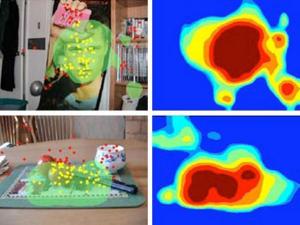
Researchers at MIT's McGovern Institute for Brain Research have developed a new mathematical model to describe how the human brain visually identifies objects. The model accurately predicts human performance on certain visual-perception tasks, which suggests that it's a good indication of what actually happens in the brain, and it could also help improve computer object-recognition systems.
Image
A new computational model of how the primate brain 
recognizes objects creates a map of "interesting" features 
(right) for a given image. The model's predictions of which 
parts of the image will attract a viewer's attention 
(green clouds, left) accord well with experimental data 
(yellow and red dots). 
(Credit: Images courtesy of Sharat Chikkerur)

The model was designed to reflect neurological evidence that in the primate brain, object identification -- deciding what an object is -- and object location -- deciding where it is -- are handled separately. "Although what and where are processed in two separate parts of the brain, they are integrated during perception to analyze the image," says Sharat Chikkerur, lead author on a paper appearing this week in the journal Vision Research, which describes the work. "The model that we have tries to explain how this information is integrated."

The mechanism of integration, the researchers argue, is attention. According to their model, when the brain is confronted by a scene containing a number of different objects, it can't keep track of all of them at once. So instead it creates a rough map of the scene that simply identifies some regions as being more visually interesting than others. If it's then called upon to determine whether the scene contains an object of a particular type, it begins by searching -- turning its attention toward -- the regions of greatest interest.

Chikkerur and Tomaso Poggio, the Eugene McDermott Professor in the Department of Brain and Cognitive Sciences and at the Computer Science and Artificial Intelligence Laboratory, together with graduate student Cheston Tan and former postdoc Thomas Serre, implemented the model in software, then tested its predictions against data from experiments with human subjects. The subjects were asked first to simply regard a street scene depicted on a computer screen, then to count the cars in the scene, and then to count the pedestrians, while an eye-tracking system recorded their eye movements. The software predicted with great accuracy which regions of the image the subjects would attend to during each task.

The software's analysis of an image begins with the identification of interesting features -- rudimentary shapes common to a wide variety of images. It then creates a map that depicts which features are found in which parts of the image. But thereafter, shape information and location information are processed separately, as they are in the brain.

The software creates a list of all the interesting features in the feature map, and from that, it creates another list, of all the objects that contain those features. But it doesn't record any information about where or how frequently the features occur.

At the same time, it creates a spatial map of the image that indicates where interesting features are to be found, but not what sorts of features they are.

It does, however, interpret the "interestingness" of the features probabilistically. If a feature occurs more than once, its interestingness is spread out across all the locations at which it occurs. If another feature occurs at only one location, its interestingness is concentrated at that one location.

Mathematically, this is a natural consequence of separating information about objects' identity and location and interpreting the results probabilistically. But it ends up predicting another aspect of human perception, a phenomenon called "pop out." A human subject presented with an image of, say, one square and one star will attend to both objects about equally. But a human subject presented an image of one square and a dozen stars will tend to focus on the square.

Like a human asked to perform a visual-perception task, the software can adjust its object and location models on the fly. If the software is asked to identify only the objects at a particular location in the image, it will cross off its list of possible objects any that don't contain the features found at that location.

By the same token, if it's asked to search the image for a particular kind of object, the interestingness of features not found in that object will go to zero, and the interestingness of features found in the object will increase proportionally. This is what allows the system to predict the eye movements of humans viewing a digital image, but it's also the aspect of the system that could aid the design of computer object-recognition systems. A typical object-recognition system, when asked to search an image for multiple types of objects, will search through the entire image looking for features characteristic of the first object, then search through the entire image looking for features characteristic of the second object, and so on. A system like Poggio and Chikkerur's, however, could limit successive searches to just those regions of the image that are likely to have features of interest.

Funding: DARPA, the Honda Research Institute USA, NEC, Sony and the Eugene McDermott Foundation

Friday, March 26, 2010

Harmful Intent: Emotions Key to Judging Others


A new study from MIT neuroscientists suggests that our ability to respond appropriately to intended harms -- that is, with outrage toward the perpetrator -- is seated in a brain region associated with regulating emotions.

Brain
New research suggests that our ability to respond appropriately to intended harms -- that is, with outrage toward the perpetrator -- is seated in a brain region associated with regulating emotions. (Credit: iStockphoto/Mark Evans)
Patients with damage to this brain area, known as the ventromedial prefrontal cortex (VMPC), are unable to conjure a normal emotional response to hypothetical situations in which a person tries, but fails, to kill another person. Therefore, they judge the situation based only on the outcome, and do not hold the attempted murderer morally responsible.

The finding offers a new piece to the puzzle of how the human brain constructs morality, says Liane Young, a postdoctoral associate in MIT's Department of Brain and Cognitive Sciences and lead author of a paper describing the findings in the March 25 issue of the journal Neuron.

"We're slowly chipping away at the structure of morality," says Young. "We're not the first to show that emotions matter for morality, but this is a more precise look at how emotions matter."

How they did it: Working with researchers at the University of Southern California, led by Antonio Damasio, Young studied a group of nine patients with damage (caused by aneurisms or tumors) to the VMPC, a plum-sized area located behind and above the eyes.

Such patients have difficulty processing social emotions such as empathy or embarrassment, but "they have a perfectly intact capacity for reasoning and other cognitive functions," says Young.

The researchers gave the subjects a series of 24 hypothetical scenarios and asked for their reactions. The scenarios of most interest to the researchers were ones featuring a mismatch between the person's intention and the outcome -- either failed attempts to harm or accidental harms.

When confronted with failed attempts to harm, the patients had no problems understanding the perpetrator's intentions, but they failed to hold them morally responsible. The patients even judged attempted harms as more permissible than accidental harms (such as accidentally poisoning someone) -- a reversal of the pattern seen in normal adults.

"They can process what people are thinking and their intentions, but they just don't respond emotionally to that information," says Young. "They can read about a murder attempt and judge it as morally permissible because no harm was done."

This supports the idea that making moral judgments requires at least two processes -- a logical assessment of the intention, and an emotional reaction to it. The study also supports the theory that the emotional component is seated in the VMPC.

Next steps: Young hopes to study patients who incurred damage to the VMPC when they were younger, to see if they have the same impaired judgment. She also plans to study patient reactions to situations where the harmful attempts may be directed at the patient and therefore are more personal.
Reblog this post [with Zemanta]