BTemplates.com

Powered by Blogger.

Pageviews past week

Quantum mechanics

Auto News

artificial intelligence

About Me

Recommend us on Google!

Information Technology

Popular Posts

Showing posts with label Quantum computer. Show all posts

Saturday, June 25, 2011

Optical circuit enables new approach to quantum technologies


An international research group led by scientists from the University of Bristol, UK, and the Universities of Osaka and Hokkaido, Japan, has demonstrated a fundamental building block for quantum computing that could soon be employed in a range of quantum technologies.

Professor Jeremy O’Brien, Director of the University of Bristol’s Centre for Quantum Photonics, and his Japanese colleagues have demonstrated a quantum logic gate acting on four particles of light – photons. The researchers believe their device could provide important routes to new quantum technologies, including secure communication, precision measurement, and ultimately a quantum computer—a powerful type of computer that uses quantum bits (qubits) rather than the conventional bits used in today’s computers.

Unlike conventional bits or transistors, which can be in one of only two states at any one time (1 or 0), a qubit can be in several states at the same time and can therefore be used to hold and process a much larger amount of information at a greater rate.

“We have realised a fundamental element for processing quantum information—a controlled-NOT or CNOT gate—based on a recipe that was theoretically proposed 10 years ago,” said Professor O’Brien. “The reason it has taken so long to achieve this milestone is that even for such a relatively simple circuit we require complete control over four single photons whizzing around at the speed of light!”

The approach taken by Professor O’Brien and his colleagues combined several methods for making optical circuits that must be stable to within a fraction of the wavelength of light, that is, nanometres. In 2001 optical quantum computing became possible when a theoretical recipe for realising this CNOT gate, as well as the other necessary components, was developed. However, the technological challenges associated with making the optical circuits have prevented its realisation until now. The implications for this new approach are far-reaching.

“The ability to implement such a logic gate on photons is critical for building up larger scale circuits and even algorithms,” said Professor O’Brien. “Using an integrated optics on a chip approach that we have pioneered here at Bristol over the last several years will enable this to proceed far more rapidly, paving the way to quantum technologies that will help us understand the most complex scientific problems.”


In the short term, the team expect to apply their new results immediately for developing new approaches to quantum communication and measurement and then for simulation tools in their lab. In the longer term, a small-scale quantum simulator based on a multi-photon optical circuit could be used to simulate processes which themselves are governed by quantum mechanics, such as superconductivity and photosynthesis. “Our technique could improve our understanding of such important processes and help, for example, in the development of more efficient solar cells,” said Professor O’Brien. Other applications include the development of ultra-fast and efficient search engines, designing high-tech materials and new pharmaceuticals.

The leap from using one photon to two photons is not trivial because the two particles need to be identical in every way and because of the way these particles interfere, or interact, with each other. There is no direct analogue of this interaction outside of quantum physics.

“Now that we can implement the fundamental building blocks for quantum circuits, the move to a larger scale devices will become our focus. Because of the increasingly complexity the results will be just as exciting” said Professor O’Brien. “Each time we add a photon, the complexity of the problem we are able to investigate increases exponentially, so if a one-photon quantum circuit has 10 outcomes, a two-photon system can give 100 outcomes and a three-photon system 1000 solutions and so on.”

The Centre for Quantum Photonics now plans to use their chip-based approach to increase the complexity of their experiment not only by adding more photons but also by using larger circuits.

The research is published in Proceedings of the National Academy of Sciences.

Sunday, April 3, 2011

World First: Calculations With 14 Quantum Bits


Quantum physicists from the University of Innsbruck have set another world record: They have achieved controlled entanglement of 14 quantum bits (qubits) and, thus, realized the largest quantum register that has ever been produced. With this experiment the scientists have not only come closer to the realization of a quantum computer but they also show surprising results for the quantum mechanical phenomenon of entanglement.
Up to 14 quantum bits were entangled in an ion trap. 
(Credit: University of Innsbruck)

The term entanglement was introduced by the Austrian Nobel laureate Erwin Schrödinger in 1935, and it describes a quantum mechanical phenomenon that while it can clearly be demonstrated experimentally, is not understood completely. Entangled particles cannot be defined as single particles with defined states but rather as a whole system. By entangling single quantum bits, a quantum computer will solve problems considerably faster than conventional computers. "It becomes even more difficult to understand entanglement when there are more than two particles involved," says Thomas Monz, junior scientist in the research group led by Rainer Blatt at the Institute for Experimental Physics at the University of Innsbruck. "And now our experiment with many particles provides us with new insights into this phenomenon," adds Blatt.

World record: 14 quantum bits

Since 2005 the research team of Rainer Blatt has held the record for the number of entangled quantum bits realized experimentally. To date, nobody else has been able to achieve controlled entanglement of eight particles, which represents one quantum byte. Now the Innsbruck scientists have almost doubled this record. They confined 14 calcium atoms in an ion trap, which, similar to a quantum computer, they then manipulated with laser light. The internal states of each atom formed single qubits and a quantum register of 14 qubits was produced. This register represents the core of a future quantum computer. In addition, the physicists of the University of Innsbruck have found out that the decay rate of the atoms is not linear, as usually expected, but is proportional to the square of the number of the qubits. When several particles are entangled, the sensitivity of the system increases significantly. "This process is known as superdecoherence and has rarely been observed in quantum processing," explains Thomas Monz. It is not only of importance for building quantum computers but also for the construction of precise atomic clocks or carrying out quantum simulations.

Increasing the number of entangled particles
By now the Innsbruck experimental physicists have succeeded in confining up to 64 particles in an ion trap. "We are not able to entangle this high number of ions yet," says Thomas Monz. "However, our current findings provide us with a better understanding about the behavior of many entangled particles." And this knowledge may soon enable them to entangle even more atoms. Some weeks ago Rainer Blatt's research group reported on another important finding in this context in the scientific journal Nature: They showed that ions might be entangled by electromagnetic coupling. This enables the scientists to link many little quantum registers efficiently on a micro chip. All these findings are important steps to make quantum technologies suitable for practical information processing," Rainer Blatt is convinced.

The results of this work are published in the scientific journal Physical Review Letters. The Innsbruck researchers are supported by the Austrian Science Fund (FWF), the European Commission and the Federation of Austrian Industries Tyrol.

Saturday, March 19, 2011

Quantum Pen for Single Atoms Is a Big Step Toward Large-Scale Quantum Computing


Physicists at the Max Planck Institute of Quantum Optics succeeded in manipulating atoms individually in a lattice of light and in arranging them in arbitrary patterns. These results are an important step towards large scale quantum computing and for the simulation of condensed matter systems.
With the help of a laser beam, the scientists could address single atoms in the lattice of light and change their spin state. In this way they succeeded in having total control over the single atoms and in "writing" arbitrary two-dimensional patterns. (Credit: Image courtesy of Max Planck Institute of Quantum Optics)

Physicists around the world are searching for the best way to realize a quantum computer. Now scientists of the team around Stefan Kuhr and Immanuel Bloch at the Max Planck Institute of Quantum Optics (Garching/Munich) took a decisive step in this direction. They can now address and change the spin of single atoms with laser light and arrange them in arbitrary patterns. In this way, the physicists strung the atoms along a line and could directly observe their tunneling dynamics in a “racing duel” of the atoms. A register of hundreds of addressable quantum particles could serve for storing and processing of quantum information in a quantum computer.

In the present experiment, the scientists loaded laser-cooled rubidium atoms into an artificial crystal of light. These so-called optical lattices are generated by superimposing several laser beams. The atoms are kept in the lattice of light in a way similar to marbles being contained in the hollows of an egg carton.

A few months ago, the team of Stefan Kuhr and Immanuel Bloch showed that each site of the optical lattice can be filled with exactly one atom. With the help of a microscope, the scientists visualized the array atom by atom and thereby verified the shell-like structure of this “Mott insulator.” Now the scientists succeeded in individually addressing the atoms in the lattice and in changing their respective energy state. Using the microscope, they focused a laser beam down to a diameter of about 600 nanometers, which is just above the lattice spacing, and directed it at individual atoms with high precision.

The laser beam slightly deforms the electron shell of the addressed (targeted) atom and thereby changes the energy difference between its two spin states. Atoms with a spin – i.e. an intrinsic angular momentum – behave like little magnetic needles that can align in two opposite directions. If the atoms are irradiated with microwaves that are in resonance with the modified spin transition, only the addressed atoms absorb a microwave photon, which causes their spin to flip. All other atoms in the lattice remain unaffected by the microwave field.

The scientists demonstrated the high fidelity of this addressing scheme in a series of experiments. For this purpose, the spins of all atoms along a line were flipped one after the other, by moving the addressing laser from lattice site to lattice site. After removing all atoms with a flipped spin from the trap, the addressed atoms are visible as holes, which can easily be counted. In this way, the physicists deduced that the addressing worked in 95% of the cases. Atoms at the neighboring sites are not influenced by the addressing laser. The method provides the possibility to generate arbitrary distributions of atoms in the lattice.

Starting from an arrangement of 16 atoms that were strung together on neighboring lattice sites like a necklace of beads, the scientists studied what happens when the height of the lattice is ramped down so far that the particles are allowed to “tunnel” according to the rules of quantum mechanics. They move from one lattice site to the other, even if their energy is not sufficient to cross the barrier between the lattice wells. “As soon as the height of the lattice has reached the point where tunneling is possible, the particles start running as if they took part in a horse-race”, doctoral candidate Christof Weitenberg describes. “By taking snapshots of the atoms in the lattice at different times after the "starting signal", we could directly observe the quantum mechanical tunneling-effect of single massive particles in an optical lattice for the first time.”

The new addressing technique allows many interesting studies of the dynamics of collective quantum states, as they appear in solid state systems. It also opens new perspectives in quantum information processing. “A Mott isolator with exactly one atom per lattice site acts as a natural quantum register with a few hundred quantum bits, the ideal starting point for scalable quantum information processing,” as Stefan Kuhr explains. “We have shown that we can individually address single atoms. In order for the atom to suit as a quantum bit, we need to generate coherent superpositions of its two spin states. A further step is to realize elementary logical operations between two selected atoms in the lattice, so-called quantum gates.”

Saturday, March 5, 2011

New Kinds of Superconductivity? Physicists Demonstrate Coveted 'Spin-Orbit Coupling' in Atomic Gases


Physicists at the Joint Quantum Institute (JQI), a collaboration of the National Institute of Standards and Technology (NIST) and the University of Maryland-College Park, have for the first time caused a gas of atoms to exhibit an important quantum phenomenon known as spin-orbit coupling. Their technique opens new possibilities for studying and better understanding fundamental physics and has potential applications to quantum computing, next-generation "spintronics" devices and even "atomtronic" devices built from ultracold atoms.
In an ultracold gas of nearly 200,000 rubidium-87 atoms (shown as the large humps) the atoms can occupy one of two energy levels (represented as red and blue); lasers then link together these levels as a function of the atoms' motion. At first atoms in the red and blue energy states occupy the same region (Phase Mixed), then at higher laser strengths, they separate into different regions (Phase Separated). (Credit: Ian Spielman, JQI/NIST)


In the researchers' demonstration of spin-orbit coupling, two lasers allow an atom's motion to flip it between a pair of energy states. The new work, published in Nature, demonstrates this effect for the first time in bosons, which make up one of the two major classes of particles. The same technique could be applied to fermions, the other major class of particles, according to the researchers. The special properties of fermions would make them ideal for studying new kinds of interactions between two particles -- for example those leading to novel "p-wave" superconductivity, which may enable a long-sought form of quantum computing known as topological quantum computation.

In an unexpected development, the team also discovered that the lasers modified how the atoms interacted with each other and caused atoms in one energy state to separate in space from atoms in the other energy state.

One of the most important phenomena in quantum physics, spin-orbit coupling describes the interplay that can occur between a particle's internal properties and its external properties. In atoms, it usually describes interactions that only occur within an atom: how an electron's orbit around an atom's core (nucleus) affects the orientation of the electron's internal bar-magnet-like "spin." In semiconductor materials such as gallium arsenide, spin-orbit coupling is an interaction between an electron's spin and its linear motion in a material.

"Spin-orbit coupling is often a bad thing," said JQI's Ian Spielman, senior author of the paper. "Researchers make 'spintronic' devices out of gallium arsenide, and if you've prepared a spin in some desired orientation, the last thing you'd want it to do is to flip to some other spin when it's moving."

"But from the point of view of fundamental physics, spin-orbit coupling is really interesting," he said. "It's what drives these new kinds of materials called 'topological insulators.'"

One of the hottest topics in physics right now, topological insulators are special materials in which location is everything: the ability of electrons to flow depends on where they are located within the material. Most regions of such a material are insulating, and electric current does not flow freely. But in a flat, two-dimensional topological insulator, current can flow freely along the edge in one direction for one type of spin, and the opposite direction for the opposite kind of spin. In 3-D topological insulators, electrons would flow freely on the surface but be inhibited inside the material. While researchers have been making higher and higher quality versions of this special class of material in solids, spin-orbit coupling in trapped ultracold gases of atoms could help realize topological insulators in their purest, most pristine form, as gases are free of impurity atoms and the other complexities of solid materials.

Usually, atoms do not exhibit the same kind of spin-orbit coupling as electrons exhibit in gallium-arsenide crystals. While each individual atom has its own spin-orbit coupling going on between its internal components (electrons and nucleus), the atom's overall motion generally is not affected by its internal energy state.

But the researchers were able to change that. In their experiment, researchers trapped and cooled a gas of about 200,000 rubidium-87 atoms down to 100 nanokelvins, 3 billion times colder than room temperature. The researchers selected a pair of energy states, analogous to the "spin-up" and "spin-down" states in an electron, from the available atomic energy levels. An atom could occupy either of these "pseudospin" states. Then researchers shined a pair of lasers on the atoms so as to change the relationship between the atom's energy and its momentum (its mass times velocity), and therefore its motion. This created spin-orbit coupling in the atom: the moving atom flipped between its two "spin" states at a rate that depended upon its velocity.

"This demonstrates that the idea of using laser light to create spin-orbit coupling in atoms works. This is all we expected to see," Spielman said. "But something else really neat happened."

They turned up the intensity of their lasers, and atoms of one spin state began to repel the atoms in the other spin state, causing them to separate.

"We changed fundamentally how these atoms interacted with one another," Spielman said. "We hadn't anticipated that and got lucky."

The rubidium atoms in the researchers' experiment were bosons, sociable particles that can all crowd into the same space even if they possess identical values in their properties including spin. But Spielman's calculations show that they could also create this same effect in ultracold gases of fermions. Fermions, the more antisocial type of atoms, cannot occupy the same space when they are in an identical state. And compared to other methods for creating new interactions between fermions, the spin states would be easier to control and longer lived.

A spin-orbit-coupled Fermi gas could interact with itself because the lasers effectively split each atom into two distinct components, each with its own spin state, and two such atoms with different velocities could then interact and pair up with one other. This kind of pairing opens up possibilities, Spielman said, for studying novel forms of superconductivity, particularly "p-wave" superconductivity, in which two paired atoms have a quantum-mechanical phase that depends on their relative orientation. Such p-wave superconductors may enable a form of quantum computing known as topological quantum computation.

Tuesday, March 1, 2011

Atomic Antennas Transmit Quantum Information Across a Microchip


The Austrian research group led by physicist Rainer Blatt suggests a fundamentally novel architecture for quantum computation. They have experimentally demonstrated quantum antennas, which enable the exchange of quantum information between two separate memory cells located on a computer chip. This offers new opportunities to build practical quantum computers.
Quantum antennae enable the exchange of quantum 
information between two separate memory cells located 
on a computer chip. (Credit: Harald Ritsch)


The researchers have published their work in the scientific journal Nature.

Six years ago scientists at the University of Innsbruck realized the first quantum byte -- a quantum computer with eight entangled quantum particles; a record that still stands. "Nevertheless, to make practical use of a quantum computer that performs calculations, we need a lot more quantum bits," says Prof. Rainer Blatt, who, with his research team at the Institute for Experimental Physics, created the first quantum byte in an electromagnetic ion trap. "In these traps we cannot string together large numbers of ions and control them simultaneously."

To solve this problem, the scientists have started to design a quantum computer based on a system of many small registers, which have to be linked. To achieve this, Innsbruck quantum physicists have now developed a revolutionary approach based on a concept formulated by theoretical physicists Ignacio Cirac and Peter Zoller. In their experiment, the physicists electromagnetically coupled two groups of ions over a distance of about 50 micrometers. Here, the motion of the particles serves as an antenna. "The particles oscillate like electrons in the poles of a TV antenna and thereby generate an electromagnetic field," explains Blatt. "If one antenna is tuned to the other one, the receiving end picks up the signal of the sender, which results in coupling." The energy exchange taking place in this process could be the basis for fundamental computing operations of a quantum computer.

Antennas amplify transmission

"We implemented this new concept in a very simple way," explains Rainer Blatt. In a miniaturized ion trap a double-well potential was created, trapping the calcium ions. The two wells were separated by 54 micrometers. "By applying a voltage to the electrodes of the ion trap, we were able to match the oscillation frequencies of the ions," says Blatt.

"This resulted in a coupling process and an energy exchange, which can be used to transmit quantum information." A direct coupling of two mechanical oscillations at the quantum level has never been demonstrated before. In addition, the scientists show that the coupling is amplified by using more ions in each well. "These additional ions function as antennas and increase the distance and speed of the transmission," says Rainer Blatt, who is excited about the new concept. This work constitutes a promising approach for building a fully functioning quantum computer.

"The new technology offers the possibility to distribute entanglement. At the same time, we are able to target each memory cell individually," explains Rainer Blatt. The new quantum computer could be based on a chip with many micro traps, where ions communicate with each other through electromagnetic coupling. This new approach represents an important step towards practical quantum technologies for information processing.

The quantum researchers are supported by the Austrian Science Fund FWF, the European Union, the European Research Council and the Federation of Austrian Industries Tyrol.

Saturday, October 2, 2010

Three Solid-State Qubits Entangled: Big Step Toward Quantum Error Correction


The rules that govern the world of the very small, quantum mechanics, are known for being bizarre. One of the strangest tenets is something called quantum entanglement, in which two or more objects (such as particles of light, called photons) become inextricably linked, so that measuring certain properties of one object reveals information about the other(s), even if they are separated by thousands of miles. Einstein found the consequences of entanglement so unpalatable he famously dubbed it "spooky action at a distance."
The quantum entanglement of three solid-state qubits, or quantum bits, represents the first step towards quantum error correction, a crucial aspect of future quantum computing. (Credit: iStockphoto/Yenwen Lu)

Now a team led by Yale researchers has harnessed this counterintuitive aspect of quantum mechanics and achieved the entanglement of three solid-state qubits, or quantum bits, for the first time. Their accomplishment, described in the Sept. 30 issue of the journal Nature, is a first step towards quantum error correction, a crucial aspect of future quantum computing.

"Entanglement between three objects has been demonstrated before with photons and charged particles," said Steven Girvin, the Eugene Higgins Professor of Physics & Applied Physics at Yale and an author of the paper. "But this is the first three-qubit, solid-state device that looks and feels like a conventional microprocessor."

The new result builds on the team's development last year of the world's first rudimentary solid-state quantum processor, which they demonstrated was capable of executing simple algorithms using two qubits.

The team, led by Robert Schoelkopf, the William A. Norton Professor of Applied Physics & Physics at Yale, used artificial "atoms" -- actually made up of a billion aluminum atoms that behave as a single entity -- as their qubits. These "atoms" can occupy two different energy states, akin to the "1" and "0" or "on" and "off" states of regular bits used in conventional computers. The strange laws of quantum mechanics, however, allow for qubits to be placed in a "superposition" of these two states at the same time, resulting in far greater information storage and processing power.

In this new study, the team was able to achieve an entangled state by placing the three qubits in a superposition of two possibilities -- all three were either in the 0 state or the 1 state. They were able to attain this entangled state 88 percent of the time.

With the particular entangled state the team achieved, they also demonstrated for the first time the encoding of quantum information from a single qubit into three qubits using a so-called repetition code. "This is the first step towards quantum error correction, which, as in a classical computer, uses the extra qubits to allow the computer to operate correctly even in the presence of occasional errors," Girvin said.

Such errors might include a cosmic ray hitting one of the qubits and switching it from a 0 to a 1 state, or vice versa. By replicating the qubits, the computer can confirm whether all three are in the same state (as expected) by checking each one against the others.

"Error correction is one of the holy grails in quantum computing today," Schoelkopf said. "It takes at least three qubits to be able to start doing it, so this is an exciting step."

Other authors of the paper include Leonardo DiCarlo, Matthew Reed, Luyan Sun, Blake Johnson, Jerry Chow and Michel Devoret (all of Yale University); and Jay Gambetta (University of Waterloo).

Wednesday, September 29, 2010

Sole Electron Reader Opens Path for Quantum Computation


A team led by engineers and physicists at the University of New South Wales (UNSW) in Sydney, Australia, make developed one of the key building blocks needed to make a quantum computer using silicon: a "single electron reader."
Artist's impression of a phosphorus atom (red sphere surrounded by a blue electron cloud, with spin) coupled to a silicon single-electron transistor, to achieve single-shot readout of the phosphorus electron spin. (Credit: William Algar-Chuklin, College of Fine Arts, The University of New South Wales)

Their work was published in the journal Nature.

Quantum computers promise exponential function increases in processing speed over today's computers through their use of the "spin," or magnetic orientation, of single electrons to correspond data in their computings.

In order to employ electron spin, the quantum computer needs both a way of changing the spin state (write) and of measuring that change (read) to form a qubit -- the equivalent of the bits in a conventional computer.

In creating the single electron reader, a team of engineers and physicists led by Dr Andrea Morello and Professor Andrew Dzurak, of the School of Electrical Engineering and Telecommunications at UNSW, has for the first time made possible the measurement of the spin of one electron in silicon in a single shot experiment. The team also includes researchers from the University of Melbourne and Aalto University in Finland.

"Our device detects the spin state of a single electron in a single phosphorus atom implanted in a block of silicon. The spin state of the electron controls the flow of electrons in a nearby circuit," said Dr Morello, the lead author of the paper, Single-shot readout of an electron spin in silicon.

"Until this experiment, no-one had actually measured the spin of a single electron in silicon in a single-shot experiment."

By using silicon -- the foundation material of conventional computers -- rather than light or the esoteric materials and approaches being pursued by other researchers, the device opens the way to constructing a simpler quantum computer, scalable and amenable to mass-production.

The team has built on a body of research that has put Australia at forefront of the race to construct a working quantum computer. In 1998 Bruce Kane, then at UNSW, outlined in Nature the concept for a silicon-based quantum computer, in which the qubits are defined by single phosphorus atoms in an otherwise ultra-pure silicon chip. The new device brings his vision closer.

"We expect quantum computers will be able to perform certain tasks much faster than normal computers, such as searching databases, modelling complex molecules or developing new drugs," says co-author Prof Andrew Dzurak. "They could also crack most modern forms of encryption."

"After a decade of work trying to build this type of single atom qubit device, this is a very special moment."

Now the team has created a single electron reader, they are working to quickly complete a single electron writer and combine the two. Then they will combine pairs of these devices to create a 2-bit logic gate -- the basic processing unit of a quantum computer.

The research team is part of the Australian Research Council (ARC) Centre of Excellence for Quantum Computer Technology, which is headquartered at UNSW. The team is led by Professor Dzurak and Dr Morello, with Mr Jarryd Pla and Dr Floris Zwanenburg as key supporting experimentalists. The paper's co-authors include Prof David Jamieson from the University of Melbourne; Dr Bob Clark, Australia's Chief Defence Scientist, and 10 other researchers from UNSW, The University of Melbourne, and Finland's Aalto University.

The research was funded by: the Australian, US, and NSW governments; UNSW; and the University of Melbourne.

Friday, May 14, 2010

Quantum Move Toward Next Generation Computing


Physicists at McGill University have developed a system for measuring the energy involved in adding electrons to semi-conductor nanocrystals, also known as quantum dots -- a technology that may revolutionize computing and other areas of science.
Me
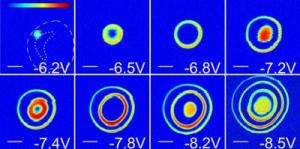
These images show the electrostatic energy given 
off when electrons are added to a quantum dot. 
They were made with an atomic-force microscope
(Credit: Dept. of Physics, McGill University)

Dr. Peter Grütter, McGill's Associate Dean of Research and Graduate Education, Faculty of Science, explains that his research team has developed a cantilever force sensor that enables individual electrons to be removed and added to a quantum dot and the energy involved in the operation to be measured.

Being able to measure the energy at such infinitesimal levels is an important step in being able to develop an eventual replacement for the silicon chip in computers -- the next generation of computing. Computers currently work with processors that contain transistors that are either in an on or off position -- conductors and semi-conductors -- while quantum computing would allow processors to work with multiple states, vastly increasing their speed while reducing their size even more.

Although popularly used to connote something very large, the word "quantum" itself actually means the smallest amount by which certain physical quantities can change. Knowledge of these energy levels enables scientists to understand and predict the electronic properties of the nanoscale systems they are developing.

"We are determining optical and electronic transport properties," Grütter said. "This is essential for the development of components that might replace silicon chips in current computers."

The electronic principles of nanosystems also determine their chemical properties, so the team's research is relevant to making chemical processes "greener" and more energy efficient. For example, this technology could be applied to lighting systems, by using nanoparticles to improving their energy efficiency. "We expect this method to have many important applications in fundamental as well as applied research," said Lynda Cockins of McGill's Department of Physics.

The principle of the cantilever sensors sounds relatively simple. "The cantilever is about 0.5 mm in size (about the thickness of a thumbnail) and is essentially a simple driven, damped harmonic oscillator, mathematically equivalent to a child's swing being pushed," Grütter explained. "The signal we measure is the damping of the cantilever, the equivalent to how hard I have to push the kid on the swing so that she maintains a constant height, or what I would call the 'oscillation amplitude.' "

Dr. Aashish Clerk, Yoichi Miyahara, and Steven D. Bennett of McGill's Dept. of Physics, and scientists at the Institute for Microstructural Sciences of the National Research Council of Canada contributed to this research, which was published online in the Proceedings of the National Academy of Sciences. The research received funding from the Natural Sciences and Engineering Research Council of Canada, le Fonds Québécois de le Recherche sur la Nature et les Technologies, the Carl Reinhardt Fellowship, and the Canadian Institute for Advanced Research.
Reblog this post [with Zemanta]

Thursday, April 22, 2010

Bizarre Matter Could Find Use in Quantum Computers


There are enticing new findings in the search for materials that support fault-tolerant quantum computing. New results from Rice University and Princeton University indicate that a bizarre state of matter that acts like a particle with one-quarter electron charge also has a "quantum registry" that is immune to information loss from external perturbations.
Me
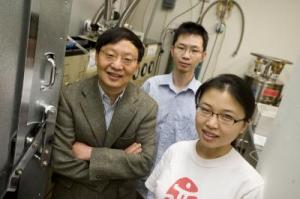
From left, Rice physicist Rui-Rui Du, graduate students Chi Zhang and Yanhua Dai, and former postdoctoral researcher Tauno Knuuttila (not pictured) have found that odd groupings of ultracold electrons could be useful in making fault-tolerant quantum computers. (Credit: Jeff Fitlow/Rice University)

The research appeared online April 21 in Physical Review Letters. The team of physicists found that ultracold mixes of electrons caught in magnetic traps could have the necessary properties for constructing fault-tolerant quantum computers -- future computers that could be far more powerful than today's computers. The mixes of electrons are dubbed "5/2 quantum Hall liquids" in reference to the unusual quantum properties that describe their makeup.

"The big goal, the whole driving force, besides deep academic curiosity, is to build a quantum computer out of this," said the study's lead author Rui-Rui Du, professor of physics at Rice. "The key for that is whether these 5/2 liquids have 'topological' properties that would render them immune to the sorts of quantum perturbations that could cause information degradation in a quantum computer."

Du said the team's results indicate the 5/2 liquids have the desired properties. In the parlance of condensed-matter physics, they are said to represent a "non-Abelian" state of matter.

Non-Abelian is a mathematical term for a system with "noncommutative" properties. In math, commutative operations, like addition, are those that have the same outcome regardless of the order in which they are carried out. So, one plus two equals three, just as two plus one equals three. In daily life, commutative and noncommutative tasks are commonplace. For example, when doing the laundry, it doesn't matter if the detergent is added before the water or the water before the detergent, but it does matter if the clothes are washed before they're placed in the dryer.

"It will take a while to fully understand the complete implications of our results, but it is clear that we have nailed down the evidence for 'spin polarization,' which is one of the two necessary conditions that must be proved to show that the 5/2 liquids are non-Abelian," Du said. "Other research teams have been tackling the second condition, the one-quarter charge, in previous experiments."

The importance of the noncommutative quantum properties is best understood within the context of fault-tolerant quantum computers, a fundamentally new type of computer that hasn't been built yet.

Computers today are binary. Their electrical circuits, which can be open or closed, represent the ones and zeros in binary bits of information. In quantum computers, scientists hope to use "quantum bits," or qubits. Unlike binary ones and zeros, the qubits can be thought of as little arrows that represent the position of a bit of quantum matter. The arrow might represent a one if it points straight up or a zero if it points straight down, but it could also represent any number in between. In physics parlance, these arrows are called quantum "states." And for certain complex calculations, being able to represent information in many different states would present a great advantage over binary computing.

The upshot of the 5/2 liquids being non-Abelian is that they have a sort of "quantum registry," where information doesn't change due to external quantum perturbations.

"In a way, they have internal memory of their previous state," Du said.

The conditions needed to create the 5/2 liquids are extreme. At Rice, Tauno Knuuttila, a former postdoctoral research scientist in Du's group, spent several years building the "demagnetization refrigerator" needed to cool 5-millimeter squares of ultrapure semiconductors to within one-10,000th of a degree of absolute zero. It took a week for Knuuttila to simply cool the nearly one-ton instrument to the necessary temperature for the Rice experiments.

The gallium arsenide semiconductors used in the tests are the most pure on the planet. They were created by Loren Pfieiffer, Du's longtime collaborator at Princeton and Bell Labs. Rice graduate student Chi Zhang conducted additional tests at the National High Magnetic Field Laboratory in Tallahassee, Fla., to verify that the 5/2 liquid was spin- polarized.

Study co-authors include Zhang, Knuuttila, Pfeiffer, Princeton's Ken West and Rice's Yanhua Dai. The research is supported by the Department of Energy, the National Science Foundation and the Keck Foundation.

Wednesday, February 17, 2010

Diamond Nanowires for Quantum Computing?


Diamond Nanowire Device Could Lead to New Class of Diamond Nanomaterials Suitable for Quantum Cryptography, Quantum Computing, and Magnetic Field Imaging

By creating diamond-based nanowire devices, a team at Harvard has taken another step towards making applications based on quantum science and technology possible.
A diamond-based nanowire device. Researchers used a top-down nanofabrication technique to embed color centers into a variety of machined structures. By creating large device arrays rather than just "one-of-a-kind" designs, the realization of quantum networks and systems, which require the integration and manipulation of many devices in parallel, is more likely. (Credit: Illustrated by Jay Penni.)

The new device offers a bright, stable source of single photons at room temperature, an essential element in making fast and secure computing with light practical.

The finding could lead to a new class of nanostructured diamond devices suitable for quantum communication and computing, as well as advance areas ranging from biological and chemical sensing to scientific imaging.

Published in the February 14th issue of Nature Nanotechnology,researchers led by Marko Loncar, Assistant Professor of Electrical Engineering at the Harvard School of Engineering and Applied Sciences (SEAS), found that the performance of a single photon source based on a light emitting defect (color center) in diamond could be improved by nanostructuring the diamond and embedding the defect within a diamond nanowire.

Scientists, in fact, first began exploiting the properties of natural diamonds after learning how to manipulate the electron spin, or intrinsic angular momentum, associated with the nitrogen vacancy (NV) color center of the gem. The quantum (qubit) state can be initialized and measured using light.

The color center "communicates" by emitting and absorbing photons. The flow of photons emitted from the color center provides a means to carry the resulting information, making the control, capture, and storage of photons essential for any kind of practical communication or computation. Gathering photons efficiently, however, is difficult since color-centers are embedded deep inside the diamond.

"This presents a major problem if you want to interface a color center and integrate it into real-world applications," explains Loncar. "What was missing was an interface that connects the nano-world of a color center with macro-world of optical fibers and lenses."

The diamond nanowire device offers a solution, providing a natural and efficient interface to probe an individual color center, making it brighter and increasing its sensitivity. The resulting enhanced optical properties increases photon collection by nearly a factor of ten relative to natural diamond devices.

"Our nanowire device can channel the photons that are emitted and direct them in a convenient way," says lead-author Tom Babinec, a graduate student at SEAS.

Further, the diamond nanowire is designed to overcome hurdles that have challenged other state-of-the-art systems -- such as those based on fluorescent dye molecules, quantum dots, and carbon nanotubes -- as the device can be readily replicated and integrated with a variety of nano-machined structures.

The researchers used a top-down nanofabrication technique to embed color centers into a variety of machined structures. By creating large device arrays rather than just "one-of-a-kind" designs, the realization of quantum networks and systems, which require the integration and manipulation of many devices in parallel, is more likely.

"We consider this an important step and enabling technology towards more practical optical systems based on this exciting material platform," says Loncar. "Starting with these synthetic, nanostructured diamond samples, we can start dreaming about the diamond-based devices and systems that could one day lead to applications in quantum science and technology as well as in sensing and imaging."

Loncar and Babinec's co-authors included research scholar Birgit Hausmann, graduate student Yinan Zhang, and postdoctoral student Mughees Khan, all at SEAS; graduate student Jero Maze in the Department of Physics at Harvard; and faculty member Phil R. Hemmer at Texas A&M University.

The researchers acknowledge the following support: Nanoscale Interdisciplinary Research Team (NIRT) grant from National Science Foundation (NSF), the NSF-funded Nanoscale Science and Engineering Center at Harvard (NSEC); the Defense Advanced Research Projects Agency (DARPA); and a National Defense Science and Engineering Graduate Fellowship and National Science Foundation Graduate Fellowship. All devices have been fabricated at the Center for Nanoscale Systems (CNS) at Harvard.

Reblog this post [with Zemanta]