BTemplates.com

Powered by Blogger.

Pageviews past week

Quantum mechanics

Auto News

artificial intelligence

About Me

Recommend us on Google!

Information Technology

Popular Posts

Showing posts with label Personal computer. Show all posts

Saturday, October 22, 2011

Pi enthusiast calculates it to ten trillion digits


Shigeru Kondo is a seriously committed guy. Ever since discovering he had an interest in calculating pi (aka Ï€) back in his college days, he’s been following the results achieved by others using massive supercomputers. Now, in his late 50's, with some help from Northwestern University grad school student Alexander Yee, he’s succeeded in calculating pi to ten trillion digits; on a home built PC yet.

Pi, the mathematical constant that describes the ratio of a circle’s circumference to its diameter, is generally rounded off to just two places, bringing it to 3.14. Believed to have been first described by Archimedes way back in the 3rd century BC, the ratio is used in all sorts of mathematical computations, not the least of which is in figuring out the area of a circle. But because pi is an irrational number, it’s value cannot be written as an fraction which means when written as a decimal approximation, it’s numbers go on infinitely, and perhaps more importantly, never repeat.

For hundreds of years, pi has held fascination for mathematicians, scientists, philosophers and even regular run of the mill people. Why this is so is hard to say, and so too is the seemingly endless progression of people that have set before themselves the task of calculating its digits. In spite of that, it’s possible that none has ever been so obsessed as Kondo. He’s spent the better part of a year with the singular task of finding the ten trillionth digit, and of course all those past the five trillionth and one digit leading up to the ten trillionth, since he found the five trillionth digit just last year.

Finding the value of pi to 10 trillion digits requires performing a lot of calculations (using software written by Yee), so many in fact, that Kondo had to add a lot more hard drive space than you’d find on your average PC. Forty eight terabytes to be exact. So intense was the computation that the computer alone caused the temperature in the room to hold steady at 104° F.

Also, it’s not as easy to keep a custom built super-sized PC going full steam ahead twenty four hours day for months on end, as it might seem. Hard drive failures and the threat of power disruption from the earthquake in Japan back in March threatened the project many times. And of course there was that power bill itself which ran to something close to $400 a month as the computer ground away.

But in the end, it was Kondo’s persistence that paid off. For his efforts he will be forever known (in the annals of science, and probably the Guinness Book of World Records) as the man who calculated the ten trillionth digit of pi. It’s 5.

More information: http://www.numberworld.org/misc_runs/pi-10t/details.html
http://ja0hxv.calico.jp/pai/estart.html


Friday, June 10, 2011

The PC (As We Know It) Is Dead


The rapid rise of cloud computing, coupled with a slew of increasingly powerful mobile computing devices, is killing the PC faster than analysts had predicted.

In fact, some now say, the desktop PC is essentially dead – an immobile zombie that's already irrelevant to many consumers and soon will be to businesses, too.
Lights out for today's personal computers.
CREDIT: Dreamstime/BusinessNewsDaily illustration

Yesterday's announcement of Apple's iCloud, which will store content online and synch all of a user's Apple devices wirelessly, is the latest in a series of nails being hammered into the PC coffin. Smart phones and tablets have given rise to a new consumer demand for immediate information at our fingertips, which John Quain, industry expert and longtime technology writer, said has made the desktop computer defunct.

"We don’t need PCs anymore," Quain told BusinessNewsDaily. "They are dead."

PC sales slide

The two-stage death march is evident in surprisingly dim statistics released recently.

Two of the world's largest manufactures of personal computers, HP and Dell, recently reported significant losses in sales to consumers. PC sales to individuals for quarter ending April 30 plunged 23 percent at HP and 7 percent at Dell.

PC sales to businesses have fared better. But overall, a turning point has clearly passed.

This spring, Gartner, Inc. released statistics showing PC sales overall dropped 1.1 percent compared to last year. Meanwhile, IMS Research has forecasted a whopping 213 percent growth for tablets.

While the PC has long been considered a necessity in the workplace, Quain said mobile devices are now giving businesses the chance to break from that mold.

"I see a lot of large enterprises and small businesses reconsidering the need for a desktop computer," Quain said. "The tablet computers are much cheaper, and give small and medium-size business another option so they don’t have to invest in a desktop computer."

Meanwhile laptops, considered to be PC's, are changing rapidly. Apple's Mac Air has the instant-on capability of a tablet computer, and isn't much bigger than one. Intel recently announced Ultrabook, a thin, light tablet-like laptop with a touch screen. The company thinks it'll make up half the laptop market by the end of next year.

And earlier this year, Motorola released the Atrix 4G, a smartphone that docks to a laptop-like device that's really just a screen, keyboard and giant battery. The smartphone is the brains of the operation.

Gone from campuses

Nowhere is the PC demise more stark than among the consumers of tomorrow.

At Penn State University, Director of Education Technology Services Allan Gyorke said the former student staple is now rarely spotted in dorm rooms.

"The desktop PC is dead," Gyorke said, estimating that 95 percent of students now bring a laptop or tablet media device to campus instead of using a traditional PC in their dorm room.

Those newer devices, he said, are easier to store and easier to set up.

While not ready to put the final nail in the PC's coffin, Roger Kay, an industry expert and president of Endpoint Technologies Associates, said the growing use of media tablets and smartphones is indeed pushing it out the door.

"Death might be an over-exaggeration, but the wind has been taken out of the PC’s sails," Kay said. "There is a lot of momentum going the other way."

With tablets and smartphones having as many computer capabilities as a desktop PC, Kay said it's only naturally for people to choose the handier option.

"It is hugely more convenient," Kay said. "It immediately changed my lifestyle, in that it offered a type of mobile computing that wasn’t available before."

The wireless connection

The explosion of wireless networks is also linked to the PC's demise. You no longer need to be seated at a desktop computer that is plugged into the phone line next to it to access the Internet, Gyorke noted.

"If there is a wireless connection somewhere, people want to access it," Gyorke said. "That is a real drawing force."

Apple's new iCloud will help seal the desktop's fate by spurring the use of all cloud-based services, Quain said. "It is going to make everyone feel more confident in using those cloud services."

Other analysts point out that the iCloud is mostly an Apple affair, but that Google, Microsoft and others who want a foothold in the cloud are already racing in that direction, and iCloud will only heat that race up.

Evolve or die

Still, even as he acknowledged that PC alternatives like the iPad and other media tablets are slowing personal computer sales, George Shiffler, research director at Gartner, Inc., said he expects the PC to survive by evolving into something else.

"PCs are a very flexible platform," Shiffler said. “There will be something like a PC (in the future), but it won't be exactly what it is like today.”

One scenario, he suggested, is to have a further merge of the television and computer.


"I think we may see the desktop move to an all-in-one screen," Shiffler said. "Then it becomes a media center."

Gyorke said he actually sees the future of personal computers headed in the same direction as tablets, with touch screens and app centers.

"The interface will be very similar to the iPad," Gyorke said.

Friday, September 24, 2010

Brain Coprocessors The need for operating systems to help brains and machines work together.


The last few decades have seen a surge of invention of technologies that enable the observation or perturbation of information in the brain. Functional MRI, which measures blood flow changes associated with brain activity, is being explored for purposes as diverse as lie detection, prediction of human decision making, and assessment of language recovery after stroke.

Implanted electrical stimulators, which enable control of neural circuit activity, are borne by hundreds of thousands of people to treat conditions such as deafness, Parkinson's disease, and obsessive-compulsive disorder. And new methods, such as the use of light to activate or silence specific neurons in the brain, are being widely utilized by researchers to reveal insights into how to control neural circuits to achieve therapeutically useful changes in brain dynamics. We are entering a neurotechnology renaissance, in which the toolbox for understanding the brain and engineering its functions is expanding in both scope and power at an unprecedented rate.

This toolbox has grown to the point where the strategic utilization of multiple neurotechnologies in conjunction with one another, as a system, may yield fundamental new capabilities, both scientific and clinical, beyond what they can offer alone. For example, consider a system that reads out activity from a brain circuit, computes a strategy for controlling the circuit so it enters a desired state or performs a specific computation, and then delivers information into the brain to achieve this control strategy. Such a system would enable brain computations to be guided by predefined goals set by the patient or clinician, or adaptively steered in response to the circumstances of the patient's environment or the instantaneous state of the patient's brain.

Some examples of this kind of "brain coprocessor" technology are under active development, such as systems that perturb the epileptic brain when a seizure is electrically observed, and prosthetics for amputees that record nerves to control artificial limbs and stimulate nerves to provide sensory feedback. Looking down the line, such system architectures might be capable of very advanced functions--providing just-in-time information to the brain of a patient with dementia to augment cognition, or sculpting the risk-taking profile of an addiction patient in the presence of stimuli that prompt cravings.

Given the ever-increasing number of brain readout and control technologies available, a generalized brain coprocessor architecture could be enabled by defining common interfaces governing how component technologies talk to one another, as well as an "operating system" that defines how the overall system works as a unified whole--analogous to the way personal computers govern the interaction of their component hard drives, memories, processors, and displays. Such a brain coprocessor platform could facilitate innovation by enabling neuroengineers to focus on neural prosthetics at an algorithmic level, much as a computer programmer can work on a computer at a conceptual level without having to plan the fate of every individual bit. In addition, if new technologies come along, e.g., a new kind of neural recording technology, they could be incorporated into a system, and in principle rapidly coupled to existing computation and perturbation methods, without requiring the heavy readaptation of those other components.

Developing such brain coprocessor architectures would take some work--in particular, it would require technologies standardized enough, or perhaps open enough, to be interoperable in a variety of combinations. Nevertheless, much could be learned from developing relatively simple prototype systems. For example, recording technologies by themselves can report brain activity, but cannot fully attest to the causal contribution that the observed brain activity makes to a specific behavioral or clinical outcome; control technologies can input information into neural targets, but by themselves their outcomes might be difficult to interpret due to endogenous neural information and unobserved neural processing. These scientific issues can be disambiguated by rudimentary brain coprocessors, built with readily available off-the-shelf components, that use recording technologies to assess how a given neural circuit perturbation alters brain dynamics. Such explorations may begin to reveal principles governing how best to control a circuit--revealing the neural targets and control strategies that most efficaciously lead to a goal brain state or behavioral effect, and thus pointing the way to new therapeutic strategies. Miniature, implantable brain coprocessors might be able to support new kinds of personalized medicine, for example continuously adapting a neural control strategy to the goals, state, environment, and history of an individual patient--important powers, given the dynamic nature of many brain disorders.

In the future, the computational module of a brain coprocessor may be powerful enough to assist in high-level human cognition or complex decision making. Of course, the augmentation of human intelligence has been one of the key goals of computer engineers for well over half a century. Indeed, if we relax the definition of brain coprocessor just a bit, so as not to require direct physical access to the brain, many consumer technologies being developed today are converging upon brain coprocessor-like architectures. A large number of new technologies are attempting to discover information useful to a user and to deliver this information to the user in real time. Also, these discovery and delivery processes are increasingly shaped by the environment (e.g., location) and history (e.g., social interactions, searches) of the user. Thus we are seeing a departure from the classical view (as initially anticipated by early thinkers about human-machine symbiosis such as J. C. R. Licklider) in which computers receive goals from humans, perform defined computations, and then provide the results back to humans.

Of course, giving machines the authority to serve as proactive human coprocessors, and allowing them to capture our attention with their computed priorities, has to be considered carefully, as anyone who has lost hours due to interruption by a slew of social-network updates or search-engine alerts can attest. How can we give the human brain access to increasingly proactive coprocessing technologies without losing sight of our overarching goals? One idea is to develop and deploy metrics that allow us to evaluate the IQ of a human plus a coprocessor, working together--evaluating the performance of collaborating natural and artificial intelligences in a broad battery of problem-solving contexts. After all, humans with Internet-based brain coprocessors (e.g., laptops running Web browsers) may be more distractible if the goals include long, focused writing tasks, but they may be better at synthesizing data broadly from disparate sources; a given brain coprocessor configuration may be good for some problems but bad for others. Thinking of emerging computational technologies as brain coprocessors forces us to think about them in terms of the impacts they have on the brain, positive and negative, and importantly provides a framework for thoughtfully engineering their direct, as well as their emergent, effects.

Monday, September 6, 2010

Nano Switches that Store More Data Head to Market Products featuring memristors could appear in 2013.


An electronic component that offers a new way to squeeze more data into computers and portable gadgets is set to go into production in just a couple of years. Hewlett-Packard announced today that it has entered an agreement with the Korean electronics manufacturer Hynix Semiconductor to make the components, called "memristors," starting in 2013. Storage devices made of memristors will allow PCs, cellphones, and servers to store more and switch on instantly.
Making memories: This colorized
atomic-force microscopy image shows
17 memristors. The circuit elements,
shown in green, are formed at the
crossroads of metal nanowires.
Credit: StanWilliams, HP Labs

Memristors are nanoscale electronic switches that have a variable resistance, and can retain their resistance even when the power is switched off. This makes them similar to the transistors used to store data in flash memory. But memristors are considerably smaller--as small as three nanometers. In contrast, manufacturers are experimenting with flash memory components that are 20 nanometers in size.

"The goal is to be at least double whatever flash memory is in three years--we know we'll beat flash in speed, power, and endurance, and we want to beat it in density, too," says Stanley Williams, a senior fellow at HP who has been developing memristors in his lab for about five years.

HP makes memristors by laying down parallel metal nanowires onto a substrate, coating them with a layer of titanium dioxide, and placing a second layer of nanowires perpendicular to the first layer. Where the wires cross, a memristor is formed. HP expects the first devices containing memristors to offer about 20 gigabytes of storage per square centimeter, twice the projected capacity of flash at this time. The company has dubbed memristor-based data storage "ReRAM", which stands for Resistive Random Access Memory.

Like other silicon technologies, flash memory is approaching the physical limits of what's possible in miniaturization. Flash memory also wears out after about 100,000 read-write cycles (longer than the lifetime of most gadgets), while lab tests have shown that memristors can withstand up to about a million read-write cycles.

Under the terms of the new agreement, HP will maintain the intellectual property related to memristors. Hynix will make and sell memristor memory to HP and other customers. Williams says the company's goal is to encourage the industry to adopt memristor memory. "The economic benefit to HP will be as the first mover," says Jim McGregor, chief technology strategist at industry analyst firm InStat.

Displacing flash could still take years and billions of dollars, and the industry has other experimental kinds of memory to consider, notes McGregor. Researchers are working on phase-change and ferroelectric materials that can make new forms of memory. McGregor believes that, given the likelihood of speed bumps in manufacturing, it's unlikely a commercial memristor product will be available in 2013, as HP and Hynix predict.

But Williams does not foresee any major manufacturing hurdles. He says HP has been working for the past year on prototype devices with an undisclosed semiconductor manufacturer. Williams adds that memristors can be made with materials and machinery already present in semiconductor factories.

Dan Olds, a consultant with Gabriel Consulting Group in Beaverton, Oregon, is optimistic about the technology. "The sky's the limit if they can deliver on the promise of memristors--the question is at what price, and how fast prices will come down," he says. "Any new technology is a crapshoot, but if it's a matter of engineering and not basic research, then you feel more confident betting on it."

Thursday, July 1, 2010

PCs that Work While They Sleep


SleepServer creates a virtual copy of a dozing machine.

Software that lets desktop computers continue to function in sleep mode could reduce the energy consumption of office networks by around 60 percent.

Networked PCs are increasingly being left on 24/7 to allow for out-of-hours access by employees, says Yuvraj Agarwal, at the University of California, San Diego. "The administrator may want to do a backup, or the user may want to be able to connect into it," he says. But most of the time these PCs remain idle, wasting significant amounts of energy, he says.

Image
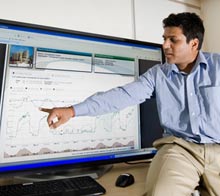
Energy saver: Yuvraj Agarwal
demonstrates the SleepServer control
software.
Credit: UC San Diego / Erik Jepsen


Agarwal's solution, developed with two UCSD professors, Stefan Savage and Rajesh Gupta, is to create a stripped down, virtual copy of a machine. Software running on a remote server maintains a version of a PC's operating systems and applications. The software, called SleepServer, carries on tasks on behalf of the desktop machine while it is put into a low-energy sleep mode.

This lets SleepServer perform basic tasks on behalf of the PC, such as downloading files or staying logged into voice communications or instant-messaging software. When more complex activity is required, the software wakes up the computer, says Agarwal, a process that typically takes less than 10 seconds.

"Normally if I put my computer to sleep, then Skype is going to show that I'm offline, or I won't be able to continue downloading a large file from the Internet," says Agarwal. SleepServer maintains a fast connection, over the internal network, to each desktop, so any files it has downloaded on behalf of a PC can be transferred quickly.

The energy savings come from the fact that each server can host up to 500 virtual machines. Even the latest low-power computers consume around 45 watts of power when idle. In contrast, a single SleepServer machine runs at just 300 watts, Agarwal says. Using fully functional virtual machines and low power "thin client" desktop machines could reduce power consumption further still.

In trials, details of which were presented at the USENIX Annual Technical Conference in Boston last week, 30 PCs used SleepServer for two weeks. The energy they consumed was dropped by between 27 and 86 percent--an average reduction of 60 percent, says Agarwal. With up to 80 percent of electricity consumption in modern offices coming from computing equipment, the savings a SleepServer offers could be roughly equivalent to $60 per computer each year, he says. Fifty PCs in the computer science building of UCSD are now running SleepServer.

Other software can be used to wake up sleeping computers, such as Apple's Wake-on Demand and Microsoft's Sleep Proxy. But these applications do not carry out tasks on behalf of a sleeping machine.

"It's a clever approach," says Howard Noble, principle investigator of the Low Carbon Information and Communication Technology Project, at the University of Oxford, in the U.K.

But Noble says it would be preferable to be able to power down computers completely. Modern computers can still consume as much as five watts when asleep. "We have never found it to be reliable, because often they don't stay asleep," he says.

Enhanced by Zemanta

Friday, March 27, 2009

Streaming games look to make consoles, PC upgrades obsolete


A screenshot of the OnLive ‘Arena’ of games

A new technology service called OnLive claims to have developed a way to stream video games over the Internet, without any lag that humans can notice.

The on-demand service would allow users to play games on any TV and nearly any personal computer – even stripped-down netbooks and PCs without graphics processors, said founder and chief executive Steve Perlman.

“When you want to play a game, you just click a button and it plays instantly. It’s that simple,” said Perlman. “So the instant you press a button to shoot something on the screen, the gun goes off.”

This has not been possible before, because unlike with music and movies – which can be compressed for easy online transfers before being streamed – video games are interactive and require instant responses.

OnLive’s technology gets around that limitation with a new form of compression that lets its game servers communicate with players over broadband connections in real time.

Thus, the service can also work on older computers, even those without a graphics processing unit – an essential component of gaming.

For a standard definition TV, a broadband connection of at least 1.5 megabits per second (mbps) is required. And for HDTV resolution, a connection of at least 5 mbps is needed.

Through a “MicroConsole” gadget, OnLive’s service will also be available for television sets.

In a demonstration on Tuesday at the Game Developers Conference in San Diego, Perlman played Crysis – a game notorious for its demanding graphical processing needs – on a TV set and on a Mac laptop through OnLive.

Leading game publishers, such as Electronic Arts, Take-Two and Eidos, have already signed on. OnLive has also incorporated social networking elements for multiplayer gaming, such as letting users share ‘brag clips’, which save the last 10 seconds of your game.

Perlman has a lot of confidence in OnLive: “It’s the last console you’ll need.”

If you like this post, buy me a beer at $3!
Reblog this post [with Zemanta]

Thursday, February 5, 2009

Google Latitude lets you track friends,kids


A new service on Google Maps, called Latitude, allows cellphone users to check their own location, as well as track their friends' whereabouts. The software, which can also be installed on a laptop or PC, plots a user's location - marked by a personal picture on the map - by relaying on cellphone towers, GPS or a Wi-Fi connection. As for privacy concerns, Latitude - functional in India lets the user decide who can monitor his location, and in how much detail.
Reblog this post [with Zemanta]