BTemplates.com

Powered by Blogger.

Pageviews past week

Quantum mechanics

Auto News

artificial intelligence

About Me

Recommend us on Google!

Information Technology

Popular Posts

Showing posts with label Electricity generation. Show all posts

Friday, September 23, 2011

Microwave Ovens a Key to Energy Production from Wasted Heat


More than 60 percent of the energy produced by cars, machines, and industry around the world is lost as waste heat -- an age-old problem -- but researchers have found a new way to make "thermoelectric" materials for use in technology that could potentially save vast amounts of energy.
Thermoelectric generation of electricity offers a way to recapture some of the enormous amounts of wasted energy lost during industrial activities. (Credit: Graphic courtesy of Oregon State University)

And it's based on a device found everywhere from kitchens to dorm rooms: a microwave oven.

Chemists at Oregon State University have discovered that simple microwave energy can be used to make a very promising group of compounds called "skutterudites," and lead to greatly improved methods of capturing wasted heat and turning it into useful electricity.

A tedious, complex and costly process to produce these materials that used to take three or four days can now be done in two minutes.

Most people are aware you're not supposed to put metal foil into a microwave, because it will spark. But powdered metals are different, and OSU scientists are tapping into that basic phenomenon to heat materials to 1,800 degrees in just a few minutes -- on purpose, and with hugely useful results.

These findings, published in Materials Research Bulletin, should speed research and ultimately provide a more commercially-useful, low-cost path to a future of thermoelectric energy.

"This is really quite fascinating," said Mas Subramanian, the Milton Harris Professor of Materials Science at OSU. "It's the first time we've ever used microwave technology to produce this class of materials."

Thermoelectric power generation, researchers say, is a way to produce electricity from waste heat -- something as basic as the hot exhaust from an automobile, or the wasted heat given off by a whirring machine. It's been known of for decades but never really used other than in niche applications, because it's too inefficient, costly and sometimes the materials needed are toxic. NASA has used some expensive and high-tech thermoelectric generators to produce electricity in outer space.

The problem of wasted energy is huge. A car, for instance, wastes about two-thirds of the energy it produces. Factories, machines and power plants discard enormous amounts of energy.

But the potential is also huge. A hybrid automobile that has both gasoline and electric engines, for instance, would be ideal to take advantage of thermoelectric generation to increase its efficiency. Heat that is now being wasted in the exhaust or vented by the radiator could instead be used to help power the car. Factories could become much more energy efficient, electric utilities could recapture energy from heat that's now going up a smokestack. Minor applications might even include a wrist watch operated by body heat.


"To address this, we need materials that are low cost, non-toxic and stable, and highly efficient at converting low-grade waste heat into electricity," Subramanian said. "In material science, that's almost like being a glass and a metal at the same time. It just isn't easy. Because of these obstacles almost nothing has been done commercially in large scale thermoelectric power generation."

Skutterudites have some of the needed properties, researchers say, but historically have been slow and difficult to make. The new findings cut that production time from days to minutes, and should not only speed research on these compounds but ultimately provide a more affordable way to produce them on a mass commercial scale.

OSU researchers have created skutterudites with microwave technology with an indium cobalt antimonite compound, and believe others are possible. They are continuing research, and believe that ultimately a range of different compounds may be needed for different applications of thermoelectric generation.

Collaborators on this study included Krishnendu Biswas, a post-doctoral researcher, and Sean Muir, a doctoral candidate, both in the OSU Department of Chemistry. The work has been supported by both the National Science Foundation and U.S. Department of Energy.

"We were surprised this worked so well," Subramanian said. "Right now large-scale thermoelectric generation of electricity is just a good idea that we couldn't make work. In the future it could be huge." 

Recommend this story on Facebook, Twitter, and Google +1

Saturday, September 3, 2011

Powering Gadgets a Step at a Time


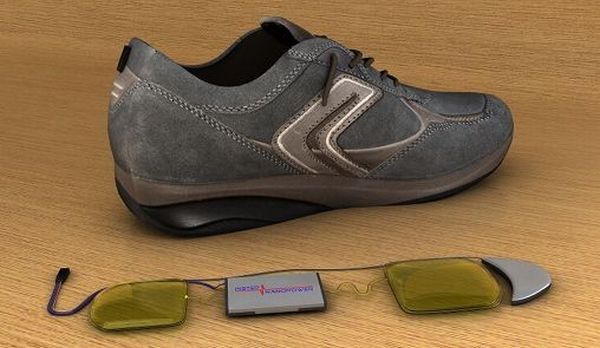
A microfluidics approach could be ideal for harnessing electricity from footsteps.

Power walk: An artist’s concept shows an energy-harvesting device based on a new microfluidics approach. The device could be embedded in ashoe sole.Credit: InStep NanoPower
A new way to harvest footfall energy could someday let shoes generate enough power to keep cell phones and laptops topped up.

University of Wisconsin-Madison researchers have come up with a microfluidics technique that scavenges considerably more energy from human footfalls and converts it into electric power. Previous attempts to make energy-harvesting shoes have yielded less than a watt of power, but the new approach could lead to a shoe-mounted generator that produces up to 10 watts, says Tom Krupenkin, a mechanical engineering professor who led the work.

"A lot of energy is simply wasted as heat while we walk," says Krupenkin. "If one can convert this into electrical energy, numbers come out to be up to 10 watts per foot." Cell phones and smart phones need about one to two watts, while small laptops need 10 to 12 watts. Power-generating shoes could be an important breakthrough for soldiers, who currently carry heavy batteries to power their radios, GPS units, and night-vision goggles.

Walking exerts a lot of force on the heel and toe, and cushioned soles can compress by about a centimeter with every step. Energy harvesters convert this force and displacement into electrical energy. The most promising approaches to tap into the human gait have involved piezoelectrics and electroactive polymers, materials that convert mechanical stress into electric power. But neither material works well with the relatively high displacements, but low frequency, of footfalls, Krupenkin says.


The new concept, presented in a Nature Communications paper, involves microscopic droplets of a conductive fluid flowing between electrodes coated with dielectric films. The droplets—the researchers used mercury or a gallium-based alloy called galistan—can be sandwiched between flat plates coated with the film or can be enclosed in a coated microchannel. When the area of overlap between the droplets and electrodes changes, an electric current is produced.

"It's a unique approach to energy harvesting," says Andrew Haughian, a partner at Vancouver, Canada-based venture capital firm Pangaea Ventures, which is evaluating the technology for potential investment. "The biggest opportunity I see would be in [developing countries], where the power grid is not reliable."

It might be years before you can buy a power-generating shoe, though. So far, the researchers have only made an array of 150 droplets that gives a few milliwatts of power. However, they calculate that a device with 1,000 droplets in a four-meter-long, one-millimeter-wide channel, which would cover an area of 40 square centimeters and fit in a shoe sole, could generate a few watts.

"The process is interesting, and the work itself is very good," says Paul Wright, a mechanical engineering professor at the University of California at Berkeley. However, he says, "to be useful to society, they would need to scale up the approach and show that it still works."

Krupenkin and his colleagues have established a startup, InStep NanoPower, to develop and possibly commercialize the technology. The company has a first-generation benchtop-sized prototype device. They expect the third generation harvester could be embedded in footwear. "This type of product will have to be a collaborative project between Instep and a shoe manufacturer," Krupenkin says. "We can't expect anything on the market earlier than two years."


Wednesday, August 3, 2011

Sun-Free Photovoltaics Powered by Heat


A new photovoltaic energy-conversion system developed at MIT can be powered solely by heat, generating electricity with no sunlight at all. While the principle involved is not new, a novel way of engineering the surface of a material to convert heat into precisely tuned wavelengths of light -- selected to match the wavelengths that photovoltaic cells can best convert to electricity -- makes the new system much more efficient than previous versions.
A variety of silicon chip micro-reactors developed by the MIT team. Each of these contains photonic crystals on both flat faces, with external tubes for injecting fuel and air and ejecting waste products. Inside the chip, the fuel and air react to heat up the photonic crystals. In use, these reactors would have a photovoltaic cell mounted against each face, with a tiny gap between, to convert the emitted wavelengths of light to electricity. (Credit: Photo by Justin Knight)

The key to this fine-tuned light emission, described in the journal Physical Review A, lies in a material with billions of nanoscale pits etched on its surface. When the material absorbs heat -- whether from the sun, a hydrocarbon fuel, a decaying radioisotope or any other source -- the pitted surface radiates energy primarily at these carefully chosen wavelengths.

Based on that technology, MIT researchers have made a button-sized power generator fueled by butane that can run three times longer than a lithium-ion battery of the same weight; the device can then be recharged instantly, just by snapping in a tiny cartridge of fresh fuel. Another device, powered by a radioisotope that steadily produces heat from radioactive decay, could generate electricity for 30 years without refueling or servicing -- an ideal source of electricity for spacecraft headed on long missions away from the sun.

According to the U.S. Energy Information Administration, 92 percent of all the energy we use involves converting heat into mechanical energy, and then often into electricity -- such as using fuel to boil water to turn a turbine, which is attached to a generator. But today's mechanical systems have relatively low efficiency, and can't be scaled down to the small sizes needed for devices such as sensors, smartphones or medical monitors.

"Being able to convert heat from various sources into electricity without moving parts would bring huge benefits," says Ivan Celanovic ScD '06, research engineer in MIT's Institute for Soldier Nanotechnologies (ISN), "especially if we could do it efficiently, relatively inexpensively and on a small scale."

It has long been known that photovoltaic (PV) cells needn't always run on sunlight. Half a century ago, researchers developed thermophotovoltaics (TPV), which couple a PV cell with any source of heat: A burning hydrocarbon, for example, heats up a material called the thermal emitter, which radiates heat and light onto the PV diode, generating electricity. The thermal emitter's radiation includes far more infrared wavelengths than occur in the solar spectrum, and "low band-gap" PV materials invented less than a decade ago can absorb more of that infrared radiation than standard silicon PVs can. But much of the heat is still wasted, so efficiencies remain relatively low.

An ideal match

The solution, Celanovic says, is to design a thermal emitter that radiates only the wavelengths that the PV diode can absorb and convert into electricity, while suppressing other wavelengths. "But how do we find a material that has this magical property of emitting only at the wavelengths that we want?" asks Marin Soljačić, professor of physics and ISN researcher. The answer: Make a photonic crystal by taking a sample of material and create some nanoscale features on its surface -- say, a regularly repeating pattern of holes or ridges -- so light propagates through the sample in a dramatically different way.


"By choosing how we design the nanostructure, we can create materials that have novel optical properties," Soljačić says. "This gives us the ability to control and manipulate the behavior of light."

The team -- which also includes Peter Bermel, research scientist in the Research Laboratory for Electronics (RLE); Peter Fisher, professor of physics; and Michael Ghebrebrhan, a postdoc in RLE -- used a slab of tungsten, engineering billions of tiny pits on its surface. When the slab heats up, it generates bright light with an altered emission spectrum because each pit acts as a resonator, capable of giving off radiation at only certain wavelengths.

This powerful approach -- co-developed by John D. Joannopoulos, the Francis Wright Davis Professor of Physics and ISN director, and others -- has been widely used to improve lasers, light-emitting diodes and even optical fibers. The MIT team, supported in part by a seed grant from the MIT Energy Initiative, is now working with collaborators at MIT and elsewhere to use it to create several novel electricity-generating devices.

Mike Waits, an electronics engineer at the Army Research Laboratory in Adelphi, Md., who was not involved in this work, says this approach to producing miniature power supplies could lead to lighter portable electronics, which is "critical for the soldier to lighten his load. It not only reduces his burden, but also reduces the logistics chain" to deliver those devices to the field. "There are a lot of lives at stake," he says, "so if you can make the power sources more efficient, it could be a great benefit."

The button-like device that uses hydrocarbon fuels such as butane or propane as its heat source -- known as a micro-TPV power generator -- has at its heart a "micro-reactor" designed by Klavs Jensen, the Warren K. Lewis Professor of Chemical Engineering, and fabricated in the Microsystems Technology Laboratories. While the device achieves a fuel-to-electricity conversion efficiency three times greater than that of a lithium-ion battery of the same size and weight, Celanovic is confident that with further work his team can triple the current energy density. "At that point, our TPV generator could power your smartphone for a whole week without being recharged," he says.

Celanovic and Soljačić stress that building practical systems requires integrating many technologies and fields of expertise. "It's a really multidisciplinary effort," Celanovic says. "And it's a neat example of how fundamental research in materials can result in new performance that enables a whole spectrum of applications for efficient energy conversion."

Note: The full version of the MITEI story is available at: http://web.mit.edu/mitei/research/spotlights/making-electricity-with-photovoltaics.html


Enhanced by Zemanta

Sunday, September 26, 2010

Mimicking Nature, Water-Based Artificial Leaf Produces Electricity


A team led by a North Carolina State University researcher has shown that water-gel-based solar devices -- "artificial leaves" -- can act like solar cells to produce electricity. The findings prove the concept for making solar cells that more closely mimic nature. They also have the potential to be less expensive and more environmentally friendly than the current standard-bearer: silicon-based solar cells.
Just as real leaves do, water-gel-based solar devices can act like solar cells to produce electricity, new research shows. (Credit: iStockphoto/Chaikovskiy Igor)

The bendable devices are composed of water-based gel infused with light-sensitive molecules -- the researchers used plant chlorophyll in one of the experiments -- coupled with electrodes coated by carbon materials, such as carbon nanotubes or graphite. The light-sensitive molecules get "excited" by the sun's rays to produce electricity, similar to plant molecules that get excited to synthesize sugars in order to grow, says NC State's Dr. Orlin Velev, Invista Professor of Chemical and Biomolecular Engineering and the lead author of a paper published online in the Journal of Materials Chemistry describing this new generation of solar cells.

Velev says that the research team hopes to "learn how to mimic the materials by which nature harnesses solar energy." Although synthetic light-sensitive molecules can be used, Velev says naturally derived products -- like chlorophyll -- are also easily integrated in these devices because of their water-gel matrix.

Now that they've proven the concept, Velev says the researchers will work to fine-tune the water-based photovoltaic devices, making them even more like real leaves.

"The next step is to mimic the self-regenerating mechanisms found in plants," Velev says. "The other challenge is to change the water-based gel and light-sensitive molecules to improve the efficiency of the solar cells."

Velev even imagines a future where roofs could be covered with soft sheets of similar electricity-generating artificial-leaf solar cells.

"We do not want to overpromise at this stage, as the devices are still of relatively low efficiency and there is a long way to go before this can become a practical technology," Velev says. "However, we believe that the concept of biologically inspired 'soft' devices for generating electricity may in the future provide an alternative for the present-day solid-state technologies."

Researchers from the Air Force Research Laboratory and Chung-Ang University in Korea co-authored the study. The study was funded by the Air Force Research Laboratory and the U.S. Department of Energy. The work is part of NC State's universitywide nanotechnology program, Nano@NC State.

NC State's Department of Chemical and Biomolecular Engineering is part of the university's College of Engineering.

Sunday, May 2, 2010

Renewable Energy: Inexpensive Metal Catalyst Can Effectively Generate Hydrogen from Water


Hydrogen would command a key role in future renewable energy technologies, experts agree, if a relatively cheap, efficient and carbon-neutral means of producing it can be developed. An important step towards this elusive goal has been taken by a team of researchers with the U.S. Department of Energy's (DOE) Lawrence Berkeley National Laboratory (Berkeley Lab) and the University of California, Berkeley. The team has discovered an inexpensive metal catalyst that can effectively generate hydrogen gas from water.

Me
From left, Jeffrey Long, Christopher Chang and 
Hemamala Karunadasa have discovered an inexpensive 
metal that can generate hydrogen from neutral water, 
even if it is dirty, and can operate in sea water. 
(Credit: Photo by Roy Kaltschmidt, Berkeley Lab Public Affairs)

"Our new proton reduction catalyst is based on a molybdenum-oxo metal complex that is about 70 times cheaper than platinum, today's most widely used metal catalyst for splitting the water molecule," said Hemamala Karunadasa, one of the co-discoverers of this complex. "In addition, our catalyst does not require organic additives, and can operate in neutral water, even if it is dirty, and can operate in sea water, the most abundant source of hydrogen on earth and a natural electrolyte. These qualities make our catalyst ideal for renewable energy and sustainable chemistry."

Karunadasa holds joint appointments with Berkeley Lab's Chemical Sciences Division and UC Berkeley's Chemistry Department. She is the lead author of a paper describing this work that appears in the April 29, 2010 issue of the journal Nature, titled "A molecular molybdenum-oxo catalyst for generating hydrogen from water." Co-authors of this paper were Christopher Chang and Jeffrey Long, who also hold joint appointments with Berkeley Lab and UC Berkeley. Chang, in addition, is also an investigator with the Howard Hughes Medical Institute (HHMI).

Hydrogen gas, whether combusted or used in fuel cells to generate electricity, emits only water vapor as an exhaust product, which is why this nation would already be rolling towards a hydrogen economy if only there were hydrogen wells to tap. However, hydrogen gas does not occur naturally and has to be produced. Most of the hydrogen gas in the United States today comes from natural gas, a fossil fuel. While inexpensive, this technique adds huge volumes of carbon emissions to the atmosphere. Hydrogen can also be produced through the electrolysis of water -- using electricity to split molecules of water into molecules of hydrogen and oxygen. This is an environmentally clean and sustainable method of production -- especially if the electricity is generated via a renewable technology such as solar or wind -- but requires a water-splitting catalyst.

Nature has developed extremely efficient water-splitting enzymes -- called hydrogenases -- for use by plants during photosynthesis, however, these enzymes are highly unstable and easily deactivated when removed from their native environment. Human activities demand a stable metal catalyst that can operate under non-biological settings.

Metal catalysts are commercially available, but they are low valence precious metals whose high costs make their widespread use prohibitive. For example, platinum, the best of them, costs some $2,000 an ounce.

"The basic scientific challenge has been to create earth-abundant molecular systems that produce hydrogen from water with high catalytic activity and stability," Chang says. "We believe our discovery of a molecular molybdenum-oxo catalyst for generating hydrogen from water without the use of additional acids or organic co-solvents establishes a new chemical paradigm for creating reduction catalysts that are highly active and robust in aqueous media."

The molybdenum-oxo complex that Karunadasa, Chang and Long discovered is a high valence metal with the chemical name of (PY5Me2)Mo-oxo. In their studies, the research team found that this complex catalyzes the generation of hydrogen from neutral buffered water or even sea water with a turnover frequency of 2.4 moles of hydrogen per mole of catalyst per second.

Long says, "This metal-oxo complex represents a distinct molecular motif for reduction catalysis that has high activity and stability in water. We are now focused on modifying the PY5Me ligand portion of the complex and investigating other metal complexes based on similar ligand platforms to further facilitate electrical charge-driven as well as light-driven catalytic processes. Our particular emphasis is on chemistry relevant to sustainable energy cycles."

This research was supported in part by the DOE Office of Science through Berkeley Lab's Helios Solar Energy Research Center, and in part by a grant from the National science Foundation.
Reblog this post [with Zemanta]