BTemplates.com

Powered by Blogger.

Pageviews past week

Quantum mechanics

Auto News

artificial intelligence

About Me

Recommend us on Google!

Information Technology

Popular Posts

Showing posts with label University of Wisconsin–Madison. Show all posts

Saturday, September 3, 2011

Powering Gadgets a Step at a Time


A microfluidics approach could be ideal for harnessing electricity from footsteps.
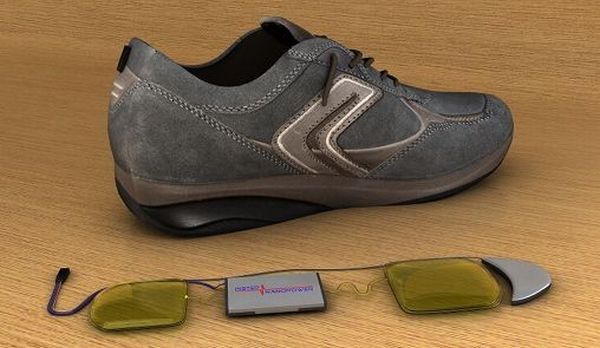
Power walk: An artist’s concept shows an energy-harvesting device based on a new microfluidics approach. The device could be embedded in ashoe sole.Credit: InStep NanoPower
A new way to harvest footfall energy could someday let shoes generate enough power to keep cell phones and laptops topped up.

University of Wisconsin-Madison researchers have come up with a microfluidics technique that scavenges considerably more energy from human footfalls and converts it into electric power. Previous attempts to make energy-harvesting shoes have yielded less than a watt of power, but the new approach could lead to a shoe-mounted generator that produces up to 10 watts, says Tom Krupenkin, a mechanical engineering professor who led the work.

"A lot of energy is simply wasted as heat while we walk," says Krupenkin. "If one can convert this into electrical energy, numbers come out to be up to 10 watts per foot." Cell phones and smart phones need about one to two watts, while small laptops need 10 to 12 watts. Power-generating shoes could be an important breakthrough for soldiers, who currently carry heavy batteries to power their radios, GPS units, and night-vision goggles.

Walking exerts a lot of force on the heel and toe, and cushioned soles can compress by about a centimeter with every step. Energy harvesters convert this force and displacement into electrical energy. The most promising approaches to tap into the human gait have involved piezoelectrics and electroactive polymers, materials that convert mechanical stress into electric power. But neither material works well with the relatively high displacements, but low frequency, of footfalls, Krupenkin says.


The new concept, presented in a Nature Communications paper, involves microscopic droplets of a conductive fluid flowing between electrodes coated with dielectric films. The droplets—the researchers used mercury or a gallium-based alloy called galistan—can be sandwiched between flat plates coated with the film or can be enclosed in a coated microchannel. When the area of overlap between the droplets and electrodes changes, an electric current is produced.

"It's a unique approach to energy harvesting," says Andrew Haughian, a partner at Vancouver, Canada-based venture capital firm Pangaea Ventures, which is evaluating the technology for potential investment. "The biggest opportunity I see would be in [developing countries], where the power grid is not reliable."

It might be years before you can buy a power-generating shoe, though. So far, the researchers have only made an array of 150 droplets that gives a few milliwatts of power. However, they calculate that a device with 1,000 droplets in a four-meter-long, one-millimeter-wide channel, which would cover an area of 40 square centimeters and fit in a shoe sole, could generate a few watts.

"The process is interesting, and the work itself is very good," says Paul Wright, a mechanical engineering professor at the University of California at Berkeley. However, he says, "to be useful to society, they would need to scale up the approach and show that it still works."

Krupenkin and his colleagues have established a startup, InStep NanoPower, to develop and possibly commercialize the technology. The company has a first-generation benchtop-sized prototype device. They expect the third generation harvester could be embedded in footwear. "This type of product will have to be a collaborative project between Instep and a shoe manufacturer," Krupenkin says. "We can't expect anything on the market earlier than two years."


Thursday, October 14, 2010

Large Study Shows : Females Are Equal to Males in Math Skills


The mathematical skills of boys and girls, as well as men and women, are substantially equal, according to a new examination of existing studies in the current online edition of journal Psychological Bulletin.
Young women studying mathematics. The mathematical skills of boys and girls, as well as men and women, are substantially equal, according to a new examination of existing studies.

One portion of the new study looked systematically at 242 articles that assessed the math skills of 1,286,350 people, says chief author Janet Hyde, a professor of psychology and women's studies at the University of Wisconsin-Madison.

These studies, all published in English between 1990 and 2007, looked at people from grade school to college and beyond. A second portion of the new study examined the results of several large, long-term scientific studies, including the National Assessment of Educational Progress.

In both cases, Hyde says, the difference between the two sexes was so close as to be meaningless.

Sara Lindberg, now a postdoctoral fellow in women's health at the UW-Madison School of Medicine and Public Health, was the primary author of the meta-analysis in Psychological Bulletin.

The idea that both genders have equal math abilities is widely accepted among social scientists, Hyde adds, but word has been slow to reach teachers and parents, who can play a negative role by guiding girls away from math-heavy sciences and engineering. "One reason I am still spending time on this is because parents and teachers continue to hold stereotypes that boys are better in math, and that can have a tremendous impact on individual girls who are told to stay away from engineering or the physical sciences because 'Girls can't do the math.'"

Scientists now know that stereotypes affect performance, Hyde adds. "There is lots of evidence that what we call 'stereotype threat' can hold women back in math. If, before a test, you imply that the women should expect to do a little worse than the men, that hurts performance. It's a self-fulfilling prophecy.

"Parents and teachers give little implicit messages about how good they expect kids to be at different subjects," Hyde adds, "and that powerfully affects their self-concept of their ability. When you are deciding about a major in physics, this can become a huge factor."

Hyde hopes the new results will slow the trend toward single-sex schools, which are sometimes justified on the basis of differential math skills. It may also affect standardized tests, which gained clout with the passage of No Child Left Behind, and tend to emphasize lower-level math skills such as multiplication, Hyde says. "High-stakes testing really needs to include higher-level problem-solving, which tends to be more important in jobs that require math skills. But because many teachers teach to the test, they will not teach higher reasoning unless the tests start to include it."

The new findings reinforce a recent study that ranked gender dead last among nine factors, including parental education, family income, and school effectiveness, in influencing the math performance of 10-year-olds.

Hyde acknowledges that women have made significant advances in technical fields. Half of medical school students are female, as are 48 percent of undergraduate math majors. "If women can't do math, how are they getting these majors?" she asks.

Because progress in physics and engineering is much slower, "we have lots of work to do," Hyde says. "This persistent stereotyping disadvantages girls. My message to parents is that they should have confidence in their daughter's math performance. They need to realize that women can do math just as well as men. These changes will encourage women to pursue occupations that require lots of math."

Editor's Note: This article is not intended to provide medical advice, diagnosis or treatment.