BTemplates.com

Powered by Blogger.

Pageviews past week

Quantum mechanics

Auto News

artificial intelligence

About Me

Recommend us on Google!

Information Technology

Popular Posts

Showing posts with label University of Oxford. Show all posts

Thursday, July 7, 2011

Ultrafast switch for superconductors


A high-temperature superconductor can now be switched on and off within a trillionth of a second – 100 years after the discovery of superconductivity and 25 years after the first high-temperature superconductor was. A team including physicists from the University of Oxford and the Max Planck Research Group for Structural Dynamics at the University of Hamburg has realised an ultrafast superconducting switch by using intense terahertz pulses. This experiment opens up the possibility to discover more about the still unsettled cause of this type of superconductivity, and also hints at possible applications for ultrafast electronics in the future.
The superconducting transport between the layers of a cuprate crystal (three layers, red and blue spheres represent the oxygen and copper atoms respectively) is controlled with an ultrashort terahertz pulse (yellow in the background). The three-dimensional superconductivity can thus be switched on and off very quickly (orange spheres represent electrons). © J.M. Harms, Max Planck Research Group for Structural Dynamics

Superconductivity is one of the most remarkable effects in physics. Every electrical conductor has a resistivity, but some materials lose their resistivity completely if they are cooled to below a characteristic temperature; the current then flows without any loss whatsoever. When the Dutch physicist Heike Kamerlingh Onnes discovered this effect in 1911 in mercury, he initially believed that his measuring instruments were faulty, before he became aware of the significance of his monumental discovery.

“Normal” conductors such as mercury or lead must be cooled down to temperatures near absolute zero at minus 273.16 degrees Celsius in order to become superconducting. It was therefore a sensation when, in 1986, Johannes Georg Bednorz and Karl Alexander Müller presented a ceramic material that already became superconducting at minus 248 degrees Celsius. Since then, these cold conductors have been a burning issue with both scientists working in basic research and users. The ultrafast switch, which has now been developed by the research group working with Andrea Cavalleri, head of the Max Planck Research Group for Structural Dynamics at the University of Hamburg, is a further astonishing discovery in this field.

The high-temperature superconductor used by the Hamburg scientists has been known for a long time. It is a crystal based on lanthanum cuprate (La2CuO4) to which a specific quantity of strontium has been added (La1,84Sr0,16CuO4). Its transition temperature is minus 233 degrees Celsius. Although it is not yet completely clear how the superconductivity arises here, essential elements are known: “The crystal is formed by copper-oxygen planes which lie on top of each other like the pages of a book,” explains Cavalleri. The electrons can only move within these planes; the current transport therefore only occurs in two dimensions.

If the material is cooled below 40 Kelvin, a link is suddenly created between these two planes. Physicists explain this using the wave model, according to which the electrons are pictured not as particles, but as waves. Below the transition temperature the electrons from neighbouring planes overlap, and this allows the electric charge carriers to change from one plane to the other. Current is suddenly transported in all three spatial dimensions: the superconducting state has been created.

A terahertz pulse briefly destroys the coupling of the electrons
Cavalleri and his colleagues then wanted to know whether this transport between the layers can be deliberately interrupted and switched on again. In theory this is possible if a very strong electric field is applied at right angles to the layers. However, applying such a field is impractical. “This causes the crystal to heat upand the superconductivity collapses,” explains Cavalleri. The solution was to send in an ultrashort pulse of light to manipulate the superconductor.


This so-called terahertz pulse is an electromagnetic wave, similar to light, but with a much longer wavelength. It has an electric field that briefly destroys the coupling of the electron waves between the planes when it penetrates into the crystal. This is only successful if the electric field strength of the pulse is very high, in the order of several ten thousand volts per centimetre. And it must be short enough that it does not heat up the crystal.

Only recently has it been possible to generate such extremely powerful, ultrashort terahertz pulses. This is the task of team member Matthias Hoffmann. In very simple terms, this is done by the interaction of an ultrashort laser pulse with a lithium niobate crystal. An effect which physicists call optical rectification then generates the desired terahertz radiation in the crystal.

The experiment, which Andreas Dienst designed and carried out in Oxford, succeeded as anticipated: for the short time of less than one picosecond (10-12 seconds) as the pulse interacts with the superconductor, the coupling between the planes, and thus the superconductivity, was interrupted before subsequently returning. The superconductor does not suffer in this process and can be switched as often as one likes.

“This is a very fascinating result, because we can also use this method to investigate how high-temperature superconductors work,” says Cavalleri. It is also possible that this effect additionally has real-world applications. Basically, the switchable high-temperature superconductor works in a very similar way to a conventional field-effect transistor. This is a semiconductor whose ability to pass a current can be controlled by applying an electric voltage. Analogous to this, is conceivable that the high-temperature superconductor could be used as an ultrafast, nanoelectronic transistor that is controlled by microwaves.

More information: A. Dienst, M. Hoffmann, D. Fausti, J. Petersen, S. Pyon, T. Takayama, H. Takagi, A. Cavalleri, Bi-directional ultrafast electric-field gating of interlayer charge transport in a cuprate superconductor, Nature Photonics, adv. Online public., 26. Juni 2011, DOI: 10.1038/NPHOTON.2011.124

Provided by Max-Planck-Gesellschaft

Sunday, June 12, 2011

3-D movie shows, for the first time, what happens in the brain as it loses consciousness


For the first time researchers have been able to watch what happens to the brain as it loses consciousness. Using sophisticated imaging equipment they have constructed a 3-D movie of the brain as it changes while an anaesthetic drug takes effect.

Brian Pollard, Professor of Anaesthesia at The University of Manchester (UK), will tell the European Anaesthesiology Congress in Amsterdam that the real-time 3-D images seemed to show that losing consciousness involves a change in electrical activity deep within the brain, changing the activity of certain groups of nerve cells (neurons) and hindering communication between different parts of the brain.

He said the findings appear to support a hypothesis put forward by Professor Susan Greenfield, of the University of Oxford, about the nature of consciousness itself. Prof Greenfield suggests consciousness is formed by different groups of brain cells (neural assemblies), which work efficiently together, or not, depending on the available sensory stimulations, and that consciousness is not an all-or-none state but more like a dimmer switch, changing according to growth, mood or drugs. When someone is anaesthetised it appears that small neural assemblies either work less well together or inhibit communication with other neural assemblies.

"Our findings suggest that unconsciousness may be the increase of inhibitory assemblies across the brain's cortex. These findings lend support to Greenfield's hypothesis of neural assemblies forming consciousness," said Prof Pollard.

The team use an entirely new imaging method called "functional electrical impedance tomography by evoked response" (fEITER *), which enables high speed imaging and monitoring of electrical activity deep within the brain and is designed to enable researchers to measure brain function.

The new device was developed by a multidisciplinary team drawn from the Schools of Medicine and Electrical and Electronic Engineering at The University of Manchester (UK) led by Professor Hugh McCann and with support from a Wellcome Trust Translation Award.

The machine itself is a portable, light-weight monitor, which can fit on a small trolley. It has 32 electrodes that are fitted around the patient's head. A small, high-frequency electric current (too small to be felt or have any effect) is passed between two of the electrodes, and the voltages between other pairs of electrodes are measured in a process that takes less than one thousandth of a second.

An "electronic scan" is thus carried out and the machine does this whole procedure 100 times a second. By measuring the resistance to current flow (electrical impedance), a cross sectional image of the changing electrical conductivity within the brain is constructed. This is thought to reflect the amount of electrical activity in different parts of the brain. The speed of the response of fEITER is such that the evoked response of the brain to external stimuli, such as an anaesthetic drug, can be captured in rapid succession as different parts of the brain respond, thus tracking the brain's processing activity.

"We have looked at 20 healthy volunteers and are now looking at 20 anaesthetised patients scheduled for surgery," said Prof Pollard. "We are able to see 3-D images of the brain's conductivity change, and those where the patient is becoming anaesthetised are most interesting."

"We have been able to see a real time loss of consciousness in anatomically distinct regions of the brain for the first time. We are currently working on trying to interpret the changes that we have observed. We still do not know exactly what happens within the brain as unconsciousness occurs, but this is another step in the direction of understanding the brain and its functions."

The team at Manchester is one of many worldwide teams investigating electrical impedance tomography (EIT), but this is its first application to anaesthesia. Prof Pollard said that a huge amount of research still needed to be done to fully understand the role EIT could play in medicine.

"If its power can be harnessed, then it has the potential to make a huge impact on many areas of imaging in medicine. It should help us to better understand anaesthesia, sedation and unconsciousness, although its place in medicine is more likely to be in diagnosing changes to the brain that occur as a result of, for example, head injury, stroke and dementia.

"The biggest hurdle is working out what we are seeing and exactly what it means, and this will be an ongoing challenge," he concluded.

Provided by European Society of Anaesthesiology
Enhanced by Zemanta

Thursday, July 1, 2010

PCs that Work While They Sleep


SleepServer creates a virtual copy of a dozing machine.

Software that lets desktop computers continue to function in sleep mode could reduce the energy consumption of office networks by around 60 percent.

Networked PCs are increasingly being left on 24/7 to allow for out-of-hours access by employees, says Yuvraj Agarwal, at the University of California, San Diego. "The administrator may want to do a backup, or the user may want to be able to connect into it," he says. But most of the time these PCs remain idle, wasting significant amounts of energy, he says.

Image
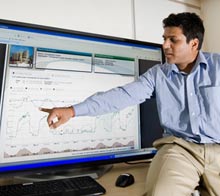
Energy saver: Yuvraj Agarwal
demonstrates the SleepServer control
software.
Credit: UC San Diego / Erik Jepsen


Agarwal's solution, developed with two UCSD professors, Stefan Savage and Rajesh Gupta, is to create a stripped down, virtual copy of a machine. Software running on a remote server maintains a version of a PC's operating systems and applications. The software, called SleepServer, carries on tasks on behalf of the desktop machine while it is put into a low-energy sleep mode.

This lets SleepServer perform basic tasks on behalf of the PC, such as downloading files or staying logged into voice communications or instant-messaging software. When more complex activity is required, the software wakes up the computer, says Agarwal, a process that typically takes less than 10 seconds.

"Normally if I put my computer to sleep, then Skype is going to show that I'm offline, or I won't be able to continue downloading a large file from the Internet," says Agarwal. SleepServer maintains a fast connection, over the internal network, to each desktop, so any files it has downloaded on behalf of a PC can be transferred quickly.

The energy savings come from the fact that each server can host up to 500 virtual machines. Even the latest low-power computers consume around 45 watts of power when idle. In contrast, a single SleepServer machine runs at just 300 watts, Agarwal says. Using fully functional virtual machines and low power "thin client" desktop machines could reduce power consumption further still.

In trials, details of which were presented at the USENIX Annual Technical Conference in Boston last week, 30 PCs used SleepServer for two weeks. The energy they consumed was dropped by between 27 and 86 percent--an average reduction of 60 percent, says Agarwal. With up to 80 percent of electricity consumption in modern offices coming from computing equipment, the savings a SleepServer offers could be roughly equivalent to $60 per computer each year, he says. Fifty PCs in the computer science building of UCSD are now running SleepServer.

Other software can be used to wake up sleeping computers, such as Apple's Wake-on Demand and Microsoft's Sleep Proxy. But these applications do not carry out tasks on behalf of a sleeping machine.

"It's a clever approach," says Howard Noble, principle investigator of the Low Carbon Information and Communication Technology Project, at the University of Oxford, in the U.K.

But Noble says it would be preferable to be able to power down computers completely. Modern computers can still consume as much as five watts when asleep. "We have never found it to be reliable, because often they don't stay asleep," he says.

Enhanced by Zemanta