BTemplates.com

Powered by Blogger.

Pageviews past week

Quantum mechanics

Auto News

artificial intelligence

About Me

Recommend us on Google!

Information Technology

Popular Posts

Showing posts with label Lithium-ion battery. Show all posts

Thursday, November 17, 2011

Better Batteries: New Technology Improves Both Energy Capacity and Charge Rate in Rechargeable Batteries


Imagine a cellphone battery that stayed charged for more than a week and recharged in just 15 minutes. That dream battery could be closer to reality thanks to Northwestern University research.
New research could lead to rechargeable lithium-ion
batteries that hold a charge up to 10 times greater than
current technology and that charge 10 times faster than
current batteries. (Credit: © janaka Dharmasena / Fotolia)

A team of engineers has created an electrode for lithium-ion batteries -- rechargeable batteries such as those found in cellphones and iPods -- that allows the batteries to hold a charge up to 10 times greater than current technology. Batteries with the new electrode also can charge 10 times faster than current batteries.

The researchers combined two chemical engineering approaches to address two major battery limitations -- energy capacity and charge rate -- in one fell swoop. In addition to better batteries for cellphones and iPods, the technology could pave the way for more efficient, smaller batteries for electric cars.

The technology could be seen in the marketplace in the next three to five years, the researchers said.

A paper describing the research is published by the journal Advanced Energy Materials.

"We have found a way to extend a new lithium-ion battery's charge life by 10 times," said Harold H. Kung, lead author of the paper. "Even after 150 charges, which would be one year or more of operation, the battery is still five times more effective than lithium-ion batteries on the market today."

Kung is professor of chemical and biological engineering in the McCormick School of Engineering and Applied Science. He also is a Dorothy Ann and Clarence L. Ver Steeg Distinguished Research Fellow.

Lithium-ion batteries charge through a chemical reaction in which lithium ions are sent between two ends of the battery, the anode and the cathode. As energy in the battery is used, the lithium ions travel from the anode, through the electrolyte, and to the cathode; as the battery is recharged, they travel in the reverse direction.

With current technology, the performance of a lithium-ion battery is limited in two ways. Its energy capacity -- how long a battery can maintain its charge -- is limited by the charge density, or how many lithium ions can be packed into the anode or cathode. Meanwhile, a battery's charge rate -- the speed at which it recharges -- is limited by another factor: the speed at which the lithium ions can make their way from the electrolyte into the anode.

In current rechargeable batteries, the anode -- made of layer upon layer of carbon-based graphene sheets -- can only accommodate one lithium atom for every six carbon atoms. To increase energy capacity, scientists have previously experimented with replacing the carbon with silicon, as silicon can accommodate much more lithium: four lithium atoms for every silicon atom. However, silicon expands and contracts dramatically in the charging process, causing fragmentation and losing its charge capacity rapidly.

Currently, the speed of a battery's charge rate is hindered by the shape of the graphene sheets: they are extremely thin -- just one carbon atom thick -- but by comparison, very long. During the charging process, a lithium ion must travel all the way to the outer edges of the graphene sheet before entering and coming to rest between the sheets. And because it takes so long for lithium to travel to the middle of the graphene sheet, a sort of ionic traffic jam occurs around the edges of the material.

Now, Kung's research team has combined two techniques to combat both these problems. First, to stabilize the silicon in order to maintain maximum charge capacity, they sandwiched clusters of silicon between the graphene sheets. This allowed for a greater number of lithium atoms in the electrode while utilizing the flexibility of graphene sheets to accommodate the volume changes of silicon during use.

"Now we almost have the best of both worlds," Kung said. "We have much higher energy density because of the silicon, and the sandwiching reduces the capacity loss caused by the silicon expanding and contracting. Even if the silicon clusters break up, the silicon won't be lost."

Kung's team also used a chemical oxidation process to create miniscule holes (10 to 20 nanometers) in the graphene sheets -- termed "in-plane defects" -- so the lithium ions would have a "shortcut" into the anode and be stored there by reaction with silicon. This reduced the time it takes the battery to recharge by up to 10 times.

This research was all focused on the anode; next, the researchers will begin studying changes in the cathode that could further increase effectiveness of the batteries. They also will look into developing an electrolyte system that will allow the battery to automatically and reversibly shut off at high temperatures -- a safety mechanism that could prove vital in electric car applications.

The Energy Frontier Research Center program of the U.S. Department of Energy, Basic Energy Sciences, supported the research.

The paper is titled "In-Plane Vacancy-Enabled High-Power Si-Graphene Composite Electrode for Lithium-Ion Batteries." Other authors of the paper are Xin Zhao, Cary M. Hayner and Mayfair C. Kung, all from Northwestern.
Monday, April 5, 2010

Significant Step Toward Lightweight Batteries


A team of researchers at MIT has made significant progress on a technology that could lead to batteries with up to three times the energy density of any battery that currently exists.

Yang Shao-Horn, an MIT associate professor of mechanical engineering and materials science and engineering, says that many groups have been pursuing work on lithium-air batteries, a technology that has great potential for achieving great gains in energy density. But there has been a lack of understanding of what kinds of electrode materials could promote the electrochemical reactions that take place in these batteries.
Me
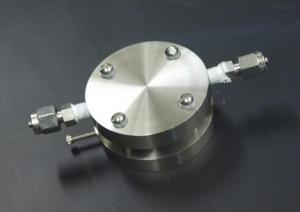
Test battery has inlet and outlet on the sides to provide 
a flow of air,providing oxygen for the battery's operation.
Photo: (Credit: Patrick Gillooly/MIT)


Lithium-oxygen (also known as lithium-air) batteries are similar in principle to the lithium-ion batteries that now dominate the field of portable electronics and are a leading contender for electric vehicles. But because lithium-air batteries replace the heavy conventional compounds in such batteries with a carbon-based air electrode and flow of air, the batteries themselves can be much lighter. That's why leading companies, including IBM and General Motors, have committed to major research initiatives on lithium-air technology.

In a paper published this week in the journal Electrochemical and Solid-State Letters, Shao-Horn, along with some of her students and visiting professor Hubert Gasteiger, reported on a study showing that electrodes with gold or platinum as a catalyst show a much higher level of activity and thus a higher efficiency than simple carbon electrodes in these batteries. In addition, this new work sets the stage for further research that could lead to even better electrode materials, perhaps alloys of gold and platinum or other metals, or metallic oxides, and to less expensive alternatives.

Doctoral student Yi-Chun Lu, lead author of the paper, explains that this team has developed a method for analyzing the activity of different catalysts in the batteries, and now they can build on this research to study a variety of possible materials. "We'll look at different materials, and look at the trends," she says. "Such research could allow us to identify the physical parameters that govern the catalyst activity. Ultimately, we will be able to predict the catalyst behaviors. "

Lightweight batteries that can deliver lots of energy are crucial for a variety of applications -- for example, improving the range of electric cars. For that reason, even modest increases in a battery's energy-density rating -- a measure of the amount of energy that can be delivered for a given weight -- are important advances.

One issue to be dealt with in developing a battery system that could be widely commercialized is safety. Lithium in metallic form, which is used in lithium-air batteries, is highly reactive in the presence of even minuscule amounts of water. This is not an issue in current lithium-ion batteries because carbon-based materials are used for the negative electrode. Shao-Horn says the same battery principle can be applied without the need to use metallic lithium; graphite or some other more stable negative electrode materials could be used instead, she says, leading to a safer system.

A number of issues must be addressed before lithium-air batteries can become a practical commercial product, she says. The biggest issue is developing a system that keeps its power through a sufficient number of charging and discharging cycles for it to be useful in vehicles or electronic devices.

Researchers also need to look into details of the chemistry of the charging and discharging processes, to see what compounds are produced and where, and how they react with other compounds in the system. "We're at the very beginning" of understanding exactly how these reactions occur, Shao-Horn says.

Gholam-Abbas Nazri, a researcher at the GM Research & Development Center in Michigan, calls this research "interesting and important," and says this addresses a significant bottleneck in the development of this technology: the need find an efficient catalyst. This work is "in the right direction for further understanding of the role of catalysts," and it "may significantly contribute to the further understanding and future development of lithium-air systems," he says.

While some companies working on lithium-air batteries have said they see it as a 10-year development program, Shao-Horn says it is too early to predict how long it may take to reach commercialization. "It's a very promising area, but there are many science and engineering challenges to be overcome," she says. "If it truly demonstrates two to three times the energy density" of today's lithium-ion batteries, she says, the likely first applications will be in portable electronics such as computers and cell phones, which are high-value items, and only later would be applied to vehicles once the costs are reduced.

Funding was provided by the Department of Energy, with additional support from the Martin Family Society of Fellows for Sustainability and the National Science Foundation.
Reblog this post [with Zemanta]

Friday, January 1, 2010

Lithium-Air Batteries might Displace Gasoline in Future Cars


Inside surplus of seven million barrels of gasoline are consumed by vehicles in the United States each time. Equally scientists rush to discover environmentally sound solutions to fuel the world's ever-growing moving needs, battery researchers are exploring the look good of lithium-air battery equipment.

Argonne researcher Lynn Trahey tons a coin-sized cell on a trying thing used to evaluate electrochemical cycling performance in batteries. (Credit: Photo by Wes Agresta / Courtesy of Argonne National Laboratory)

Li-air batteries aid a catalytic air cathode with the intention of equipment oxygen, an electrolyte and a lithium anode. The equipment has the the makings to pile almost as much energy as a tank of gasoline, and will be inflicted with a room pro energy storage space with the intention of is five to 10 era greater than with the intention of of Li-ion batteries, a join equipment. That the makings, however, will not be realized until vital methodical challenges be inflicted with been solved.

Monday, November 30, 2009

Solar Power from Your Windows, Awnings, Even Clothing?


On a 104-degree Friday in July when sunlight bathed The University of Arizona campus, doctoral student Dio Placencia sat before a noisy vacuum chamber in the Chemical Sciences Building trying to advance the renewable energy revolution.

 An organic photovoltaic cell on glass. The goal for UA scientists is to understand and control the interfaces in these devices at nanometer-length scales (less than 1/100,000 the
thickness of a human hair) to enable the development of long-lived solar energy 
conversion devices on tough, flexible and extremely low-cost plastic substrates. 
(Credit: Image courtesy of University of Arizona)

As a member of UA professor Neal R. Armstrong's research group, Placencia conducts research aimed at creating a thin, flexible organic solar cell that could power a tent or keep a car charged between trips to work and back home again.

Monday, June 8, 2009

A cheaper, lighter and longer-lasting alternative to modern batteries


MOBILE phones looked like bricks in the 1980s. Indeed, they were so cumbersome that most were installed in cars. That was because the batteries required to power them were so hefty. When lithium-ion batteries were invented, mobile phones became small enough to be carried in a pocket or slipped into a handbag. Now a new design of battery that uses oxygen from ambient air to power devices could provide even smaller and lighter sources of power. Not only that, such batteries would be cheaper and last for longer between charges.


Lithium-ion batteries have two electrodes immersed in an electrically conductive solution, called an electrolyte. One of the electrodes, the cathode, is made of lithium cobalt oxide; the other, the anode, is composed of carbon. When the battery is being charged, positively charged lithium ions break away from the cathode and travel in the electrolyte to the anode, where they meet electrons brought there by a charging device. When electricity is needed, the anode releases the lithium ions, which rapidly move back to the cathode. As they do so, the electrons that were paired with them in the anode during the charging process are released. These electrons travel around an external circuit to which the battery is attached and power it.


Peter Bruce and his colleagues at the University of St Andrews in Scotland came up with the idea of replacing the lithium cobalt oxide electrode with a cheaper and lighter alternative. They designed an electrode made from porous carbon and lithium oxide. They knew that lithium oxide forms naturally from lithium ions, electrons and oxygen, but, to their surprise, they found that it could also be made to separate easily when an electric current passed through it. They exposed one side of their porous carbon electrode to an electrolyte rich in lithium ions and put a mesh window on the other side of the electrode through which air could be drawn. Oxygen from the air took the place of the cobalt oxide.


When they charged their battery, the lithium ions migrated to the anode where they combined with electrons from the charging device. When they discharged it, lithium ions and electrons were released from the anode. The ions crossed the electrolyte and the electrons travelled round the external circuit. The ions and electrons then met at the cathode, where they combined with the oxygen to form lithium oxide that filled the pores in the carbon.


Because the oxygen being used by the battery comes from the surrounding air rather than having to be carried around inside the battery, the device that Dr Bruce’s team has designed can be a mere one-eighth to one-tenth the size and weight of modern batteries, while still carrying the same charge. Alternatively, batteries using the new technology would last eight to ten times longer than modern batteries of the same size.


Performance and size are not the only expected improvements. Although they are not yet commercially available, making such a battery is expected to be cheaper. Lithium cobalt oxide accounts for 30% of the cost of a lithium-ion battery. Air, however, is free.


If you like this post, buy me a beer at $3!
Reblog this post [with Zemanta]

Friday, April 3, 2009

Virus-built Battery Could Power Cars, Electronic Devices


Angela Belcher holds a display of the virus-built battery she helped engineer. The battery -- the silver-colored disc -- is being used to power an LED. (Credit: Photo by Donna Coveney)

For the first time, MIT researchers have shown they can genetically engineer viruses to build both the positively and negatively charged ends of a lithium-ion battery.

The new virus-produced batteries have the same energy capacity and power performance as state-of-the-art rechargeable batteries being considered to power plug-in hybrid cars, and they could also be used to power a range of personal electronic devices, said Angela Belcher, the MIT materials scientist who led the research team.


The new batteries, described in the April 2 online edition of Science, could be manufactured with a cheap and environmentally benign process: The synthesis takes place at and below room temperature and requires no harmful organic solvents, and the materials that go into the battery are non-toxic.


In a traditional lithium-ion battery, lithium ions flow between a negatively charged anode, usually graphite, and the positively charged cathode, usually cobalt oxide or lithium iron phosphate. Three years ago, an MIT team led by Belcher reported that it had engineered viruses that could build an anode by coating themselves with cobalt oxide and gold and self-assembling to form a nanowire.


In the latest work, the team focused on building a highly powerful cathode to pair up with the anode, said Belcher, the Germeshausen Professor of Materials Science and Engineering and Biological Engineering. Cathodes are more difficult to build than anodes because they must be highly conducting to be a fast electrode, however, most candidate materials for cathodes are highly insulating (non-conductive).


To achieve that, the researchers, including MIT Professor Gerbrand Ceder of materials science and Associate Professor Michael Strano of chemical engineering, genetically engineered viruses that first coat themselves with iron phosphate, then grab hold of carbon nanotubes to create a network of highly conductive material.


Because the viruses recognize and bind specifically to certain materials (carbon nanotubes in this case), each iron phosphate nanowire can be electrically "wired" to conducting carbon nanotube networks. Electrons can travel along the carbon nanotube networks, percolating throughout the electrodes to the iron phosphate and transferring energy in a very short time.


The viruses are a common bacteriophage, which infect bacteria but are harmless to humans.


The team found that incorporating carbon nanotubes increases the cathode's conductivity without adding too much weight to the battery. In lab tests, batteries with the new cathode material could be charged and discharged at least 100 times without losing any capacitance. That is fewer charge cycles than currently available lithium-ion batteries, but "we expect them to be able to go much longer," Belcher said.


The prototype is packaged as a typical coin cell battery, but the technology allows for the assembly of very lightweight, flexible and conformable batteries that can take the shape of their container.


Last week, MIT President Susan Hockfield took the prototype battery to a press briefing at the White House where she and U.S. President Barack Obama spoke about the need for federal funding to advance new clean-energy technologies.


Now that the researchers have demonstrated they can wire virus batteries at the nanoscale, they intend to pursue even better batteries using materials with higher voltage and capacitance, such as manganese phosphate and nickel phosphate, said Belcher. Once that next generation is ready, the technology could go into commercial production, she said.


Lead authors of the Science paper are Yun Jung Lee and Hyunjung Yi, graduate students in materials science and engineering. Other authors are Woo-Jae Kim, postdoctoral fellow in chemical engineering; Kisuk Kang, recent MIT PhD recipient in materials science and engineering; and Dong Soo Yun, research engineer in materials science and engineering.


The research was funded by the Army Research Office Institute of the Institute of Collaborative Technologies, and the National Science Foundation through the Materials Research Science and Engineering Centers program.

==================================================================

Journal reference:


  1. Yun Jung Lee, Hyunjung Yi, Woo-Jae Kim, Kisuk Kang, Dong Soo Yun, Michael S. Strano, Gerbrand Ceder, and Angela M. Belcher. Fabricating Genetically Engineered High-Power Lithium Ion Batteries Using Multiple Virus Genes. Science, 2009; DOI: 10.1126/science.1171541

Adapted from materials provided by Massachusetts Institute of Technology
.

If you like this post, buy me a beer at $3!
Reblog this post [with Zemanta]