BTemplates.com

Powered by Blogger.

Pageviews past week

Quantum mechanics

Auto News

artificial intelligence

About Me

Recommend us on Google!

Information Technology

Popular Posts

Showing posts with label Humidity. Show all posts

Thursday, August 26, 2010

Electricity collected from the air could become the newest alternative energy source


Imagine devices that capture electricity from the air ― much like solar cells capture sunlight ― and using them to light a house or recharge an electric car. Imagine using similar panels on the rooftops of buildings to prevent lightning before it forms. Strange as it may sound, scientists already are in the early stages of developing such devices, according to a report presented today at the 240th National Meeting of the American Chemical Society (ACS).
Powering homes with electricity collected from the air may
be possible after scientists report solving a centuries old
riddle about how moisture in the atmosphere
becomes electrically charged. Credit: Martin Fischer

"Our research could pave the way for turning electricity from the atmosphere into an alternative energy source for the future," said study leader Fernando Galembeck, Ph.D. His research may help explain a 200-year-old scientific riddle about how electricity is produced and discharged in the atmosphere. "Just as solar energy could free some households from paying electric bills, this promising new energy source could have a similar effect," he maintained.

"If we know how electricity builds up and spreads in the atmosphere, we can also prevent death and damage caused by lightning strikes," Galembeck said, noting that lightning causes thousands of deaths and injuries worldwide and millions of dollars in property damage.

The notion of harnessing the power of electricity formed naturally has tantalized scientists for centuries. They noticed that sparks of static electricity formed as steam escaped from boilers. Workers who touched the steam even got painful electrical shocks. Famed inventor Nikola Tesla, for example, was among those who dreamed of capturing and using electricity from the air. It's the electricity formed, for instance, when water vapor collects on microscopic particles of dust and other material in the air. But until now, scientists lacked adequate knowledge about the processes involved in formation and release of electricity from water in the atmosphere, Galembeck said. He is with the University of Campinas in Campinas, SP, Brazil.

Scientists once believed that water droplets in the atmosphere were electrically neutral, and remained so even after coming into contact with the electrical charges on dust particles and droplets of other liquids. But new evidence suggested that water in the atmosphere really does pick up an electrical charge.

Galembeck and colleagues confirmed that idea, using laboratory experiments that simulated water's contact with dust particles in the air. They used tiny particles of silica and aluminum phosphate, both common airborne substances, showing that silica became more negatively charged in the presence of high humidity and aluminum phosphate became more positively charged. High humidity means high levels of water vapor in the air ― the vapor that condenses and becomes visible as "fog" on windows of air-conditioned cars and buildings on steamy summer days.

"This was clear evidence that water in the atmosphere can accumulate electrical charges and transfer them to other materials it comes into contact with," Galembeck explained. "We are calling this 'hygroelectricity,' meaning 'humidity electricity'."

In the future, he added, it may be possible to develop collectors, similar to the solar cells that collect the sunlight to produce electricity, to capture hygroelectricity and route it to homes and businesses. Just as solar cells work best in sunny areas of the world, hygroelectrical panels would work more efficiently in areas with high humidity, such as the northeastern and southeastern United States and the humid tropics.

Galembeck said that a similar approach might help prevent lightning from forming and striking. He envisioned placing hygroelectrical panels on top of buildings in regions that experience frequent thunderstorms. The panels would drain electricity out of the air, and prevent the building of electrical charge that is released in lightning. His research group already is testing metals to identify those with the greatest potential for use in capturing atmospheric electricity and preventing lightning strikes.

"These are fascinating ideas that new studies by ourselves and by other scientific teams suggest are now possible," Galembeck said. "We certainly have a long way to go. But the benefits in the long range of harnessing hygroelectricity could be substantial."

Wednesday, June 23, 2010

New A/C System Could Slash Energy Bills


Ah, the cool, refreshing feel of air conditioning on a sweltering summer day.
Image
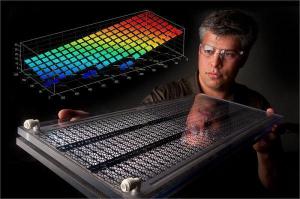
NREL senior engineer Eric Kozubal examines a prototype air flow channel of the DEVap air conditioner, which he co-invented. DEVap, which stands for desiccant-enhanced evaporative air conditioner, is a novel concept that uses membrane technology to combine the efficiency of evaporative cooling and the drying potential of liquid desiccant salt solutions. The graph superimposed on the photo shows shows how hot humid air, in red, changes to cool dry air, in blue, as the air passes through the DEVap core. (Credit: Pat Corkery)

Ugh, the discomfort when those energy bills in July, August and September come due -- $200, $400, $600 or more.

Feel miserable, or dig deep into your wallet -- not much of a choice for the 250 million Americans who live in climates where heat, humidity or both are a Catch-22 for three to 12 months a year.

A soothing solution may be on its way, thanks to a melding of technologies in filters, coolers and drying agents.

The U.S. Department of Energy's National Renewable Energy Laboratory has invented a new air conditioning process with the potential of using 50 percent to 90 percent less energy than today's top-of-the-line units. It uses membranes, evaporative cooling and liquid desiccants in a way that has never been done before in the centuries-old science of removing heat from the air.

"The idea is to revolutionize cooling, while removing millions of metric tons of carbon from the air," NREL mechanical engineer Eric Kozubal, co-inventor of the Desiccant-Enhanced eVaporative air conditioner (DEVap), said.

"We'd been working with membranes, evaporative coolers and desiccants. We saw an opportunity to combine them into a single device for a product with unique capabilities."

Hot and Humid Climates are Tricky

Evaporative coolers are a lower-cost alternative to A/C in dry climates that don't get too hot or humid -- say, Denver, but not Phoenix or Miami. Water flows over a mesh, and a fan blows air through the wet mesh to create humid, cool air.

In humid climes, adding water to the air creates a hot and sticky building environment. Furthermore, the air cannot absorb enough water to become cold.

In Phoenix or Tucson, the evaporative cooler can bring down the temperature, but not enough to make it pleasant inside on a 100-degree day or during the four to eight week moist period known as monsoon season. The cooling bumps up against the wet bulb temperature, the lowest temperature to which air can be cooled by evaporating without changing the pressure. The wet bulb temperature could be 75 or 80 degrees on a mid-summer Tucson day. Typically, evaporative coolers only can bring the temperatures about 85 percent of the way to the wet bulb level.

So, for most of the country, refrigeration-based air conditioning is the preferred way of keeping cool.

Cooling Requires Temperature Drop and Less Moisture

Cooling comes in two forms -- sensible cooling, which is a temperature drop, and latent cooling, which comes from pulling the moisture out of the air.

One intriguing product already on the market in arid, temperate climates is the Coolerado cooler. It differs from a typical evaporative cooler by never increasing the moisture content of the supply air. It provides cool air through indirect evaporative cooling. Indirect evaporative systems use a purge air stream that removes heat from the product or supply air stream that is then directed into a building.

That way, the Coolerado can cool the air all the way to the wet-bulb temperature.

"It's a big improvement on evaporative cooling because it doesn't add moisture and still gives you cold air," Kozubal said. However, in a humid climate, it still does not provide cold air or humidity control.

DEVap: Liquid Desiccants, Permeable Membranes

The DEVap solves that problem. It relies on the desiccants' capacity to create dry air using heat and evaporative coolers' capacity to take dry air and make cold air.

"By no means is the concept novel, the idea of combining the two," Kozubal said. "But no one has been able to come up with a practical and cost-effective way to do it."

HVAC engineers have known for decades the value of desiccants to air conditioning. In fact, one of the pioneers of early A/C, Willis Haviland Carrier, knew of its potential, but opted to go the refrigeration route.

Most people know of desiccants as the pebble-sized handfuls that come with new shoes to keep them dry.

The kind NREL uses are syrupy liquids -- highly concentrated aqueous salt solutions of lithium chloride or calcium chloride. They have a high affinity for water vapor, and can thus create very dry air.

Because of the complexity of desiccant cooling systems, they have traditionally only been used in industrial drying processes. Inventing a device simple enough for easy installation and maintenance is what has impaired desiccant cooling from entering into commercial and residential cooling markets.

To solve that problem, the NREL device uses thin membranes that simplify the process of integrating air flow, desiccants, and evaporative cooling. These result in an air conditioning system that provides superior comfort and humidity control.

The membranes in the DEVap A/C are hydrophobic, which means water tends to bead up rather than soak through the membranes. Imagine rain falling on a freshly waxed car. That property allows the membranes to control the liquid flows within the cooling core. "It's that property that keeps the water and the desiccant separated from the air stream," Kozubal said.

"We bring the water and liquid desiccant into DEVap's heat-mass exchanger core," Kozubal said. "The desiccant and evaporative cooling effect work together to create cold-dry air."

The air is cooled and dried from a hot-humid condition to a cold and dry condition all in one step. This all happens in a fraction of a second as air flows through the DEVap air conditioner. The result is an air conditioner that controls both thermal and humidity loads.

DEVap helps the environment in many ways. DEVap uses 50 percent to 90 percent less energy than top-of-the-line refrigeration-based air conditioning.

Because DEVap uses salt solutions rather than refrigerants, there are no harmful chlorofluorocarbons (CFCs) or hydrochlorofluorocarbons (HCFCs) to worry about. A pound of CFC or HCFC in refrigerant-based A/Cs contributes as much to global warming as 2,000 pounds of carbon dioxide. A typical residential size A/C has as much as 13 pounds of these refrigerants. The release of this much refrigerant is equivalent to burning more than 1,300 gallons of gasoline, or driving over 60,000 miles in a 2010 Toyota Prius. That's based on the Environmental Protection Agency's fuel efficiency rating for the 2010 Toyota Prius and on the standard of 19.5 pounds of carbon dioxide for every gallon of gasoline burned.

Traditional air conditioners use a lot of electricity to run the refrigeration cycle, but DEVap replaces that refrigeration cycle with an absorption cycle that is thermally activated. It can be powered by natural gas or solar energy and uses very little electricity.

This means that DEVap could become the most energy efficient way to cool your house whether you live in Phoenix, New York, or Houston.

NREL has patented the DEVap concept, and Kozubal expects that over the next couple of years he will be working on making the device smaller and simpler and perfecting the heat transfer to make DEVap more cost effective.

Eventually, NREL will license the technology to industry, "We're never going to be in the air conditioner manufacturing business," said Ron Judkoff, Principle Program Manager for Building Energy Research at NREL. "But we'd like to work with manufacturers to bring DEVap to market and create a more efficient and environmentally benign air conditioning product."