BTemplates.com

Powered by Blogger.

Pageviews past week

Quantum mechanics

Auto News

artificial intelligence

About Me

Recommend us on Google!

Information Technology

Popular Posts

Showing posts with label Rice University. Show all posts

Monday, December 19, 2011

Close Family Ties Keep Cheaters in Check: Why Almost All Multicellular Organisms Begin Life as a Single Cell


Any multicellular animal, from a blue whale to a human being, poses a special difficulty for the theory of evolution. Most of the cells in its body will die without reproducing, and only a privileged few will pass their genes to the next generation.
An amoeba that must succeed at both single-celled and
multicellular living to pass on its genes, Dicty allows
scientists to ask questions about cooperation and cheating
in multicellular organisms. (Credit: Scott Solomon)

How could the extreme degree of cooperation multicellular existence requires ever evolve? Why aren't all creatures unicellular individualists determined to pass on their own genes?

Joan Strassmann, PhD, and David Queller, PhD, a husband and wife team of evolutionary biologists at Washington University in St. Louis, provide an answer in the Dec. 16 issue of the journal Science. Experiments with amoebae that usually live as individuals but must also join with others to form multicellular bodies to complete their life cycles showed that cooperation depends on kinship.

If amoebae occur in well-mixed cosmopolitan groups, then cheaters will always be able to thrive by freeloading on their cooperative neighbors. But if groups derive from a single cell, cheaters will usually occur in all-cheater groups and will have no cooperators to exploit.

The only exceptions are brand new cheater mutants in all-cooperator groups, and these could pose a problem if the mutation rate is high enough and there are many cells in the group to mutate. In fact, the scientists calculated just how many times amoebae that arose from a single cell can safely divide before cooperation degenerates into a free-for-all.

The answer turns out to be 100 generations or more.

So population bottlenecks that kill off diversity and restart the population from a single cell are powerful stabilizers of cellular cooperation, the scientists conclude.

In other words our liver, blood and bone cells help our eggs and sperm pass on their genes because we passed through a single-cell bottleneck at the moment of conception.

The social amoebae

Queller, the Spencer T. Olin professor, and Strassmann, professor of biology, moved to WUSTL from Rice University this summer, bringing a truckload of frozen spores with them.

Although they worked for many years with wasps and stingless bees, Queller and Strassmann's current "lab rat" is the social amoeba Dictyostelium discoideum, known as Dicty for short.

The social amoebae can be found almost everywhere; in Antarctica, in deserts, in the canopies of tropical forests, and in Forest Park, the urban park that adjoins Washington University.

The amoebae spend most of their lives as tiny amorphous blobs of streaming protoplasm crawling through the soil looking for E. coli and other bacteria to eat.

Things become interesting when bacteria are scarce and the amoebae begin to starve. They then release chemicals that attract other amoebae, which follow this trail until they bump into one another.

A mound of some 10,000 amoebae forms and then elongates into a slug a few millimeters long that crawls forward (but never backward) toward heat and light.

The slug stops moving when it has reached a suitable place for dispersal, and then the front 20 percent of the amoebae die to produce a sturdy stalk that the remaining cells flow up and there become hardy spores.

Crucially, the 20 percent of the amoebae in the stalk sacrifice their genes so that the other 80 percent can pass theirs on.

When Strassmann and Queller began to work with Dicty in 1998, one of the first things they discovered was that the amoebae sometimes cheat.

Dennis Welker of Utah State University had given them a genetically diverse collection of wild-caught clones (genetically identical amoebae). They mixed amoebae from two clones together and then examined the fruiting bodies to see where the clones ended up. Each fruiting body included cells from both clones, but some clones contributed disproportionately to the spore body. They had cheated.

How can a blob of protoplasm cheat? The answer, it turns out, is many different ways.

"They might," Queller says, "have a mutation that makes an adhesion molecule less sticky, for example, so that they slide to the back of the slug, the part that forms spores."

"But there are tradeoffs," Strassmann says, "because if you're too slippery, you'll fall off the slug and lose all the advantages of being part of group."

Natural born cheaters

Mulling this over, Strassmann and Queller began to wonder if it would be possible to break the social contract among the amoebae by setting up conditions where relatedness was low and each clonal lineage encountered mostly strangers and rarely relatives.

Together with then-graduate student, Jennie Kuzdzal-Fick, they set up an experiment to learn what happened to cheating as heterogeneous (low relatedness) populations of amoebae evolved.

"At the end of the experiment, we assessed the cheating ability of the descendants by mixing equal numbers of descendants and ancestors and checking to see whether the descendants ended up in the stalks or the spores of the fruiting bodies," Strassmann says.

They found that in nearly all cases, the descendants cheated their ancestors. What's more, when descendent amoebae were grown as individual clones, about a third of them were unable to form fruiting bodies.

Many of the mutants, in other words, were "obligate" cheaters. Having lost the ability to form their own fruiting bodies, they were able to survive only by freeloading, or taking advantage of the amoebae that had retained the ability to cooperate.

This result, Queller and Strassmann say, shows that cheater mutations that threaten multicellularity occur naturally and are even favored -- as long as the population of amoebae remains genetically diverse.

What happens in the wild?

But the scientists were aware that obligate cheaters are either very rare or altogether missing among wild social amoebae. They had not found any obligate cheaters in the more than 2,000 wild clones they have sampled.

They also knew that in the wild, the amoebae in fruiting bodies are close kin, if not clones.

What prevents cooperation in wild populations from degenerating into the laboratory free-for-all? Could the difference be that the amoebae in the laboratory were distant relations and those in the wild are kissing kin?

Suppose, the scientists thought, one amoeba ventured alone into a pristine field of bacteria. As it grew and multiplied, making copies of itself, how long would it take for cheating mutations to appear (what was the mutation rate) and how successfully would these mutations proliferate (how strongly would they be selected)?

To establish the mutation rate, Strassmann and Queller together with graduate student Sara Fox ran what is called a mutation accumulation experiment.

In this experiment, amoebae that mutated didn't have to compete against amoebae that were faithful replicators. In the absence of selection, all but the most severe mutations were also reproduced and became a permanent part of the lineage's genome.

The scientists allowed 90 different lines of amoebae to accumulate mutations in this way.

"At the end," Queller says, "we found that among those 90 lines not a single one had lost the ability to fruit. So that's almost 100 lines, almost a thousand generations, so 100,000 opportunities to lose fruiting and none of them did.

"That allowed us, using statistics, to put an upper limit on the rate at which mutations turn a cooperator into an obligate cheater," he says.

The rate was low enough that if fruiting bodies were forming in the wild from amoebae that were all descended from one spore, cheating would never be an issue.

What this has to do with elephants and blue whales

But the scientists were inquisitive enough to ask another, bigger question. They used calculations invented for population genetics to ask how many times the amoeba could divide -- theoretically -- before cheating became a problem.

What if, they asked, we let an initial single amoebae divide until there were as many of amoebae as there are cells as a fruit fly and then transferred one amoeba and allowed it to divide until the daughter colony reached fruit-fly size, and so on?

What if we let the colonies grow to human size? To elephant size? To blue whale size? Would the cheaters bring down the whale-sized Dicty colony?

The answer, it turned out, was no.

A whale-sized Dicty colony is not the same thing as a whale, but nonetheless the experiments suggest how organisms, over the course of evolution, have sidestepped the cheating trap and maintained the levels of cooperation multicellular bodies demand.

"A multicellular body like the human body is an incredibly cooperative thing," Queller says, "and sociobiologists have learned that really cooperative things are hard to evolve because of the potential for cheating.

"It's the single-cell bottleneck that generates high relatedness among the cells that, in turn, allows them to cooperate, " he says.

Our liver cells have no kick against our sperm or egg cells, in other words, because they're all nearly genetically identical descendants of a single fertilized egg.

Sunday, July 31, 2011

Brain Cap Technology Turns Thought Into Motion; Mind-Machine Interface Could Lead to New Life-Changing Technologies for Millions of People


"Brain cap" technology being developed at the University of Maryland allows users to turn their thoughts into motion. Associate Professor of Kinesiology José 'Pepe' L. Contreras-Vidal and his team have created a non-invasive, sensor-lined cap with neural interface software that soon could be used to control computers, robotic prosthetic limbs, motorized wheelchairs and even digital avatars.
University of Maryland associate professor of 
kinesiology Jose "Pepe" Contreras-Vidal wears his 
Brain Cap, a noninvasive, sensor-lined cap with neural 
interface software that soon could be used to control 
computers, robotic prosthetic limbs, motorized 
wheelchairs and even digital avatars. (Credit: John 
Consoli, University of Maryland)

"We are on track to develop, test and make available to the public- within the next few years -- a safe, reliable, noninvasive brain computer interface that can bring life-changing technology to millions of people whose ability to move has been diminished due to paralysis, stroke or other injury or illness," said Contreras-Vidal of the university's School of Public Health.

The potential and rapid progression of the UMD brain cap technology can be seen in a host of recent developments, including a just published study in the Journal of Neurophysiology, new grants from the National Science Foundation (NSF) and National Institutes of Health, and a growing list of partners that includes the University of Maryland School of Medicine, the Veterans Affairs Maryland Health Care System, the Johns Hopkins University Applied Physics Laboratory, Rice University and Walter Reed Army Medical Center's Integrated Department of Orthopaedics & Rehabilitation.

"We are doing something that few previously thought was possible," said Contreras-Vidal, who is also an affiliate professor in Maryland's Fischell Department of Bioengineering and the university's Neuroscience and Cognitive Science Program. "We use EEG [electroencephalography] to non-invasively read brain waves and translate them into movement commands for computers and other devices.

Peer Reviewed

Contreras-Vidal and his team have published three major papers on their technology over the past 18 months, the latest a just released study in the Journal of Neurophysiology in which they successfully used EEG brain signals to reconstruct the complex 3-D movements of the ankle, knee and hip joints during human treadmill walking. In two earlier studies they showed (1) similar results for 3-D hand movement and (2) that subjects wearing the brain cap could control a computer cursor with their thoughts.

Alessandro Presacco, a second-year doctoral student in Contreras-Vidal's Neural Engineering and Smart Prosthetics Lab, Contreras-Vidal and co-authors write that their Journal of Neurophysiology study indicated "that EEG signals can be used to study the cortical dynamics of walking and to develop brain-machine interfaces aimed at restoring human gait function."

There are other brain computer interface technologies under development, but Contreras-Vidal notes that these competing technologies are either very invasive, requiring electrodes to be implanted directly in the brain, or, if noninvasive, require much more training to use than does UMD's EEG-based, brain cap technology.

Partnering to Help Sufferers of Injury and Stroke

Contreras-Vidal and his team are collaborating on a rapidly growing cadre projects with researchers at other institutions to develop thought-controlled robotic prosthetics that can assist victims of injury and stroke. Their latest partnership is supported by a new $1.2 million NSF grant. Under this grant, Contreras-Vidal's Maryland team is embarking on a four-year project with researchers at Rice University, the University of Michigan and Drexel University to design a prosthetic arm that amputees can control directly with their brains, and which will allow users to feel what their robotic arm touches.


"There's nothing fictional about this," said Rice University co-principal investigator Marcia O'Malley, an associate professor of mechanical engineering. "The investigators on this grant have already demonstrated that much of this is possible. What remains is to bring all of it -- non-invasive neural decoding, direct brain control and [touch] sensory feedback -- together into one device."

In a NIH-supported project underway, Contreras-Vidal and his colleagues are pairing their brain cap's EEG-based technology with a DARPA-funded next-generation robotic arm designed by researchers at the Johns Hopkins Applied Physics Laboratory to function like a normal limb. And the UMD team is developing a new collaboration with the New Zealand's start-up Rexbionics, the developer of a powered lower-limb exoskeleton called Rex that could be used to restore gait after spinal cord injury.

Two of the earliest partnerships formed by Contreras-Vidal and his team are with the University of Maryland School of Medicine in Baltimore and the Veterans Affairs Medical Center in Baltimore. A particular focus of this research is the use of the brain cap technology to help stroke victims whose brain injuries affect their motor-sensory control. Originally funded by a seed grant from the University of Maryland, College Park and the University of Maryland, Baltimore, the work now also is supported by a VA merit grant (anklebot BMI) and an NIH grant (Stroke).

"There is a big push in brain science to understand what exercise does in terms of motor learning or motor retraining of the human brain," says Larry Forrester, an associate professor of physical therapy and rehabilitation science at the University of Maryland School of Medicine.

For the more than a year, Forrester and the UMD team have tracked the neural activity of people on a treadmill doing precise tasks like stepping over dotted lines. The researchers are matching specific brain activity recorded in real time with exact lower-limb movements.

This data could help stroke victims in several ways, Forrester says. One is a prosthetic device, called an "anklebot," or ankle robot, that stores data from a normal human gait and assists partially paralyzed people. People who are less mobile commonly suffer from other health issues such as obesity, diabetes or cardiovascular problems, Forrester says, "so we want to get [stroke survivors] up and moving by whatever means possible."

The second use of the EEG data in stroke victims is more complex, yet offers exciting possibilities. "By decoding the motion of a normal gait," Contreras-Vidal says, "we can then try and teach stroke victims to think in certain ways and match their own EEG signals with the normal signals." This could "retrain" healthy areas of the brain in what is known as neuroplasticity.

One potential method for retraining comes from one of the Maryland research team's newest members, Steve Graff, a first-year bioengineering doctoral student. He envisions a virtual reality game that matches real EEG data with on-screen characters. "It gives us a way to train someone to think the right thoughts to generate movement from digital avatars. If they can do that, then they can generate thoughts to move a device," says Graff, who brings a unique personal perspective to the work. He has congenital muscular dystrophy and uses a motorized wheelchair. The advances he's working on could allow him to use both hands -- to put on a jacket, dial his cell phone or throw a football while operating his chair with his mind.

No Surgery Required

During the past two decades a great deal of progress has been made in the study of direct brain to computer interfaces, most of it through studies using monkeys with electrodes implanted in their brains. However, for use in humans such an invasive approach poses many problems, not the least of which is that most people don't' want holes in their heads and wires attached to their brains. "EEG monitoring of the brain, which has a long, safe history for other applications, has been largely ignored by those working on brain-machine interfaces, because it was thought that the human skull blocked too much of the detailed information on brain activity needed to read thoughts about movement and turn those readings into movement commands for multi-functional high-degree of freedom prosthetics," said Contreras-Vidal. He is among the few who have used EEG, MEG or other sensing technologies to develop non-invasive neural interfaces, and the only one to have demonstrated decoding results comparable to those achieved by researchers using implanted electrodes.

A paper Contreras-Vidal and colleagues published in the Journal of Neuroscience in March 2010 showed the feasibility of Maryland's EEG-based technology to infer multidimensional natural movement from noninvasive measurements of brain activity. In their two latest studies, Contreras-Vidal and his team have further advanced the development of their EEG brain interface technology, and provided powerful new evidence that it can yield brain computer interface results as good as or better than those from invasive studies, while also requiring minimal training to use.

In a paper published in April in the Journal of Neural Engineering, the Maryland team demonstrated that people wearing the EEG brain cap, could after minimal training control a computer cursor with their thoughts and achieve performance levels comparable to those by subjects using invasive implanted electrode brain computer interface systems. Contreras-Vidal and his co-authors write that this study also shows that compared to studies of other noninvasive brain control interface systems, training time with their system was substantially shorter, requiring only a single 40-minute session.

Wednesday, September 22, 2010

Nano Antenna Concentrates Light


Everybody who's ever used a TV, radio or cell phone knows what an antenna does: It captures the aerial signals that make those devices practical. A lab at Rice University has built an antenna that captures light in the same way, at a small scale that has big potential.
This is a colorized scanning electron microscope 
image of gold tips in a nanogap device used in 
experiments to capture and amplify light. 
(Credit: Natelson Lab/Rice University)

Condensed matter physicist Doug Natelson and graduate student Dan Ward have found a way to make an optical antenna from two gold tips separated by a nanoscale gap that gathers light from a laser. The tips "grab the light and concentrate it down into a tiny space," Natelson said, leading to a thousand-fold increase in light intensity in the gap.

Getting an accurate measurement of the effect is a first, said Natelson, who reported the results in the September 19 online edition of the journal Nature Nanotechnology. He expects the discovery will be useful in the development of tools for optics and for chemical and biological sensing, even at the single-molecule scale, with implications for industrial safety, defense and homeland security.

The paper by Natelson, Ward and their colleagues in Germany and Spain details the team's technique, which involves shining laser light into the gap between a pair of gold tips less than a nanometer apart -- about a hundred-thousandth the width of a human hair.

"You can ignore the fact that your car antenna is built out of atoms; it just works," said Natelson, a Rice professor of physics and astronomy, and also electrical and computer engineering. "But when you have tiny pieces of metal very close to each other, you have to worry about all the details. The fields are going to be big, the situation's going to be complicated and you're really constrained. We've been able to use some physics that only come into play when things are very close together to help figure out what's going on."

The key to measuring light amplification turned out to be measuring something else, specifically the electrical current flowing between the gold tips.

Putting the nanotips so close together allows charge to flow via quantum tunneling as the electrons are pushed from one side to the other. The researchers could get electrons moving by pushing them at low frequencies with a voltage, in a highly controllable, measurable way. They could also get them flowing by shining the laser, which pushes the charge at the very high frequency of the light. Being able to compare the two processes set a standard by which the light amplification could be determined, Natelson said. Their German and Spanish coauthors helped supply the necessary theoretical justification for the analysis.

The amplification is a plasmonic effect, Natelson said. Plasmons, which may be excited by light, are oscillating electrons in metallic structures that act like ripples in a pool. "You've got a metal structure, you shine light on it, the light makes the electrons in this metal structure slosh around," he said. "You can think of the electrons in the metal as an incompressible fluid, like water in a bathtub. And when you get them sloshing back and forth, you get electric fields.

"At the surfaces of the metal, these fields can be very big -- much bigger than those from the original radiation," he said. "What was hard to measure was just how big. We didn't know how much the two sides were sloshing up and down -- and that's exactly the thing we care about."

By simultaneously measuring the low-frequency electrically driven and the high-frequency optically driven currents between the tips, "we can figure out the voltage zinging back and forth at the really high frequencies that are characteristic of light," he said.

Natelson said his lab's homebuilt apparatus, which combines nanoscale electronics and optics, is fairly unusual. "There are a lot of people who do optics. There are a lot who do nanoscale electrical measurements," he said. "There are still not too many people who combine the two."

The custom rig gave the Rice researchers a measure of control over thermal and electrical properties that have stymied other investigators. The tips are cooled to 80 Kelvin, about -315 degrees Fahrenheit, and are electrically insulated from their silicon bases, keeping at bay stray voltages that could skew the results.

"The reason we're studying these enhanced fields is not just because they're there," Natelson said. "If you can enhance the local field by a factor of 1,000, there are lots of things you can do in terms of sensors and non-linear optics. Anything that gives you a handle on what's happening at these tiny scales is very useful.

"This is one of those rare, happy cases where you are able to actually get information -- very local information -- about exactly something you care about."

The paper's co-authors are Falco Hüser and Fabian Pauly of the Karlsruhe Institute of Technology, Germany; and Juan Carlos Cuevas at the Autonomous University of Madrid, Spain.

Support for the project came from the Robert A. Welch Foundation, the Lockheed Martin Advanced Nanotechnology Center of Excellence at Rice (LANCER), Deutsche Forschungsgemeinschaft, the Baden-Württemberg Siftung, the European Union through the Bio-Inspired Approaches for Molecular Electronics (BIMORE) network, and the Spanish Ministry of Science and Innovation.

Thursday, April 22, 2010

Bizarre Matter Could Find Use in Quantum Computers


There are enticing new findings in the search for materials that support fault-tolerant quantum computing. New results from Rice University and Princeton University indicate that a bizarre state of matter that acts like a particle with one-quarter electron charge also has a "quantum registry" that is immune to information loss from external perturbations.
Me
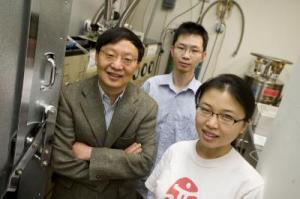
From left, Rice physicist Rui-Rui Du, graduate students Chi Zhang and Yanhua Dai, and former postdoctoral researcher Tauno Knuuttila (not pictured) have found that odd groupings of ultracold electrons could be useful in making fault-tolerant quantum computers. (Credit: Jeff Fitlow/Rice University)

The research appeared online April 21 in Physical Review Letters. The team of physicists found that ultracold mixes of electrons caught in magnetic traps could have the necessary properties for constructing fault-tolerant quantum computers -- future computers that could be far more powerful than today's computers. The mixes of electrons are dubbed "5/2 quantum Hall liquids" in reference to the unusual quantum properties that describe their makeup.

"The big goal, the whole driving force, besides deep academic curiosity, is to build a quantum computer out of this," said the study's lead author Rui-Rui Du, professor of physics at Rice. "The key for that is whether these 5/2 liquids have 'topological' properties that would render them immune to the sorts of quantum perturbations that could cause information degradation in a quantum computer."

Du said the team's results indicate the 5/2 liquids have the desired properties. In the parlance of condensed-matter physics, they are said to represent a "non-Abelian" state of matter.

Non-Abelian is a mathematical term for a system with "noncommutative" properties. In math, commutative operations, like addition, are those that have the same outcome regardless of the order in which they are carried out. So, one plus two equals three, just as two plus one equals three. In daily life, commutative and noncommutative tasks are commonplace. For example, when doing the laundry, it doesn't matter if the detergent is added before the water or the water before the detergent, but it does matter if the clothes are washed before they're placed in the dryer.

"It will take a while to fully understand the complete implications of our results, but it is clear that we have nailed down the evidence for 'spin polarization,' which is one of the two necessary conditions that must be proved to show that the 5/2 liquids are non-Abelian," Du said. "Other research teams have been tackling the second condition, the one-quarter charge, in previous experiments."

The importance of the noncommutative quantum properties is best understood within the context of fault-tolerant quantum computers, a fundamentally new type of computer that hasn't been built yet.

Computers today are binary. Their electrical circuits, which can be open or closed, represent the ones and zeros in binary bits of information. In quantum computers, scientists hope to use "quantum bits," or qubits. Unlike binary ones and zeros, the qubits can be thought of as little arrows that represent the position of a bit of quantum matter. The arrow might represent a one if it points straight up or a zero if it points straight down, but it could also represent any number in between. In physics parlance, these arrows are called quantum "states." And for certain complex calculations, being able to represent information in many different states would present a great advantage over binary computing.

The upshot of the 5/2 liquids being non-Abelian is that they have a sort of "quantum registry," where information doesn't change due to external quantum perturbations.

"In a way, they have internal memory of their previous state," Du said.

The conditions needed to create the 5/2 liquids are extreme. At Rice, Tauno Knuuttila, a former postdoctoral research scientist in Du's group, spent several years building the "demagnetization refrigerator" needed to cool 5-millimeter squares of ultrapure semiconductors to within one-10,000th of a degree of absolute zero. It took a week for Knuuttila to simply cool the nearly one-ton instrument to the necessary temperature for the Rice experiments.

The gallium arsenide semiconductors used in the tests are the most pure on the planet. They were created by Loren Pfieiffer, Du's longtime collaborator at Princeton and Bell Labs. Rice graduate student Chi Zhang conducted additional tests at the National High Magnetic Field Laboratory in Tallahassee, Fla., to verify that the 5/2 liquid was spin- polarized.

Study co-authors include Zhang, Knuuttila, Pfeiffer, Princeton's Ken West and Rice's Yanhua Dai. The research is supported by the Department of Energy, the National Science Foundation and the Keck Foundation.

Saturday, March 20, 2010

Nano-Based RFID Tags Could Replace Bar Codes


Long lines at store checkouts could be history if a new technology created in part at Rice University comes to pass.

Me
RFID tags printed through a new roll-to-roll process could replace bar codes and make checking out of a store a snap. (Credit: Gyou-Jin Cho/Sunchon National University)


Rice researchers, in collaboration with a team led by Gyou-jin Cho at Sunchon National University in Korea, have come up with an inexpensive, printable transmitter that can be invisibly embedded in packaging. It would allow a customer to walk a cart full of groceries or other goods past a scanner on the way to the car; the scanner would read all items in the cart at once, total them up and charge the customer's account while adjusting the store's inventory.

More advanced versions could collect all the information about the contents of a store in an instant, letting a retailer know where every package is at any time.

The technology reported in the March issue of the journal IEEE Transactions on Electron Devices is based on a carbon-nanotube-infused ink for ink-jet printers first developed in the Rice lab of James Tour, the T.T. and W.F. Chao Chair in Chemistry as well as a professor of mechanical engineering and materials science and of computer science. The ink is used to make thin-film transistors, a key element in radio-frequency identification (RFID) tags that can be printed on paper or plastic.

"We are going to a society where RFID is a key player," said Cho, a professor of printed electronics engineering at Sunchon, who expects the technology to mature in five years. Cho and his team are developing the electronics as well as the roll-to-roll printing process that, he said, will bring the cost of printing the tags down to a penny apiece and make them ubiquitous.

RFID tags are almost everywhere already. The tiny electronic transmitters are used to identify and track products and farm animals. They're in passports, library books and devices that let drivers pass through tollbooths without digging for change.

The technology behind RFID goes back to the 1940s, when Léon Theremin, inventor of the self-named electronic music instrument heard in so many '50s science fiction and horror movies, came up with a spy tool for the Soviet Union that drew power from and retransmitted radio waves.

RFID itself came into being in the 1970s and has been widely adopted by the Department of Defense and industry to track shipping containers as they make their way around the world, among many other uses.

But RFID tags to date are largely silicon-based. Paper or plastic tags printed as part of a package would cut costs dramatically. Cho expects his roll-to-roll technique, which uses a gravure process rather than ink-jet printers, to replace the bar codes now festooned on just about everything you can buy.

Cho, Tour and their teams reported in the journal a three-step process to print one-bit tags, including the antenna, electrodes and dielectric layers, on plastic foil. Cho's lab is working on 16-bit tags that would hold a more practical amount of information and be printable on paper as well.

Cho came across Tour's inks while spending a sabbatical at Rice in 2005. "Professor Tour first recommended we use single-walled carbon nanotubes for printing thin-film transistors," Cho said.

Tour's lab continues to support the project in an advisory role and occasionally hosts Cho's students. Tour said Rice owns half of the patent, still pending, upon which all of the technology is based. "Gyou-jin has carried the brunt of this, and it's his sole project," Tour said. "We are advisers and we still send him the raw materials" -- the single-walled carbon nanotubes produced at Rice.

Printable RFIDs are practical because they're passive. The tags power up when hit by radio waves at the right frequency and return the information they contain. "If there's no power source, there's no lifetime limit. When they receive the RF signal, they emit," Tour said.

There are several hurdles to commercialization. First, the device must be reduced to the size of a bar code, about a third the size of the one reported in the paper, Tour said. Second, its range must increase.

"Right now, the emitter has to be pretty close to the tags, but it's getting farther all the time," he said. "The practical distance to have it ring up all the items in your shopping cart is a meter. But the ultimate would be to signal and get immediate response back from every item in your store -- what's on the shelves, their dates, everything.

"At 300 meters, you're set -- you have real-time information on every item in a warehouse. If something falls behind a shelf, you know about it. If a product is about to expire, you know to move it to the front -- or to the bargain bin."

Tour allayed concerns about the fate of nanotubes in packaging. "The amount of nanotubes in an RFID tag is probably less than a picogram. That means you can produce one trillion of them from a gram of nanotubes -- a miniscule amount. Our HiPco reactor produces a gram of nanotubes an hour, and that would be enough to handle every item in every Walmart.

"In fact, more nanotubes occur naturally in the environment, so it's not even fair to say the risk is minimal. It's infinitesimal."

Co-authors of the paper include Rice graduate student Ashley Leonard; Minhun Jung, Jinsoo Noh and Gwangyong Lee of Sunchon National University; and Jaeyoung Kim, Namsoo Lim, Chaemin Lim, Junseok Kim, Kyunghwan Jung and Hwiwon Kang of the Printed Electronics Research Center, Paru Corp., Sunchon, Korea.


Reblog this post [with Zemanta]

Tuesday, April 28, 2009

Single-molecule Nano-vehicles Synthesized: 'Fantastic Voyage' Not So Far-Fetched


James Tour and coworkers at Rice University synthesized a molecular car with four carbon-based wheels that roll on axles made from linked carbon atoms. The nano-car's molecular wheels are 5,000 times smaller than a human cell. A powerful technique that allows viewing objects at the atomic level called scanning tunneling microscopy reveals the wheels roll perpendicular to the axles, rather than sliding about like a car on ice as the car moves back and forth on a surface. (Credit: Y. Shirai/Rice University)

Imagine producing vehicles so small they would be about the size of a molecule and powered by engines that run on sugar. To top it off, a penny would buy a million of them.


A new article published in the May 2009 issue of Scientific American asks readers to do just that.


The concept is nearly unthinkable, but it's exactly the kind of thing occupying National Science Foundation supported researchers at Penn State and Rice universities.


For several years, Ayusman Sen, who heads Penn State's department of chemistry, and his colleague Thomas E. Mallouk, director of the Center for Nanoscale Science at Penn State, have investigated technologies that could realize these remarkable machines whose uses might include delivering medicine to specific tissue, accomplishing surgeries or communicating with the outside world from inside the human body.


Though researchers consistently have improved ways to build nano-machines, the stumbling block has been finding a way to power them. Shrinking energy producers--internal combustion engines, electric motors or jet engines--below millimeter dimensions is not an easy task, but researchers may be closer to a fantastic solution.


In the 1966 movie Fantastic Voyage, scientists shrink a submarine to microscopic size and inject it into the blood stream of a brilliant scientist, who has a blood clot forming in his brain. The nano-sized surgeons then set out to remove the blood clot.


Today, researchers can steer nano-machines, use them to convey cargo, and guide them using electromagnetic forces or chemical interactions. All of this, they say, makes the world seen in Fantastic Voyage not so far-fetched.


The article -- "How to Build Nanotech Motors" is available on the Scientific American web site at: http://www.sciam.com/article.cfm?id=how-to-build-nanotech-motors


If you like this post, buy me a beer at $3!
Reblog this post [with Zemanta]