BTemplates.com

Powered by Blogger.

Pageviews past week

Quantum mechanics

Auto News

artificial intelligence

About Me

Recommend us on Google!

Information Technology

Popular Posts

Showing posts with label General relativity. Show all posts

Saturday, July 2, 2011

Quantum 'Graininess' of Space at Smaller Scales? Gamma-Ray Observatory Challenges Physics Beyond Einstein


The European Space Agency's Integral gamma-ray observatory has provided results that will dramatically affect the search for physics beyond Einstein. It has shown that any underlying quantum 'graininess' of space must be at much smaller scales than previously predicted.
Gamma-ray burst captured by Integral's IBIS instrument. 
(Credit: ESA/SPI Team/ECF)

Einstein's General Theory of Relativity describes the properties of gravity and assumes that space is a smooth, continuous fabric. Yet quantum theory suggests that space should be grainy at the smallest scales, like sand on a beach.

One of the great concerns of modern physics is to marry these two concepts into a single theory of quantum gravity.

Now, Integral has placed stringent new limits on the size of these quantum 'grains' in space, showing them to be much smaller than some quantum gravity ideas would suggest.

According to calculations, the tiny grains would affect the way that gamma rays travel through space. The grains should 'twist' the light rays, changing the direction in which they oscillate, a property called polarisation.

High-energy gamma rays should be twisted more than the lower energy ones, and the difference in the polarisation can be used to estimate the size of the grains.

Philippe Laurent of CEA Saclay and his collaborators used data from Integral's IBIS instrument to search for the difference in polarisation between high- and low-energy gamma rays emitted during one of the most powerful gamma-ray bursts (GRBs) ever seen.


GRBs come from some of the most energetic explosions known in the Universe. Most are thought to occur when very massive stars collapse into neutron stars or black holes during a supernova, leading to a huge pulse of gamma rays lasting just seconds or minutes, but briefly outshining entire galaxies.

GRB 041219A took place on 19 December 2004 and was immediately recognised as being in the top 1% of GRBs for brightness. It was so bright that Integral was able to measure the polarisation of its gamma rays accurately.

Dr Laurent and colleagues searched for differences in the polarisation at different energies, but found none to the accuracy limits of the data.

Some theories suggest that the quantum nature of space should manifest itself at the 'Planck scale': the minuscule 10-35 of a metre, where a millimetre is 10-3 m.

However, Integral's observations are about 10 000 times more accurate than any previous and show that any quantum graininess must be at a level of 10-48 m or smaller.

"This is a very important result in fundamental physics and will rule out some string theories and quantum loop gravity theories," says Dr Laurent.

Integral made a similar observation in 2006, when it detected polarised emission from the Crab Nebula, the remnant of a supernova explosion just 6500 light years from Earth in our own galaxy.

This new observation is much more stringent, however, because GRB 041219A was at a distance estimated to be at least 300 million light years.

In principle, the tiny twisting effect due to the quantum grains should have accumulated over the very large distance into a detectable signal. Because nothing was seen, the grains must be even smaller than previously suspected.

"Fundamental physics is a less obvious application for the gamma-ray observatory, Integral," notes Christoph Winkler, ESA's Integral Project Scientist. "Nevertheless, it has allowed us to take a big step forward in investigating the nature of space itself."

Now it's over to the theoreticians, who must re-examine their theories in the light of this new result.

Saturday, June 11, 2011

Einstein's theory applied to superconducting circuits


In recent years, UC Santa Barbara scientists showed that they could reproduce a basic superconductor using Einstein's general theory of relativity. Now, using the same theory, they have demonstrated that the Josephson junction could be reproduced. The results are explained in a recent issue of the journal Physical Review Letters.
The gravitational description of the superconducting 
condensate shows a suppression in the gap. 
(Credit: Jorge Santos, UCSB)

The Josephson junction, a device that was first discovered by Brian David Josephson in the early 1960s, is a main ingredient in applications of superconductivity.

Gary Horowitz, professor of physics at UC Santa Barbara, said that Einstein's general theory of relativity — which was developed as a theory of gravity and is extremely successful in explaining a wide variety of gravitational phenomena — now is being used to explain several aspects of non-gravitational physics.

"The basic phenomenon with Josephson junctions is that you can take two superconductors, separate them by a little gap, and still find current going across it, in a specific way," said Horowitz. "And that has found many applications. So the Josephson junction is something we've reproduced using general relativity."

Horowitz said that he and his co-authors used tools from string theory to develop the gravity model of a superconductor. He explained that it was surprising to be able to link Einstein's general theory of relativity to a totally different area of physics. He said he hoped that the new tools would one day be able to shed light on new types of superconductors.

"Most materials, if you cool them down sufficiently, will actually conduct electricity without any resistance," said Horowitz. "These are superconductors. There is a standard theory of superconductivity, discovered about 50 years ago, that has worked well for most of the so-called conventional superconductors."

A new class of materials was discovered 25 years ago. These are superconductors that have zero resistance at somewhat higher temperatures. Physicists are still working on understanding the mechanism.

This new class of materials involves copper-oxygen planes. Another new class of superconductors, based on iron instead of copper, was discovered a couple of years ago. These materials, called iron nictides, also have the property of superconducting at a higher temperature.

"There is a lot of activity and interest in understanding these materials," said Horowitz. "Ultimately, the goal is to have a room-temperature superconductor, which, you can imagine, would have lots of interesting applications."

Horowitz and his research team found what could be called a gravitational model, or a gravitational dual — a dual description of a superconductor using gravity, black holes, and all of the traditional ingredients of general relativity. "This came as quite a surprise because this is a totally different area of physics, which is now being connected to this condensed matter area," said Horowitz.

Provided by UC Santa Barbara

Thursday, September 9, 2010

Big Bang Was Followed by Chaos, Mathematical Analysis Shows


Seven years ago Northwestern University physicist Adilson E. Motter conjectured that the expansion of the universe at the time of the big bang was highly chaotic. Now he and a colleague have proven it using rigorous mathematical arguments.
Time line of the Universe. (Credit: NASA)

The study, published by the journal Communications in Mathematical Physics, reports not only that chaos is absolute but also the mathematical tools that can be used to detect it. When applied to the most accepted model for the evolution of the universe, these tools demonstrate that the early universe was chaotic.

Certain things are absolute. The speed of light, for example, is the same with respect to any observer in the empty space. Others are relative. Think of the pitch of a siren on an ambulance, which goes from high to low as it passes the observer. A longstanding problem in physics has been to determine whether chaos -- the phenomenon by which tiny events lead to very large changes in the time evolution of a system, such as the universe -- is absolute or relative in systems governed by general relativity, where the time itself is relative.

A concrete aspect of this conundrum concerns one's ability to determine unambiguously whether the universe as a whole has ever behaved chaotically. If chaos is relative, as suggested by some previous studies, this question simply cannot be answered because different observers, moving with respect to each other, could reach opposite conclusions based on the ticks of their own clocks.

"A competing interpretation has been that chaos could be a property of the observer rather than a property of the system being observed," said Motter, an author of the paper and an assistant professor of physics and astronomy at Northwestern's Weinberg College of Arts and Sciences. "Our study shows that different physical observers will necessarily agree on the chaotic nature of the system."

The work has direct implications for cosmology and shows in particular that the erratic changes between red- and blue-shift directions in the early universe were in fact chaotic.

Motter worked with colleague Katrin Gelfert, a mathematician from the Federal University of Rio de Janeiro, Brazil, and a former visiting faculty member at Northwestern, who says that the mathematical aspects of the problem are inspiring and likely to lead to other mathematical developments.

An important open question in cosmology is to explain why distant parts of the visible universe -- including those that are too distant to have ever interacted with each other -- are so similar.

"One might suggest 'Because the large-scale universe was created uniform,'" Motter said, "but this is not the type of answer physicists would take for granted."

Fifty years ago, physicists believed that the true answer could be in what happened a fraction of a second after the big bang. Though the initial studies failed to show that an arbitrary initial state of the universe would eventually converge to its current form, researchers found something potentially even more interesting: the possibility that the universe as a whole was born inherently chaotic.

The present-day universe is expanding and does so in all directions, Motter explained, leading to red shift of distant light sources in all three dimensions -- the optical analog of the low pitch in a moving siren. The early universe, on the other hand, expanded in only two dimensions and contracted in the third dimension.

This led to red shift in two directions and blue shift in one. The contracting direction, however, was not always the same in this system. Instead, it alternated erratically between x, y and z.

"According to the classical theory of general relativity, the early universe experienced infinitely many oscillations between contracting and expanding directions," Motter said.

"This could mean that the early evolution of the universe, though not necessarily its current state, depended very sensitively on the initial conditions set by the big bang."

This problem gained a new dimension 22 years ago when two other researchers, Gerson Francisco and George Matsas, found that different descriptions of the same events were leading to different conclusions about the chaotic nature of the early universe. Because different descriptions can represent the perspectives of different observers, this challenged the hypothesis that there would be an agreement among different observers. Within the theory of general relativity, such an agreement goes by the name of a "relativistic invariant."

"Technically, we have established the conditions under which the indicators of chaos are relativistic invariants," Motter said. "Our mathematical characterization also explains existing controversial results. They were generated by singularities induced by the choice of the time coordinate, which are not present for physically admissible observables."

Motter also is an assistant professor of engineering sciences and applied mathematics at the McCormick School of Engineering and Applied Science, a member of the executive committee of the Northwestern Institute on Complex Systems (NICO) and a member of the Center for Interdisciplinary Exploration and Research in Astrophysics (CIERA).

Saturday, August 21, 2010

Galactic Magnifying Lens to Probe Elusive Dark Energy


An international team of astronomers using gravitational lensing observations from the NASA/ESA Hubble Space Telescope has taken an important step forward in the quest to solve the riddle of dark energy, a phenomenon which mysteriously appears to power the Universe's accelerating expansion.
This image shows the galaxy cluster Abell 1689, with the 
mass distribution of the gravitational lens overlaid 
(in purple). The mass in this lens is made up partly of normal 
(baryonic) matter and partly of dark matter. Distorted 
galaxies are clearly visible around the edges of the 
gravitational lens. The appearance of these distorted galaxies 
depends on the distribution of matter in the lens and on the 
relative geometry of the lens and the distant galaxies, as well
as on the effect of dark energy on the geometry of the universe. 
(Credit: NASA, ESA, E. Jullo (JPL/LAM), P. 
Natarajan (Yale) and J-P. Kneib (LAM).)

Their results appear in the 20 August 2010 issue of the journal Science.

Normal matter like that found in stars, planets and dust clouds only makes up a tiny fraction of the mass-energy content of the Universe. It is dwarfed by the amount of dark matter -- which is invisible, but can be detected by its gravitational pull. In turn, the amount of dark matter in the Universe is itself overwhelmed by the diffuse dark energy that permeates the entire Universe. Scientists believe that the pressure exerted by this dark energy is what pushes the Universe to expand at an ever-increasing rate.

Probing the nature of dark energy is, therefore, one of the key challenges in modern cosmology. Since its discovery in 1998, the quest has been to characterise and understand it better. This work presents an entirely new way to do so.

Eric Jullo, lead author of a new paper in the journal Science explains: "Dark energy is characterised by the relationship between its pressure and its density: this is known as its equation of state. Our goal was to try to quantify this relationship. It teaches us about the properties of dark energy and how it has affected the development of the Universe."

The team measured the properties of the gravitational lensing in the galaxy cluster Abell 1689. Gravitational lensing is a phenomenon predicted by Einstein's theory of general relativity, and was here used by the team to probe how the cosmological distances (and thus the shape of space-time) are modified by dark energy. At cosmic distances, a huge cluster of galaxies in the foreground has so much mass that its gravitational pull bends beams of light from very distant galaxies, producing distorted images of the faraway objects. The distortion induced by the lens depends in part on the distances to the objects, which have been precisely measured with large ground-based telescopes such as ESO's Very Large Telescope and the Keck Telescopes.

"The precise effects of lensing depend on the mass of the lens, the structure of space-time, and the relative distance between us, the lens and the distant object behind it," explains Priyamvada Natarajan, a co-author of the paper. "It's like a magnifying glass, where the image you get depends on the shape of the lens and how far you hold it from the object you're looking at. If you know the shape of the lens and the image you get, you can work out the path that light followed between the object and your eye."

Looking at the distorted images allows astronomers to reconstruct the path that light from distant galaxies takes to make its long journey to Earth. It also lets them study the effect of dark energy on the geometry of space in the light path from the distant objects to the lensing cluster and then from the cluster to us. As dark energy pushes the Universe to expand ever faster, the precise path that the light beams follow as they travel through space and are bent by the lens is subtly altered. This means that the distorted images from the lens encapsulate information about the underlying cosmology, as well as about the lens itself.

So why is the geometry of the Universe such a big issue?

"The geometry, the content and the fate of the Universe are all intricately linked," says Natarajan. "If you know two, you can deduce the third. We already have a pretty good knowledge of the Universe's mass-energy content, so if we can get a handle on its geometry then we will be able to work out exactly what the fate of the Universe will be."

The real strength of this new result is that it devises a totally new way to extract information about the elusive dark energy. It is a unique and powerful one, and offers great promise for future applications.

According to the scientists, their method required multiple, meticulous steps to develop. They spent several years developing specialised mathematical models and precise maps of the matter -- both dark and "normal" -- that together constitute the Abell 1689 cluster.

Co-author Jean-Paul Kneib explains: "Using our unique method in conjunction with others, we were able to come up with results that were far more precise than any achieved before."

The Hubble Space Telescope is a project of international cooperation between ESA and NASA.

The international team of astronomers in this study consists of Eric Jullo (Jet Propulsion Laboratory/ Cal Tech, USA and Laboratoire d'Astrophysique de Marseille, France), Priyamvada Natarajan (Yale University, USA), Jean-Paul Kneib (Laboratoire d'Astrophysique de Marseille, France), Anson D'Aloisio (Yale University, USA), Marceau Limousin (Laboratoire d'Astrophysique de Marseille, France and University of Copenhagen, Denmark), Johan Richard (Durham University, UK) and Carlo Schimd (Laboratoire d'Astrophysique de Marseille, France)

Thursday, March 11, 2010

General Relativity Validated on Cosmic Scale


An analysis of more than 70,000 galaxies by University of California, Berkeley, University of Zurich and Princeton University physicists demonstrates that the universe -- at least up to a distance of 3.5 billion light years from Earth -- plays by the rules set out 95 years ago by Albert Einstein in his General Theory of Relativity.
Me
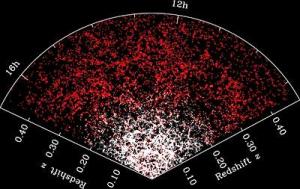
A partial map of the distribution of galaxies in the Sloan Digital Sky Survey, going out to a distance of 7 billion light years. The amount of galaxy clustering that we observe today is a signature of how gravity acted over cosmic time, and allows as to test whether general relativity holds over these scales. (Credit: M. Blanton, Sloan Digital Sky Survey)

By calculating the clustering of these galaxies, which stretch nearly one-third of the way to the edge of the universe, and analyzing their velocities and distortion from intervening material, the researchers have shown that Einstein's theory explains the nearby universe better than alternative theories of gravity.

One major implication of the new study is that the existence of dark matter is the most likely explanation for the observation that galaxies and galaxy clusters move as if under the influence of some unseen mass, in addition to the stars astronomers observe.

"The nice thing about going to the cosmological scale is that we can test any full, alternative theory of gravity, because it should predict the things we observe," said co-author Uros Seljak, a professor of physics and of astronomy at UC Berkeley, a faculty scientist at Lawrence Berkeley National Laboratory, and a professor of physics at the Institute of Theoretical Physics at the University of Zurich. "Those alternative theories that do not require dark matter fail these tests."

In particular, the tensor-vector-scalar gravity (TeVeS) theory, which tweaks general relativity to avoid resorting to the existence of dark matter, fails the test.

The result conflicts with a report late last year that the very early universe, between 8 and 11 billion years ago, did deviate from the general relativistic description of gravity.

Seljak and his current and former students, including first authors Reinabelle Reyes, a Princeton University graduate student, and Rachel Mandelbaum, a recent Princeton Ph.D. recipient, report their findings in the March 11 issue of the journal Nature. The other co-authors are Tobias Baldauf, Lucas Lombriser and Robert E. Smith of the University of Zurich, and James E. Gunn, professor of physics at Princeton and father of the Sloan Digital Sky Survey.

Einstein's General Theory of Relativity holds that gravity warps space and time, which means that light bends as it passes near a massive object, such as the core of a galaxy. The theory has been validated numerous times on the scale of the solar system, but tests on a galactic or cosmic scale have been inconclusive.

"There are some crude and imprecise tests of general relativity at galaxy scales, but we don't have good predictions for those tests from competing theories," Seljak said.

Such tests have become important in recent decades because the idea that some unseen mass permeates the universe disturbs some theorists and has spurred them to tweak general relativity to get rid of dark matter. TeVeS, for example, says that acceleration caused by the gravitational force from a body depends not only on the mass of that body, but also on the value of the acceleration caused by gravity.

The discovery of dark energy, an enigmatic force that is causing the expansion of the universe to accelerate, has led to other theories, such as one dubbed f(R), to explain the expansion without resorting to dark energy.

Tests to distinguish between competing theories are not easy, Seljak said. A theoretical cosmologist, he noted that cosmological experiments, such as detections of the cosmic microwave background, typically involve measurements of fluctuations in space, while gravity theories predict relationships between density and velocity, or between density and gravitational potential.

"The problem is that the size of the fluctuation, by itself, is not telling us anything about underlying cosmological theories. It is essentially a nuisance we would like to get rid of," Seljak said. "The novelty of this technique is that it looks at a particular combination of observations that does not depend on the magnitude of the fluctuations. The quantity is a smoking gun for deviations from general relativity."

Three years ago, a team of astrophysicists led by Pengjie Zhang of Shanghai Observatory suggested using a quantity dubbed EG to test cosmological models. EG reflects the amount of clustering in observed galaxies and the amount of distortion of galaxies caused by light bending as it passes through intervening matter, a process known as weak lensing. Weak lensing can make a round galaxy look elliptical, for example.

"Put simply, EG is proportional to the mean density of the universe and inversely proportional to the rate of growth of structure in the universe," he said. "This particular combination gets rid of the amplitude fluctuations and therefore focuses directly on the particular combination that is sensitive to modifications of general relativity."

Using data on more than 70,000 bright, and therefore distant, red galaxies from the Sloan Digital Sky Survey, Seljak and his colleagues calculated EG and compared it to the predictions of TeVeS, f(R) and the cold dark matter model of general relativity enhanced with a cosmological constant to account for dark energy.

The predictions of TeVeS were outside the observational error limits, while general relativity fit nicely within the experimental error. The EG predicted by f(R) was somewhat lower than that observed, but within the margin of error.

In an effort to reduce the error and thus test theories that obviate dark energy, Seljak hopes to expand his analysis to perhaps a million galaxies when SDSS-III's Baryon Oscillation Spectroscopic Survey (BOSS), led by a team at LBNL and UC Berkeley, is completed in about five years. To reduce the error even further, by perhaps as much as a factor of 10, requires an even more ambitious survey called BigBOSS, which has been proposed by physicists at LBNL and UC Berkeley, among other places.

Future space missions, such as NASA's Joint Dark Energy Mission (JDEM) and the European Space Agency's Euclid mission, will also provide data for a better analysis, though perhaps 10-15 years from now.

Seljak noted that these tests do not tell astronomers the actual identity of dark matter or dark energy. That can only be determined by other types of observations, such as direct detection experiments.