BTemplates.com

Powered by Blogger.

Pageviews past week

Quantum mechanics

Auto News

artificial intelligence

About Me

Recommend us on Google!

Information Technology

Popular Posts

Showing posts with label Electron. Show all posts

Sunday, October 14, 2012

'Invisibility': Key to Better Electronics?


Visual 'Cloaking' Technology Enables More Efficient Transfer of Electrons

 A new approach that allows objects to become "invisible" has now been applied to an entirely different area: letting particles "hide" from passing electrons, which could lead to more efficient thermoelectric devices and new kinds of electronics.
Diagram shows the 'probability flux' of electrons, a representation of the paths of electrons as they pass through an 'invisible' nanoparticle. While the paths are bent as they enter the particle, they are subsequently bent back so that they re-emerge from the other side on the same trajectory they started with — just as if the particle wasn't there.
Diagram shows the 'probability flux' of electrons, a 
representation of the paths of electrons as they pass through 
an 'invisible' nanoparticle. While the paths are bent as 
they enter the particle, they are subsequently bent back 
so that they re-emerge from the other side on the same 
trajectory they started with — just as if the particle 
wasn't there. (Credit: Image courtesy Bolin Liao et al.)

The concept -- developed by MIT graduate student Bolin Liao, former postdoc Mona Zebarjadi (now an assistant professor at Rutgers University), research scientist Keivan Esfarjani, and mechanical engineering professor Gang Chen -- is described in a paper in the journal Physical Review Letters.

Normally, electrons travel through a material in a way that is similar to the motion of electromagnetic waves, including light; their behavior can be described by wave equations. That led the MIT researchers to the idea of harnessing the cloaking mechanisms developed to shield objects from view -- but applying it to the movement of electrons, which is key to electronic and thermoelectric devices.

Previous work on cloaking objects from view has relied on so-called metamaterials made of artificial materials with unusual properties. The composite structures used for cloaking cause light beams to bend around an object and then meet on the other side, resuming their original path -- making the object appear invisible.

"We were inspired by this idea," says Chen, the Carl Richard Soderberg Professor of Power Engineering at MIT, who decided to study how it might apply to electrons instead of light. But in the new electron-cloaking material developed by Chen and his colleagues, the process is slightly different.

The MIT researchers modeled nanoparticles with a core of one material and a shell of another. But in this case, rather than bending around the object, the electrons do actually pass through the particles: Their paths are bent first one way, then back again, so they return to the same trajectory they began with.

In computer simulations, the concept appears to work, Liao says. Now, the team will try to build actual devices to see whether they perform as expected. "This was a first step, a theoretical proposal," Liao says. "We want to carry on further research on how to make some real devices out of this strategy."

While the initial concept was developed using particles embedded in a normal semiconductor substrate, the MIT researchers would like to see if the results can be replicated with other materials, such as two-dimensional sheets of graphene, which might offer interesting additional properties.

The MIT researchers' initial impetus was to optimize the materials used in thermoelectric devices, which produce an electrical current from a temperature gradient. Such devices require a combination of characteristics that are hard to obtain: high electrical conductivity (so the generated current can flow freely), but low thermal conductivity (to maintain a temperature gradient). But the two types of conductivity tend to coexist, so few materials offer these contradictory characteristics. The team's simulations show this electron-cloaking material could meet these requirements unusually well.

The simulations used particles a few nanometers in size, matching the wavelength of flowing electrons and improving the flow of electrons at particular energy levels by orders of magnitude compared to traditional doping strategies. This might lead to more efficient filters or sensors, the researchers say. As the components on computer chips get smaller, Chen says, "we have to come up with strategies to control electron transport," and this might be one useful approach.

The concept could also lead to a new kind of switches for electronic devices, Chen says. The switch could operate by toggling between transparent and opaque to electrons, thus turning a flow of them on and off. "We're really just at the beginning," he says. "We're not sure how far this is going to go yet, but there is some potential" for significant applications.

Xiang Zhang, a professor of mechanical engineering at the University of California at Berkeley who was not involved in this research, says "this is very exciting work" that expands the concept of cloaking to the domain of electrons. The authors, he says, "uncovered a very interesting approach that may be very useful to thermoelectric applications."

This research was funded by the U.S. Department of Energy (DOE) through MIT's Solid-State Solar-Thermal Energy Conversion center, a DOE Energy Frontier Research Center.

Thursday, July 21, 2011

Bristol physicists break 150-year-old law


A violation of one of the oldest empirical laws of physics has been observed by scientists at the University of Bristol. Their experiments on purple bronze, a metal with unique one-dimensional electronic properties, indicate that it breaks the Wiedemann-Franz Law. This historic discovery is described in a paper published today in Nature Communications.
Apparatus from the original 1853 paper in which the Wiedemann-Franz Law was first established

In 1853, two German physicists, Gustav Wiedemann and Rudolf Franz, studied the thermal conductivity (a measure of a system’s ability to transfer heat) of a number of elemental metals and found that the ratio of the thermal to electrical conductivities was approximately the same for different metals at the same temperature.

The origin of this empirical observation did not become clear however until the discovery of the electron and the advent of quantum physics in the early twentieth century. Electrons have a spin and a charge. When they move through a metal they cause an electrical current because of the moving charge. In addition, the moving electrons also carry heat through the metal but now it is via both the charge and the spin. So a moving electron must carry both heat and charge: that is why the ratio does not vary from metal to metal.

For the past 150-plus years, the Wiedemann-Franz law has proved to be remarkably robust, the ratio varying at most by around 50 per cent amongst the thousands of metallic systems studied.

In 1996, American physicists C. L. Kane and Matthew Fisher made a theoretical prediction that if you confine electrons to individual atomic chains, the Wiedemann-Franz law could be strongly violated. In this one-dimensional world, the electrons split into two distinct components or excitations, one carrying spin but not charge (the spinon), the other carrying charge but not spin (the holon). When the holon encounters an impurity in the chain of atoms it has no choice but for its motion to be reflected. The spinon, on the other hand, has the ability to tunnel through the impurity and then continue along the chain. This means that heat is conducted easily along the chain but charge is not. This gives rise to a violation of the Wiedemann-Franz law that grows with decreasing temperature.

The experimental group, led by Professor Nigel Hussey of the Correlated Electron Systems Group at the University of Bristol, tested this prediction on a purple bronze material comprising atomic chains along which the electrons prefer to travel.


Remarkably, the researchers found that the material conducted heat 100,000 times better than would have been expected if it had obeyed the Wiedemann-Franz law like other metals. Not only does this remarkable capability of this compound to conduct heat have potential from a technological perspective, such unprecedented violation of the Wiedemann-Franz law provides striking evidence for this unusual separation of the spin and charge of an electron in the one-dimensional world.

Professor Hussey said: “One can create purely one-dimensional atomic chains on substrates, or free-standing two-dimensional sheets, like graphene, but in a three-dimensional complex solid, there will always be some residual coupling between individual chains of atoms within the complex that allow the electrons to move in three-dimensional space.

“In this purple bronze, however, nature has conspired to limit this coupling to such an extent that the electrons are effectively confined to individual chains and thus creating a one-dimensional world inside the three-dimensional complex. The goal now is to find a way, for example, using pressure or chemical substitution, to increase the ability of the electrons to hop between adjacent chains and to study the evolution of the spin and charge states as the three-dimensional world is restored within the material.”

More information: ‘Gross violation of the Wiedemann-Franz law in a quasi-one-dimensional conductor’ by Nicholas Wakeham, et al. in Nature Communications

Provided by University of Bristol

Thursday, September 9, 2010

Puzzling Quantum Harmonies from GrapheneResearchers Hear Puzzling New Physics from Graphene Quartet's Quantum Harmonies


Using a one-of-a-kind instrument designed and built at the National Institute of Standards and Technology (NIST), an international team of researchers have "unveiled" a quartet of graphene's electron states and discovered that electrons in graphene can split up into an unexpected and tantalizing set of energy levels when exposed to extremely low temperatures and extremely high magnetic fields. Published in this week's issue of Nature, the new research raises several intriguing questions about the fundamental physics of this exciting material and reveals new effects that may make graphene even more powerful than previously expected for practical applications.
This artist's rendition illustrates the electron energy levels in graphene as revealed by a unique NIST instrument. Because of graphene's properties, an electron in any given energy level (the wide, purple band) comprises four quantum states (the four rings), called a "quartet." This quartet of levels split into different energies when immersed in a magnetic field. The two smaller bands on the outermost ring represent the further splitting of a graphene electronic state. (Credit: T. Schindler and K. Talbott/NIST)

Graphene is one of the simplest materials -- a single-atom-thick sheet of carbon atoms arranged in a honeycomb-like lattice -- yet it has many remarkable and surprisingly complex properties. Measuring and understanding how electrons carry current through the sheet is important to realizing its technological promise in wide-ranging applications, including high speed electronics and sensors. For example, the electrons in graphene act as if they have no mass and are almost 100 times more mobile than in silicon. Moreover, the speed with which electrons move through graphene is not related to their energy, unlike materials such as silicon where more voltage must be applied to increase their speed, which creates heat that is detrimental to most applications.

To fully understand the behavior of graphene's electrons, scientists must study the material under an extreme environment of ultra-high vacuum, ultra-low temperatures and large magnetic fields. Under these conditions, the graphene sheet remains pristine for weeks, and the energy levels and interactions between the electrons can be observed with precision.

NIST recently constructed the world's most powerful and stable scanning-probe microscope, with an unprecedented combination of low temperature (as low as 10 millikelvin, or 10 thousandths of a degree above absolute zero), ultra-high vacuum and high magnetic field. In the first measurements made with this instrument, the team has used its power to resolve the finest differences in the electron energies in graphene, atom-by-atom.

"Going to this resolution allows you to see new physics," said Young Jae Song, a postdoctoral researcher who helped develop the instrument at NIST and make these first measurements.

And the new physics the team saw raises a few more questions about how the electrons behave in graphene than it answers.

Because of the geometry and electromagnetic properties of graphene's structure, an electron in any given energy level populates four possible sublevels, called a "quartet." Theorists have predicted that this quartet of levels would split into different energies when immersed in a magnetic field, but until recently there had not been an instrument sensitive enough to resolve these differences.

"When we increased the magnetic field at extreme low temperatures, we observed unexpectedly complex quantum behavior of the electrons," said NIST Fellow Joseph Stroscio.

What is happening, according to Stroscio, appears to be a "many-body effect" in which electrons interact strongly with one another in ways that affect their energy levels.

One possible explanation for this behavior is that the electrons have formed a "condensate" in which they cease moving independently of one another and act as a single coordinated unit.

"If our hypothesis proves to be correct, it could point the way to the creation of smaller, very-low-heat producing, highly energy efficient electronic devices based upon graphene," said Shaffique Adam, a postdoctoral researcher who assisted with theoretical analysis othe measurements.

The research team, led by Joseph Stroscio, includes collaborators from NIST, the University of Maryland, Seoul National University, the Georgia Institute of Technology, and the University of Texas at Austin.

The group's work was also recently featured in Nature Physics, in which they describe how the energy levels of graphene's electrons vary with position as they move along the material's crystal structure. The way in which the energy varies suggests that interactions between electrons in neighboring layers may play a role.

Story Source:
The above story is reprinted (with editorial adaptations by ScienceDaily staff) from materials provided by National Institute of Standards and Technology (NIST).

Wednesday, August 25, 2010

'Spintronics' Breakthrough Holds Promise for Next-Generation Computers


Using powerful lasers, Hui Zhao, assistant professor of physics and astronomy at the University of Kansas, and graduate student Lalani Werake have discovered a new way to recognize currents of spinning electrons within a semiconductor.
Hui Zhao, assistant professor of physics and astronomy. 
(Credit: Image courtesy of University of Kansas)

Their findings could lead the way to development of superior computers and electronics. Results from their work in KU's Ultrafast Laser Lab will be published in the September issue of the journal Nature Physics and was posted online in early August.

Zhao and Werake research spin-based electronics, dubbed "spintronics."

"The goal is to replace everything -- from computers to memory devices -- to have higher performance and less energy consumption," said Zhao.

The KU investigator said that future advancements to microchips would require a different approach for transmitting the sequences of ones and zeros that make up digital information.

"We have been using the charge of the electron for several decades," said Zhao. "But right now the size of each device is just 30 to 50 nanometers, and you don't have many atoms remaining on that tiny scale. We can't continue that way anymore because we're hitting a fundamental limit."

Instead of using the presence or absence of electronic charges, spintronics relies on the direction of an electron's rotation to convey data.

"Roughly speaking, an electron can be viewed as a tiny ball that spins like a baseball," said Zhao. "The difference is that a baseball can spin at any speed, but an electron can only spin at a certain speed -- either counterclockwise or clockwise. Therefore, we can use one spin state to represent 'zero' and another to represent 'one.' Because a single electron can carry this information, this takes much less time and much less energy."

However, one major hurdle for spintronics researchers has been the difficulty in detecting the flow of spinning electrons in real time.

"We haven't been able to monitor the velocity of those spinning electrons, but velocity is associated with the spin current," Zhao said. "So there's been no way to directly detect the spin current so far."

The discovery by Zhao and Werake changes that.

The KU researchers have discovered that shining a laser beam on a piece of semiconductor generates different color lights if the spinning electrons are flowing, and the brightness of the new light is related to the strength of the spin current.

The optical effect, known as "second-harmonic generation," can monitor spin-current in real time without altering the current itself. Zhao compares his new method with a police officer's radar gun, which tracks a car's speed as it passes.

This vastly improves upon spin-current analysis now in use, which the KU researcher says is akin to analyzing still photographs to determine a car's speed, long after the car has sped away.

"Spintronics is still in the research phase, and we hope that this new technology can be used in labs to look at problems that interest researchers," said Zhao. "As spintronics become industrialized, we expect this could become a routine technique to check the quality of devices, for example."

A five-year CAREER award from the National Science Foundation funded the work by Zhao and Werake.

Friday, August 13, 2010

Breakthrough in Blinking Molecules Phenomenon


A new paper by University of Notre Dame physicist Boldizsár Jankó and colleagues offers an important new understanding of an enduring mystery in chemical physics.
Fluorescence intensity measured by a single-molecule microscope sees sharp peaks at quantum dot locations. (Credit: Boldizsár Jankó / University of Notre Dame)

More than a century ago, at the dawn of modern quantum mechanics, the Noble Prize-winning physicist Neils Bohr predicted so-called "quantum jumps." He predicted that these jumps would be due to electrons making transitions between discrete energy levels of individual atoms and molecules. Although controversial in Bohr's time, such quantum jumps were experimentally observed, and his prediction verified, in the 1980s. More recently, with the development of single molecule imaging techniques in the early 1990s, it has been possible to observe similar jumps in individual molecules.

Experimentally, these quantum jumps translate to discrete interruptions of the continuous emission from single molecules, revealing a phenomenon known as fluorescent intermittency or "blinking."

However, while certain instances of blinking can be directly ascribed to Bohr's original quantum jumps, many more cases exist where the observed fluorescence intermittency does not follow his predictions. Specifically, in systems as diverse as fluorescent proteins, single molecules and light harvesting complexes, single organic fluorophores, and, most recently, individual inorganic nanostructures, clear deviations from Bohr's predictions occur.

As a consequence, virtually all known fluorophores, including fluorescent quantum dots, rods and wires, exhibit unexplainable episodes of intermittent blinking in their emission.

The prevailing wisdom in the field of quantum mechanics was that the on and off blinking episodes were not correlated. However, at a 2007 conference on the phenomenon sponsored by Notre Dame's Institute for Theoretical Sciences, which Jankó directs, Fernando Stefani of the University of Buenos Aires presented research suggesting that there was, in fact, correlation between these on and off events. No theoretical model available at that time was able to explain these correlations.

In a 2008 Nature Physics paper, Jankó and a group of researchers that included Notre Dame chemistry professor Ken Kuno, physics visiting assistant professor Pavel Frantsuzov and Nobel Laureate Rudolph Marcus suggested that the on- and off-time intervals of intermittent nanocrystal quantum dots follow universal power law distributions. The discovery provided Jankó and other researchers in the field with the first hints for developing a deeper insight into the physical mechanism behind the vast range of on- and off-times in the intermittency.

In a new paper appearing in the journal Nano Letters, Jankó, Frantsuzov and Notre Dame graduate student Sándor Volkán-Kascó reveal that they have developed a model for the blinking phenomena that confirms what Stefani observed experimentally. The finding is important confirmation that strong correlation exists between the on and off phenomenon.

If the blinking process could be controlled, quantum dots could, for example, provide better, more stable imaging of cancer cells; provide researcher with real-time images of a viral infection, such as HIV, within a cell; lead to the development of a new generation of brighter display screens for computers, cell phones and other electronic applications; and even improved lighting fixtures for homes and offices.

The Nano Letters paper represents another important step in understanding the origins of the blinking phenomenon and identifying ways to control the process.

Wednesday, August 11, 2010

Plastic Computer Memory Device That Utilizes Electron Spin to Read and Write Data: Alternative to Traditional Semiconductors


Researchers at Ohio State University have demonstrated the first plastic computer memory device that utilizes the spin of electrons to read and write data.
Abstract digital data. (Credit: iStockphoto)


An alternative to traditional microelectronics, so-called "spintronics" could store more data in less space, process data faster, and consume less power.

In the August 2010 issue of the journal Nature Materials, Arthur J. Epstein and colleagues describe how they created a prototype plastic spintronic device using techniques found in the mainstream computer industry today.

At this point, the device is little more than a thin strip of dark blue organic-based magnet layered with a metallic ferromagnet and connected to two electrical leads. (A ferromagnet is a magnet made of ferrous metal such as iron. Common household refrigerator magnets are ferromagnets.) Still, the researchers successfully recorded data on it and retrieved the data by controlling the spins of the electrons with a magnetic field.

Epstein, Distinguished University Professor of physics and chemistry and director of the Institute for Magnetic and Electronic Polymers at Ohio State, described the material as a hybrid of a semiconductor that is made from organic materials and a special magnetic polymer semiconductor. As such, it is a bridge between today's computers and the all-polymer, spintronic computers that he and his partners hope to enable in the future.

Normal electronics encode computer data based on a binary code of ones and zeros, depending on whether an electron is present in a void within the material. But researchers have long known that electrons can be polarized to orient in particular directions, like a bar magnet. They refer to this orientation as spin -- either "spin up" or "spin down" -- and have been working on a way to store data using spin. The resulting electronics, dubbed spintronics, would effectively let computers store and transfer twice as much data per electron.

But higher data density is only part of the story.

"Spintronics is often just seen as a way to get more information out of an electron, but really it's about moving to the next generation of electronics," Epstein said. "We could solve many of the problems facing computers today by using spintronics."

Typical circuit boards use a lot of energy. Moving electrons through them creates heat, and it takes a lot of energy to cool them. Chip makers are limited in how closely they can pack circuits together to avoid overheating.

Flipping the spin of an electron requires less energy, and produces hardly any heat at all, he explained. That means that spintronic devices could run on smaller batteries. If they were made out of plastic, they would also be light and flexible.

"We would love to take portable electronics to a spin platform," Epstein said. "Think about soldiers in the field who have to carry heavy battery packs, or even civilian 'road warriors' commuting to meetings. If we had a lighter weight spintronic device which operates itself at a lower energy cost, and if we could make it on a flexible polymer display, soldiers and other users could just roll it up and carry it. We see this portable technology as a powerful platform for helping people."

The magnetic polymer semiconductor in this study, vanadium tetracyanoethanide, is the first organic-based magnet that operates above room temperature. It was developed by Epstein and his long-standing collaborator Joel S. Miller of the University of Utah. Postdoctoral researcher Jung-Woo Yoo called the new material an important milestone in spintronic research.

"Our main achievement is that we applied this polymer-based magnet semiconductor as a spin polarizer -- meaning we could save data (spin up and down) on it using a tiny magnetic field -- and a spin detector -- meaning we could read the data back," he said. "Now we are closer to constructing a device from all-organic material."

In the prototype device, electrons pass into the polymer, and a magnetic field orients them as spin up or spin down. The electrons can then pass into the conventional magnetic layer, but only if the spin of electrons there are oriented in the same way. If they are not, the resistance is too high for the electrons to pass. So the researchers were able to read spin data from their device based on whether the resistance was high or low.

Collaborators at the University of Wisconsin-Madison prepared a sample of conventional magnetic film, and Yoo and his Ohio State colleagues layered it together with the organic magnet to make a working device.

As a test, the researchers exposed the material to a magnetic field that varied in strength over time. To determine whether the material recorded the magnetic pattern and functioned as a good spin injector/detector, they measured the electric current passing through the two magnetic layers. This method is similar to the way computers read and write data to a magnetic hard drive today.

The results, Yoo said, were "textbook" -- they retrieved the magnetic data in its entirety, exactly as they stored it.

The patented technology should transfer easily to industry, he added. "Any place that makes computer chips could do this. Plus, in this case, we made the device at room temperature, and the process is very eco-friendly."

Coauthors on the paper included Chia-Yi Chen and Vladimir Prigodin of Ohio State, and H.W. Jang, C.W. Bark, and Chang-Beom Eom of the University of Wisconsin-Madison.

This research was funded by the Air Force Office of Scientific Research, the Department of Energy, the National Science Foundation, and the Office of Naval Research.

Sunday, June 13, 2010

Powerful New Science Tools


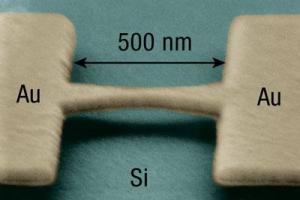
With controlled stretching of molecules, Cornell researchers have demonstrated that single-molecule devices can serve as powerful new tools for fundamental science experiments. Their work has resulted in detailed tests of long-existing theories on how electrons interact at the nanoscale.

Image
A scanning electron micrograph of a gold bridge 
suspended 40 nanometers above a silicon substrate.
In the experiment, the bridge is severed in the middle, 
a single molecule is suspended across the gap, and 
the substrate is bent to stretch the molecule while 
simultaneously measuring the electron current 
through the molecule. (Credit: J.J. Parks)

The work, led by professor of physics Dan Ralph, is published in the June 10 online edition of the journal Science. First author is J.J. Parks, a former graduate student in Ralph's lab.

The scientists studied particular cobalt-based molecules with so-called intrinsic spin -- a quantized amount of angular momentum.

Theories first postulated in the 1980s predicted that molecular spin would alter the interaction between electrons in the molecule and conduction electrons surrounding it, and that this interaction would determine how easily electrons flow through the molecule. Before now, these theories had not been tested in detail because of the difficulties involved in making devices with controlled spins.

Understanding single-molecule electronics requires expertise in both chemistry and physics, and Cornell's team has specialists in both.

"People know about high-spin molecules, but no one has been able to bring together the chemistry and physics to make controlled contact with these high-spin molecules," Ralph said.

The researchers made their observations by stretching individual spin-containing molecules between two electrodes and analyzing their electrical properties. They watched electrons flow through the cobalt complex, cooled to extremely low temperatures, while slowly pulling on the ends to stretch it. At a particular point, it became more difficult to pass current through the molecule. The researchers had subtly changed the magnetic properties of the molecule by making it less symmetric.

After releasing the tension, the molecule returned to its original shape and began passing current more easily -- thus showing the molecule had not been harmed. Measurements as a function of temperature, magnetic field and the extent of stretching gave the team new insights into exactly what is the influence of molecular spin on the electron interactions and electron flow.

The effects of high spin on the electrical properties of nanoscale devices were entirely theoretical issues before the Cornell work, Ralph said. By making devices containing individual high-spin molecules and using stretching to control the spin, the Cornell team proved that such devices can serve as a powerful laboratory for addressing these fundamental scientific questions.

The study was funded primarily by the National Science Foundation.
Enhanced by Zemanta

Monday, April 12, 2010

Exotic Quantum Spin-Liquid Simulated: A Starting Point for Superconductivity?


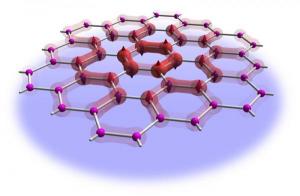
An exotic state of matter that physicists call a "quantum spin-liquid" can be realized by electrons in a honeycomb crystal structure.
flat honeycomb structure
The simulation of the quantum spin-liquid was performed 
on a flat honeycomb structure, where the electrons show
a dynamical phase lacking any order. 
(Credit: Image courtesy of University of Stuttgart)

This is shown by scientists from the Universities of Stuttgart and Würzburg, Germany in a new study published in the journal Nature.

Electrons inside a crystal exist in different states. In many cases it is the crystal structure that decides, if the material is a metal with a finite electric conductivity, or if it is an insulator, which does not carry an electric current. But there also exist insulating materials, whose crystal structures suggest that they should behave like metals. Such materials are called "Mott insulators," and it is the repulsion between the electrons, that suppresses a metallic behaviour, such that the electrons are locked to the atoms.

Such localized electrons tend to order upon lowering the temperature, such as for example in magnetic structures. A "quantum spin-liquid" however is a non-magnetic Mott-insulator that is stabilized purely by quantum mechanical effects. The electrons inside a quantum spin-liquid resist to order down to the lowest temperatures, way down to the absolute zero of temperature at minus 273 degrees Celsius. The tendency to order is suppressed by dynamical fluctuations of the electrons even at zero absolute temperature (quantum fluctuations). For this to happen, the quantum fluctuations must be sufficiently large, which is rarely the case in nature, and also hard to realize in realistic models.

Now theorists from Stuttgart University, Zi Yang Meng, Priv.-Doz. Stefan Wessel, and Prof. Alejandro Muramatsu, together with their colleges Thomas Lang and Prof. Fakher Assaad from Würzburg University, showed that such a quantum spin-liquid exists in a realistic model of interacting electrons. For their study, they used large-scale computer simulations, in order to account for both the interactions between the electrons and their quantum fluctuations. Their unexpected findings were thus accepted for publication in the "Nature" magazine.

The quantum spin-liquid found by Meng et al. occurs in materials where the atoms form a two-dimensional, periodic array of hexagons, thus realizing a honeycomb lattice. Such a crystal structre is found for example in Graphene, a two-dimensional carbon allotrope, that was only recently synthesized, and has since then been the focus of intensive research. If the electronic interactions could be enhanced in such a material, then the highly interesting quantum spin-liquid state could be realized. It appears unlikly that this can be achieved, for example by expansion, in Graphene. Thus, the physicists from Stuttgart and Würzburg suggest exploring honeycomb-like structures formed from other group IV elements that show enhanced electronic interactions. A first step in this direction might already have been taken, since previously chemist succeeded in synthesizing Graphene-like structures of silicon atoms.

Furthermore, the quantum spin-liquid should also be realizable using ultra-cold atoms. In fact, the mathematical model studied by the physicists describes both interacting electrons in solid state systems as well as interacting ultra-cold atoms in an optical lattice. The impressive progress that has been achieved in this research field opens up the possibility to realize the quantum spin-liquid with ultra-cold atoms.

Another fascinating aspect of the quantum spin-liquid is that it can also be viewed as a starting point for superconductivity. Electric currents would then flow without resistance through the material. This has potential for many applications, such as ultra fast computers or the dissipation free transport of electricity.

In their fundamental research, the two theory groups in Stuttgart and Würzburg analyse complex phases of strongly interacting quantum many-body systems in general. They discovered the quantum spin-liquid phase, while studying possible transitions between metallic and insulating phases in a model for Graphene. In the vicinity of such transitions, the quantum fluctuations become significantly enhanced, and destroy any magnetic order. The scientists could also exclude other types of electronic orders from an extensive analysis. Such a study was only possible with the help of modern supercomputers. In particular, for their calculations, the theorists could profit from the highly efficient supercomputer centers in Jülich, München and Stuttgart. For the future, they hope to apply simulations of strongly interacting electrons also to the design of novel materials that realize exotic states of matter -- including the quantum spin-liquid.

The research described above is embedded within the general research activities of the two universities. At the University of Stuttgart, the DFG research unit SFB/TRR 21, "Controll of Quantum Correlations in Tailored Matter," focuses on the realization of tailored quantum systems. Its spokesperson is Prof. Tilmann Pfau from the University of Stuttgart. At the University of Würzburg, a recently established research group "Electron Correlation-Induced Phenomena in Surfaces and Interfaces with Tuneable Interactions" complex electronic states are of central focus. Its spokesperson is Prof. Ralph Claessen from Würzburg University.