BTemplates.com

Powered by Blogger.

Pageviews past week

Quantum mechanics

Auto News

artificial intelligence

About Me

Recommend us on Google!

Information Technology

Popular Posts

Showing posts with label Climate. Show all posts

Friday, December 28, 2012

Human Evolution Driven By Changing Environment


A series of rapid environmental changes in East Africa roughly 2 million years ago may be responsible for driving human evolution, according to researchers at Penn State and Rutgers University.

The researchers examined lake sediments from Olduvai Gorge in northern Tanzania, looking for biomarkers -- fossil molecules -- from ancient trees and grasses.
The researchers examined lake sediments from Olduvai Gorge in northern Tanzania, looking for biomarkers -- fossil molecules -- from ancient trees and grasses. (Credit: Gail Ashley)

"The landscape early humans were inhabiting transitioned rapidly back and forth between a closed woodland and an open grassland about five to six times during a period of 200,000 years," said Clayton Magill, graduate student in geosciences at Penn State. "These changes happened very abruptly, with each transition occurring over hundreds to just a few thousand years."

According to Katherine Freeman, professor of geosciences, Penn State, the current leading hypothesis suggests that evolutionary changes among humans during the period the team investigated were related to a long, steady environmental change or even one big change in climate.

"There is a view this time in Africa was the 'Great Drying,' when the environment slowly dried out over 3 million years," she said. "But our data show that it was not a grand progression towards dry; the environment was highly variable."

According to Magill, many anthropologists believe that variability of experience can trigger cognitive development.

"Early humans went from having trees available to having only grasses available in just 10 to 100 generations, and their diets would have had to change in response," he said. "Changes in food availability, food type, or the way you get food can trigger evolutionary mechanisms to deal with those changes. The result can be increased brain size and cognition, changes in locomotion and even social changes -- how you interact with others in a group. Our data are consistent with these hypotheses. We show that the environment changed dramatically over a short time, and this variability coincides with an important period in our human evolution when the genus Homo was first established and when there was first evidence of tool use."

The researchers -- including Gail Ashley, professor of earth and planetary sciences, Rutgers University -- examined lake sediments from Olduvai Gorge in northern Tanzania. They removed the organic matter that had either washed or was blown into the lake from the surrounding vegetation, microbes and other organisms 2 million years ago from the sediments. In particular, they looked at biomarkers -- fossil molecules from ancient organisms -- from the waxy coating on plant leaves.

"We looked at leaf waxes because they're tough, they survive well in the sediment," said Freeman.

The team used gas chromatography and mass spectrometry to determine the relative abundances of different leaf waxes and the abundance of carbon isotopes for different leaf waxes. The data enabled them to reconstruct the types of vegetation present in the Olduvai Gorge area at very specific time intervals.

The results showed that the environment transitioned rapidly back and forth between a closed woodland and an open grassland.

To find out what caused this rapid transitioning, the researchers used statistical and mathematical models to correlate the changes they saw in the environment with other things that may have been happening at the time, including changes in the Earth's movement and changes in sea-surface temperatures.

"The orbit of the Earth around the sun slowly changes with time," said Freeman. "These changes were tied to the local climate at Olduvai Gorge through changes in the monsoon system in Africa. Slight changes in the amount of sunshine changed the intensity of atmospheric circulation and the supply of water. The rain patterns that drive the plant patterns follow this monsoon circulation. We found a correlation between changes in the environment and planetary movement."

The team also found a correlation between changes in the environment and sea-surface temperature in the tropics.

"We find complementary forcing mechanisms: one is the way Earth orbits, and the other is variation in ocean temperatures surrounding Africa," Freeman said. The researchers recently published their results in the Proceedings of the National Academy of Sciences along with another paper in the same issue that builds on these findings. The second paper shows that rainfall was greater when there were trees around and less when there was a grassland.

"The research points to the importance of water in an arid landscape like Africa," said Magill. "The plants are so intimately tied to the water that if you have water shortages, they usually lead to food insecurity.

"Together, these two papers shine light on human evolution because we now have an adaptive perspective. We understand, at least to a first approximation, what kinds of conditions were prevalent in that area and we show that changes in food and water were linked to major evolutionary changes."

The National Science Foundation funded this research.

Tuesday, July 12, 2011

Climate Change Reducing Ocean's Carbon Dioxide Uptake, New Analysis Shows


How deep is the ocean's capacity to buffer against climate change?
A new analysis provides some of the 
first observational evidence that 
climate change is negatively 
impacting the ocean carbon sink. 
(Credit: © lunamarina / Fotolia)

As one of the planet's largest single carbon absorbers, the ocean takes up roughly one-third of all human carbon emissions, reducing atmospheric carbon dioxide and its associated global changes.

But whether the ocean can continue mopping up human-produced carbon at the same rate is still up in the air. Previous studies on the topic have yielded conflicting results, says University of Wisconsin-Madison assistant professor Galen McKinley.

In a new analysis published online July 10 in Nature Geoscience, McKinley and her colleagues identify a likely source of many of those inconsistencies and provide some of the first observational evidence that climate change is negatively impacting the ocean carbon sink.

"The ocean is taking up less carbon because of the warming caused by the carbon in the atmosphere," says McKinley, an assistant professor of atmospheric and oceanic sciences and a member of the Center for Climatic Research in the Nelson Institute for Environmental Studies.

The analysis differs from previous studies in its scope across both time and space. One of the biggest challenges in asking how climate is affecting the ocean is simply a lack of data, McKinley says, with available information clustered along shipping lanes and other areas where scientists can take advantage of existing boat traffic. With a dearth of other sampling sites, many studies have simply extrapolated trends from limited areas to broader swaths of the ocean.

McKinley and colleagues at UW-Madison, the Lamont-Doherty Earth Observatory at Columbia University, and the Universite Pierre et Marie Curie in Paris expanded their analysis by combining existing data from a range of years (1981-2009), methodologies, and locations spanning most of the North Atlantic into a single time series for each of three large regions called gyres, defined by distinct physical and biological characteristics.

They found a high degree of natural variability that often masked longer-term patterns of change and could explain why previous conclusions have disagreed. They discovered that apparent trends in ocean carbon uptake are highly dependent on exactly when and where you look -- on the 10- to 15-year time scale, even overlapping time intervals sometimes suggested opposite effects.


"Because the ocean is so variable, we need at least 25 years' worth of data to really see the effect of carbon accumulation in the atmosphere," she says. "This is a big issue in many branches of climate science -- what is natural variability, and what is climate change?"

Working with nearly three decades of data, the researchers were able to cut through the variability and identify underlying trends in the surface CO2 throughout the North Atlantic.

During the past three decades, increases in atmospheric carbon dioxide have largely been matched by corresponding increases in dissolved carbon dioxide in the seawater. The gases equilibrate across the air-water interface, influenced by how much carbon is in the atmosphere and the ocean and how much carbon dioxide the water is able to hold as determined by its water chemistry.

But the researchers found that rising temperatures are slowing the carbon absorption across a large portion of the subtropical North Atlantic. Warmer water cannot hold as much carbon dioxide, so the ocean's carbon capacity is decreasing as it warms.

In watching for effects of increasing atmospheric carbon on the ocean's uptake, many people have looked for indications that the carbon content of the ocean is rising faster than that of the atmosphere, McKinley says. However, their new results show that the ocean sink could be weakening even without that visible sign.

"More likely what we're going to see is that the ocean will keep its equilibration but it doesn't have to take up as much carbon to do it because it's getting warmer at the same time," she says. "We are already seeing this in the North Atlantic subtropical gyre, and this is some of the first evidence for climate damping the ocean's ability to take up carbon from the atmosphere."

She stresses the need to improve available datasets and expand this type of analysis to other oceans, which are relatively less-studied than the North Atlantic, to continue to refine carbon uptake trends in different ocean regions. This information will be critical for decision-making, since any decrease in ocean uptake may require greater human efforts to control carbon dioxide levels in the atmosphere.

McKinley's work on the project was supported by the National Aeronautics and Space Administration.

Sunday, August 1, 2010

Signs of Reversal of Arctic Cooling: Rapid Temperature Rise in the Coldest Region of Mainland Europe


Parts of the Arctic have cooled over the past century, but temperatures have been rising steeply since 1990. This is the finding of a summer temperature reconstruction for the past 400 years produced on the base of tree rings from regions beyond the Arctic Circle.
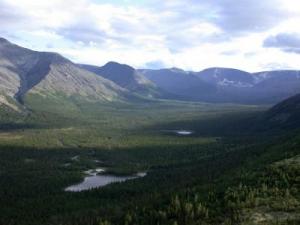
Image
This is the Kunijok Valley in the north of Khibiny 
Low Mountains (central Kola Peninsula in Arctic Russia). 
(Credit: Photo: Michael Friedrich (Institute of Botany, 
University of Hohenheim))

German and Russian researchers analysed tree growth using ring width of pine from Russia's Kola Peninsula and compared their findings with similar studies from other parts of the Arctic. For the past 400 years since AD 1600, the reconstructed summer temperature on Kola in the months of July and August has varied between 10.4°C (1709) and 14.7°C (1957), with a mean of 12.2°C. Afterwards, after a cooling phase, a ongoing warming can be observed from 1990 onwards.

Researchers from the Institute of Geography in Moscow, Hohenheim University and the Helmholtz Centre for Environmental Research (UFZ) report in journal Arctic, Antarctic and Alpine Research: "The data indicate that solar activity may have been one of the major driving factors of summer temperatures, but this has been overlaid by other factors since 1990."

The researchers used for this study wood samples from a total of 69 Scots pines (Pinus sylvestris) from the Khibiny Mountains on the Kola Peninsula, situated between the Arctic Circle and the ocean port of Murmansk, not far from the Finnish border. The investigated region is a transition zone between Scandinavia, which is strongly affected by the gulf stream resp. North Atlantic Current, and the continental regions Eurasia. This makes the region particularly interesting for climatological studies.

Kola has a cold-temperate climate with long, moderately cold winters and cool, humid summers. In this part of the Arctic, the mean temperature fluctuates between -12°C in January and +13°C in July, with a growing season of just 60 to 80 days. The northern taiga vegetation is dominated by spruce, pine and birch. The samples came from three locations in the Khibiny Mountains close to recent altitudinal timberline at altitudes of between 250 and 450 m above sea level. The geographical northern timberline lies approximately 100 km further north.

In earlier studies, researchers led by Tatjana Böttger from the UFZ were able to show that pine forests on the Kola Peninsula expanded between 7000 and 3500 years ago to about 50 km north of their present-day limit.

However, for this study, they used trees from the altitudinal timberline, since they respond very sensitively to temperature fluctuations and provide particularly useful information, as demonstrated by US researchers in November 2009 in the journal PNAS when they used a long-lived species of pine in California and Nevada to show that these trees had grown particularly fast over the last 50 of the past 3500 years because of higher temperatures.

In the Tree-Ring-Laboratory at the University of Hohenheim in Stuttgart the German researchers measured the width of the individual tree rings. The calibration of these data with the help of meteorological records for the last 127 years and the interpretation of results occurred together with Russian Academy of Sciences in Moscow and the Helmholtz Centre for Environmental Research in Halle. "Besides of temperature, growth is also strongly influenced by non-climatic factors like light, nutrients, water supply and competition from other trees. So it is vital to isolate these trends to obtain a climate signal as pure as possible," explains Yury M. Kononov from the Russian Academy of Sciences in Moscow.

Following the summer temperature reconstruction on the Kola Peninsula, the researchers compared their results with similar tree-ring studies from Swedish Lapland and from the Yamal and Taimyr Peninsulas in Russian Siberia, which had been published in Holocene in 2002. The reconstructed summer temperatures of the last four centuries from Lapland and the Kola and Taimyr Peninsulas are similar in that all three data series display a temperature peak in the middle of the twentieth century, followed by a cooling of one or two degrees. Only the data series from the Yamal Peninsula differed, reaching its peak later, around 1990. What stands out in the data from the Kola Peninsula is that the highest temperatures were found in the period around 1935 and 1955, and that by 1990 the curve had fallen to the 1870 level, which corresponds to the start of the Industrial Age.

Since 1990, however, temperatures have increased again evidently. What is conspicuous about the new data is that the reconstructed minimum temperatures coincide exactly with times of low solar activity. The researchers therefore assume that in the past, solar activity was a significant factor contributing to summer temperature fluctuations in the Arctic. However, this correlation is only visible until 1970, after which time other -- possibly regional -- factors gain the upper hand. "One thing is certain: this part of the Arctic warmed up after the end of the Little Ice Age around 250 years ago, cooled down from the middle of the last century and has been warming up again since 1990," says Dr Tatjana Böttger, a paleoclimatologist at the UFZ.

In September 2009, another international team presented model calculations showing that the Arctic had gradually cooled down by around 0.2 °C per thousand years over the last two millennia to the start of the Industrial Age. They attributed this to a gradual decline in solar radiation in the summer. However, the last decade was the warmest of the Common Era and was 1.4 °C above the forecasts, report Darrell S. Kaufman and his colleagues in Science. The new data produced by Kononov, Friedrich and Böttger support the thesis that solar activity seems to be a significant factor influencing summer temperatures in the Arctic, but that its influence has weakened considerably over the past few decades.

Thursday, December 24, 2009

Scientists Map Speed of Climate Change for Different Ecosystems


From beetles to barnacles, pikas to pine warblers, many species are already on the move in response to shifting climate regimes. But how fast will they -- and their habitats -- have to move to keep pace with global climate change over the next century? In a new study, a team of scientists including Dr. Healy Hamilton from the California Academy of Sciences have calculated that on average, ecosystems will need to shift about 0.42 kilometers per year (about a quarter mile per year) to keep pace with changing temperatures across the globe.

Subdivision in Oregon, U.S. Global warming is causing climate belts to shift toward the poles and to higher elevations. To keep pace with these changes, the average ecosystem will need to shift about a quarter mile each year, says a new study led by scientists at the Carnegie Institution. For some habitats, such as low-lying areas, climate belts are moving even faster, putting many species in jeopardy, especially where human development has blocked migration paths. (Credit: iStockphoto)

Mountainous habitats will be able to move more slowly, since a modest move up or down slope can result in a large change in temperature. However, flatter ecosystems, such as flooded grasslands, mangroves, and deserts, will need to move much more rapidly to stay in their comfort zone -- sometimes more than a kilometer per year. The team, which also included scientists from the Carnegie Institute of Science, Climate Central, and U.C. Berkeley, will publish their results in the December 24 issue of Nature.

Monday, December 7, 2009

Earth More Sensitive to Carbon Dioxide Than Previously Thought


In the long term, the Earth's temperature may be 30-50% more sensitive to atmospheric carbon dioxide than has previously been estimated, reports a new study published in Nature Geoscience.


The temperature response of the Earth (in degrees C) to an increase in atmospheric carbon dioxide from pre-industrial levels (280 parts per million by volume) to higher levels (400 parts per million by volume). (a) shows predicted global temperatures when processes that adjust on relatively short-term timescales (for example sea-ice, clouds, and water vapour) are included in the model (b) includes additional long-tem processes that adjust on relatively long timescales (vegetation and land-ice). (Credit: Image courtesy of University of Bristol)


The results show that components of the Earth's climate system that vary over long timescales -- such as land-ice and vegetation -- have an important effect on this temperature sensitivity, but these factors are often neglected in current climate models.