BTemplates.com

Powered by Blogger.

Pageviews past week

Quantum mechanics

Auto News

artificial intelligence

About Me

Recommend us on Google!

Information Technology

Popular Posts

Showing posts sorted by relevance for query quantum computer. Sort by date Show all posts

Tuesday, March 1, 2011

Atomic Antennas Transmit Quantum Information Across a Microchip


The Austrian research group led by physicist Rainer Blatt suggests a fundamentally novel architecture for quantum computation. They have experimentally demonstrated quantum antennas, which enable the exchange of quantum information between two separate memory cells located on a computer chip. This offers new opportunities to build practical quantum computers.
Quantum antennae enable the exchange of quantum 
information between two separate memory cells located 
on a computer chip. (Credit: Harald Ritsch)


The researchers have published their work in the scientific journal Nature.

Six years ago scientists at the University of Innsbruck realized the first quantum byte -- a quantum computer with eight entangled quantum particles; a record that still stands. "Nevertheless, to make practical use of a quantum computer that performs calculations, we need a lot more quantum bits," says Prof. Rainer Blatt, who, with his research team at the Institute for Experimental Physics, created the first quantum byte in an electromagnetic ion trap. "In these traps we cannot string together large numbers of ions and control them simultaneously."

To solve this problem, the scientists have started to design a quantum computer based on a system of many small registers, which have to be linked. To achieve this, Innsbruck quantum physicists have now developed a revolutionary approach based on a concept formulated by theoretical physicists Ignacio Cirac and Peter Zoller. In their experiment, the physicists electromagnetically coupled two groups of ions over a distance of about 50 micrometers. Here, the motion of the particles serves as an antenna. "The particles oscillate like electrons in the poles of a TV antenna and thereby generate an electromagnetic field," explains Blatt. "If one antenna is tuned to the other one, the receiving end picks up the signal of the sender, which results in coupling." The energy exchange taking place in this process could be the basis for fundamental computing operations of a quantum computer.

Antennas amplify transmission

"We implemented this new concept in a very simple way," explains Rainer Blatt. In a miniaturized ion trap a double-well potential was created, trapping the calcium ions. The two wells were separated by 54 micrometers. "By applying a voltage to the electrodes of the ion trap, we were able to match the oscillation frequencies of the ions," says Blatt.

"This resulted in a coupling process and an energy exchange, which can be used to transmit quantum information." A direct coupling of two mechanical oscillations at the quantum level has never been demonstrated before. In addition, the scientists show that the coupling is amplified by using more ions in each well. "These additional ions function as antennas and increase the distance and speed of the transmission," says Rainer Blatt, who is excited about the new concept. This work constitutes a promising approach for building a fully functioning quantum computer.

"The new technology offers the possibility to distribute entanglement. At the same time, we are able to target each memory cell individually," explains Rainer Blatt. The new quantum computer could be based on a chip with many micro traps, where ions communicate with each other through electromagnetic coupling. This new approach represents an important step towards practical quantum technologies for information processing.

The quantum researchers are supported by the Austrian Science Fund FWF, the European Union, the European Research Council and the Federation of Austrian Industries Tyrol.

Wednesday, September 29, 2010

Sole Electron Reader Opens Path for Quantum Computation


A team led by engineers and physicists at the University of New South Wales (UNSW) in Sydney, Australia, make developed one of the key building blocks needed to make a quantum computer using silicon: a "single electron reader."
Artist's impression of a phosphorus atom (red sphere surrounded by a blue electron cloud, with spin) coupled to a silicon single-electron transistor, to achieve single-shot readout of the phosphorus electron spin. (Credit: William Algar-Chuklin, College of Fine Arts, The University of New South Wales)

Their work was published in the journal Nature.

Quantum computers promise exponential function increases in processing speed over today's computers through their use of the "spin," or magnetic orientation, of single electrons to correspond data in their computings.

In order to employ electron spin, the quantum computer needs both a way of changing the spin state (write) and of measuring that change (read) to form a qubit -- the equivalent of the bits in a conventional computer.

In creating the single electron reader, a team of engineers and physicists led by Dr Andrea Morello and Professor Andrew Dzurak, of the School of Electrical Engineering and Telecommunications at UNSW, has for the first time made possible the measurement of the spin of one electron in silicon in a single shot experiment. The team also includes researchers from the University of Melbourne and Aalto University in Finland.

"Our device detects the spin state of a single electron in a single phosphorus atom implanted in a block of silicon. The spin state of the electron controls the flow of electrons in a nearby circuit," said Dr Morello, the lead author of the paper, Single-shot readout of an electron spin in silicon.

"Until this experiment, no-one had actually measured the spin of a single electron in silicon in a single-shot experiment."

By using silicon -- the foundation material of conventional computers -- rather than light or the esoteric materials and approaches being pursued by other researchers, the device opens the way to constructing a simpler quantum computer, scalable and amenable to mass-production.

The team has built on a body of research that has put Australia at forefront of the race to construct a working quantum computer. In 1998 Bruce Kane, then at UNSW, outlined in Nature the concept for a silicon-based quantum computer, in which the qubits are defined by single phosphorus atoms in an otherwise ultra-pure silicon chip. The new device brings his vision closer.

"We expect quantum computers will be able to perform certain tasks much faster than normal computers, such as searching databases, modelling complex molecules or developing new drugs," says co-author Prof Andrew Dzurak. "They could also crack most modern forms of encryption."

"After a decade of work trying to build this type of single atom qubit device, this is a very special moment."

Now the team has created a single electron reader, they are working to quickly complete a single electron writer and combine the two. Then they will combine pairs of these devices to create a 2-bit logic gate -- the basic processing unit of a quantum computer.

The research team is part of the Australian Research Council (ARC) Centre of Excellence for Quantum Computer Technology, which is headquartered at UNSW. The team is led by Professor Dzurak and Dr Morello, with Mr Jarryd Pla and Dr Floris Zwanenburg as key supporting experimentalists. The paper's co-authors include Prof David Jamieson from the University of Melbourne; Dr Bob Clark, Australia's Chief Defence Scientist, and 10 other researchers from UNSW, The University of Melbourne, and Finland's Aalto University.

The research was funded by: the Australian, US, and NSW governments; UNSW; and the University of Melbourne.

Sunday, April 3, 2011

World First: Calculations With 14 Quantum Bits


Quantum physicists from the University of Innsbruck have set another world record: They have achieved controlled entanglement of 14 quantum bits (qubits) and, thus, realized the largest quantum register that has ever been produced. With this experiment the scientists have not only come closer to the realization of a quantum computer but they also show surprising results for the quantum mechanical phenomenon of entanglement.
Up to 14 quantum bits were entangled in an ion trap. 
(Credit: University of Innsbruck)

The term entanglement was introduced by the Austrian Nobel laureate Erwin Schrödinger in 1935, and it describes a quantum mechanical phenomenon that while it can clearly be demonstrated experimentally, is not understood completely. Entangled particles cannot be defined as single particles with defined states but rather as a whole system. By entangling single quantum bits, a quantum computer will solve problems considerably faster than conventional computers. "It becomes even more difficult to understand entanglement when there are more than two particles involved," says Thomas Monz, junior scientist in the research group led by Rainer Blatt at the Institute for Experimental Physics at the University of Innsbruck. "And now our experiment with many particles provides us with new insights into this phenomenon," adds Blatt.

World record: 14 quantum bits

Since 2005 the research team of Rainer Blatt has held the record for the number of entangled quantum bits realized experimentally. To date, nobody else has been able to achieve controlled entanglement of eight particles, which represents one quantum byte. Now the Innsbruck scientists have almost doubled this record. They confined 14 calcium atoms in an ion trap, which, similar to a quantum computer, they then manipulated with laser light. The internal states of each atom formed single qubits and a quantum register of 14 qubits was produced. This register represents the core of a future quantum computer. In addition, the physicists of the University of Innsbruck have found out that the decay rate of the atoms is not linear, as usually expected, but is proportional to the square of the number of the qubits. When several particles are entangled, the sensitivity of the system increases significantly. "This process is known as superdecoherence and has rarely been observed in quantum processing," explains Thomas Monz. It is not only of importance for building quantum computers but also for the construction of precise atomic clocks or carrying out quantum simulations.

Increasing the number of entangled particles
By now the Innsbruck experimental physicists have succeeded in confining up to 64 particles in an ion trap. "We are not able to entangle this high number of ions yet," says Thomas Monz. "However, our current findings provide us with a better understanding about the behavior of many entangled particles." And this knowledge may soon enable them to entangle even more atoms. Some weeks ago Rainer Blatt's research group reported on another important finding in this context in the scientific journal Nature: They showed that ions might be entangled by electromagnetic coupling. This enables the scientists to link many little quantum registers efficiently on a micro chip. All these findings are important steps to make quantum technologies suitable for practical information processing," Rainer Blatt is convinced.

The results of this work are published in the scientific journal Physical Review Letters. The Innsbruck researchers are supported by the Austrian Science Fund (FWF), the European Commission and the Federation of Austrian Industries Tyrol.

Thursday, July 21, 2011

Breakthrough in Quantum Computing: Researchers Develop System That Resists 'Quantum Bug'


Scientists have taken the next major step toward quantum computing, which will use quantum mechanics to revolutionize the way information is processed.
Quantum computing uses quantum bits, or qubits, to 
encode information. (Credit: © Anterovium / Fotolia)

Quantum computers will capitalize on the mind-bending properties of quantum particles to perform complex calculations that are impossible for today's traditional computers.

Using high magnetic fields, Susumu Takahashi, assistant professor in the USC Dornsife College of Letters, Arts and Sciences, and his colleagues managed to suppress decoherence, which is one of the key stumbling blocks in quantum computing.

"High magnetic fields reduce the level of the noises in the surroundings, so they can constrain the decoherence very efficiently," Takahashi said. Decoherence has been described as a "quantum bug" that destroys fundamental properties that quantum computers would rely on.

This research will appear in the online version of Nature magazine on June 20.

Quantum computing uses quantum bits, or qubits, to encode information in the form of ones and zeros. Unlike a traditional computer that uses traditional bits, a quantum computer takes advantage of the fact seemingly impossible fact that qubits can exist in multiple states at the same time, which is called "superposition."

While can a bit can represent either a one or a zero, a qubit can represent a one and a zero at the same time due to superposition. This allows for simultaneous processing of calculations in a truly parallel system, skyrocketing computing ability.

Though the concepts underpinning quantum computing are not new, problems such as decoherence have hindered the construction of a fully functioning quantum computer.

Think of decoherence as a form of noise or interference, knocking a quantum particle out of superposition -- robbing it of that special property that makes it so useful. If a quantum computer relies on a quantum particle's ability to be both here and there, then decoherence is the frustrating phenomenon that causes a quantum particle to be either here or there.

The researchers calculated all sources of decoherence in his experiment as a function of temperature, magnetic field, and by nuclear isotopic concentrations, and suggested the optimum condition to operate qubits, reducing decoherence by approximately 1,000 times.

Qubits in his experiment lasted about 500 microseconds at the optimum condition -- ages, relatively speaking.

Decoherence in qubit systems falls into two general categories. One is an intrinsic decoherence caused by constituents in the qubit system, and the other is an extrinsic decoherence caused by imperfections of the system, for example, impurities and defects.

In their study, Takahashi and his colleagues investigated single crystals of molecular magnets. Because of their purity, molecular eliminate the extrinsic decoherence, allowing researchers to calculate intrinsic decoherence precisely.

"For the first time we've been able to predict and control all the environmental decoherence mechanisms in a very complex system -- in this case a large magnetic molecule," said Phil Stamp, UBC professor of physics and astronomy and director of the Pacific Institute of Theoretical Physics.

Using crystalline molecular magnets allowed researchers to build qubits out of multiple quantum particles, rather than a single quantum object -- the way most proto-quantum computers are built at the moment.

"This will obviously increase signals from the qubit drastically, so the detection of the qubit in the molecular magnets is much easier," Takahashi said.

Takahashi conducted his research as a project scientist in the Institute of Terahertz Science and Technology and Department of Physics at the University of California Santa Barbara and analyzed the data while at UCSB and USC. Takahashi has been in the USC Dornsife College since 2010.

Research for the article was performed in collaboration with Phil Stamp and Igor Tupitsyn of the University of British Columbia, Johan van Tol of Florida State University, and David Hendrickson of UC San Diego.

This work was supported by the National Science Foundation, the W. M. Keck Foundation, the Pacific Institute of Theoretical Physics at UBC, by the Natural Sciences and Engineering Research Council of Canada, the Canadian Institute for Advanced Research and the USC startup funds.


Saturday, June 9, 2012

Quantum Computers Move Closer to Reality, Thanks to Highly Enriched and Highly Purified Silicon


The quantum computer is a futuristic machine that could operate at speeds even more mind-boggling than the world's fastest super-computers.

SFU physicist Mike Thewalt and grad student Kamyar Saeedi with a sample of highly isotopically enriched silicon - its unique properties could advance quantum computing. (Credit: Image courtesy of Simon Fraser University)
SFU physicist Mike Thewalt and grad student Kamyar 
Saeedi with a sample of highly isotopically enriched silicon - 
its unique properties could advance quantum computing. 
(Credit: Image courtesy of Simon Fraser University)

Research involving physicist Mike Thewalt of Simon Fraser University offers a new step towards making quantum computing a reality, through the unique properties of highly enriched and highly purified silicon.

Quantum computers right now exist pretty much in physicists' concepts, and theoretical research. There are some basic quantum computers in existence, but nobody yet can build a truly practical one -- or really knows how.

Such computers will harness the powers of atoms and sub-atomic particles (ions, photons, electrons) to perform memory and processing tasks, thanks to strange sub-atomic properties.

What Thewalt and colleagues at Oxford University and in Germany have found is that their special silicon allows processes to take place and be observed in a solid state that scientists used to think required a near-perfect vacuum.

And, using this 28Si they have extended to three minutes -- from a matter of seconds -- the time in which scientists can manipulate, observe and measure the processes.

"It's by far a record in solid-state systems," Thewalt says. "If you'd asked people a few years ago if this was possible, they'd have said no. It opens new ways of using solid-state semi-conductors such as silicon as a base for quantum computing.

"You can start to do things that people thought you could only do in a vacuum. What we have found, and what wasn't anticipated, are the sharp spectral lines (optical qualities) in the 28Silicon we have been testing. It's so pure, and so perfect. There's no other material like it."

But the world is still a long way from practical quantum computers, he notes.

Quantum computing is a concept that challenges everything we know or understand about today's computers.

Your desktop or laptop computer processes "bits" of information. The bit is a fundamental unit of information, seen by your computer has having a value of either "1" or "0."

That last paragraph, when written in Word, contains 181 characters including spaces. In your home computer, that simple paragraph is processed as a string of some 1,448 "1"s and "0"s.

But in the quantum computer, the "quantum bit" (also known as a "qubit") can be both a "1" and a "0" -- and all values between 0 and 1 -- at the same time.

Says Thewalt: "A classical 1/0 bit can be thought of as a person being either at the North or South Pole, whereas a qubit can be anywhere on the surface of the globe -- its actual state is described by two parameters similar to latitude and longitude."

Make a practical quantum computer with enough qubits available and it could complete in minutes calculations that would take today's super-computers years, and your laptop perhaps millions of years.

The work by Thewalt and his fellow researchers opens up yet another avenue of research and application that may, in time, lead to practical breakthroughs in quantum computing.

Thursday, April 22, 2010

Bizarre Matter Could Find Use in Quantum Computers


There are enticing new findings in the search for materials that support fault-tolerant quantum computing. New results from Rice University and Princeton University indicate that a bizarre state of matter that acts like a particle with one-quarter electron charge also has a "quantum registry" that is immune to information loss from external perturbations.
Me
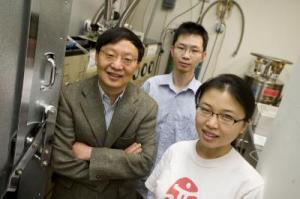
From left, Rice physicist Rui-Rui Du, graduate students Chi Zhang and Yanhua Dai, and former postdoctoral researcher Tauno Knuuttila (not pictured) have found that odd groupings of ultracold electrons could be useful in making fault-tolerant quantum computers. (Credit: Jeff Fitlow/Rice University)

The research appeared online April 21 in Physical Review Letters. The team of physicists found that ultracold mixes of electrons caught in magnetic traps could have the necessary properties for constructing fault-tolerant quantum computers -- future computers that could be far more powerful than today's computers. The mixes of electrons are dubbed "5/2 quantum Hall liquids" in reference to the unusual quantum properties that describe their makeup.

"The big goal, the whole driving force, besides deep academic curiosity, is to build a quantum computer out of this," said the study's lead author Rui-Rui Du, professor of physics at Rice. "The key for that is whether these 5/2 liquids have 'topological' properties that would render them immune to the sorts of quantum perturbations that could cause information degradation in a quantum computer."

Du said the team's results indicate the 5/2 liquids have the desired properties. In the parlance of condensed-matter physics, they are said to represent a "non-Abelian" state of matter.

Non-Abelian is a mathematical term for a system with "noncommutative" properties. In math, commutative operations, like addition, are those that have the same outcome regardless of the order in which they are carried out. So, one plus two equals three, just as two plus one equals three. In daily life, commutative and noncommutative tasks are commonplace. For example, when doing the laundry, it doesn't matter if the detergent is added before the water or the water before the detergent, but it does matter if the clothes are washed before they're placed in the dryer.

"It will take a while to fully understand the complete implications of our results, but it is clear that we have nailed down the evidence for 'spin polarization,' which is one of the two necessary conditions that must be proved to show that the 5/2 liquids are non-Abelian," Du said. "Other research teams have been tackling the second condition, the one-quarter charge, in previous experiments."

The importance of the noncommutative quantum properties is best understood within the context of fault-tolerant quantum computers, a fundamentally new type of computer that hasn't been built yet.

Computers today are binary. Their electrical circuits, which can be open or closed, represent the ones and zeros in binary bits of information. In quantum computers, scientists hope to use "quantum bits," or qubits. Unlike binary ones and zeros, the qubits can be thought of as little arrows that represent the position of a bit of quantum matter. The arrow might represent a one if it points straight up or a zero if it points straight down, but it could also represent any number in between. In physics parlance, these arrows are called quantum "states." And for certain complex calculations, being able to represent information in many different states would present a great advantage over binary computing.

The upshot of the 5/2 liquids being non-Abelian is that they have a sort of "quantum registry," where information doesn't change due to external quantum perturbations.

"In a way, they have internal memory of their previous state," Du said.

The conditions needed to create the 5/2 liquids are extreme. At Rice, Tauno Knuuttila, a former postdoctoral research scientist in Du's group, spent several years building the "demagnetization refrigerator" needed to cool 5-millimeter squares of ultrapure semiconductors to within one-10,000th of a degree of absolute zero. It took a week for Knuuttila to simply cool the nearly one-ton instrument to the necessary temperature for the Rice experiments.

The gallium arsenide semiconductors used in the tests are the most pure on the planet. They were created by Loren Pfieiffer, Du's longtime collaborator at Princeton and Bell Labs. Rice graduate student Chi Zhang conducted additional tests at the National High Magnetic Field Laboratory in Tallahassee, Fla., to verify that the 5/2 liquid was spin- polarized.

Study co-authors include Zhang, Knuuttila, Pfeiffer, Princeton's Ken West and Rice's Yanhua Dai. The research is supported by the Department of Energy, the National Science Foundation and the Keck Foundation.

Thursday, July 7, 2011

Mechanical micro-drum cooled to quantum ground state


Showcasing new tools for widespread development of quantum circuits made of mechanical parts, scientists from the National Institute of Standards and Technology have demonstrated a flexible, broadly usable technique for steadily calming the vibrations of an engineered mechanical object down to the quantum "ground state," the lowest possible energy level.
Multiple versions of NIST's superconducting circuit containing a "micro drum" were fabricated on this sapphire chip, shown next to a penny for scale. NIST scientists cooled one such drum to the lowest possible energy level, the quantum ground state. Credit: Teufel/NIST

Described in a Nature paper posted online July 6, the NIST experiments nearly stop the beating motion of a microscopic aluminum drum made of about 1 trillion atoms, placing the drum in a realm governed by quantum mechanics with its energy below a single quantum, or one unit of energy. Like a plucked guitar string that plays the same tone while the sound dissipates, the drum continues to beat 11 million times per second, but its range of motion approaches zero. The cooling technique and drum device together promise new machinery for quantum computing and tests of quantum theory, and could help advance the field of quantum acoustics exploring the quantum nature of mechanical vibrations.

NIST scientists used the pressure of microwave radiation, or light, to calm the motion of the drum, which is embedded in a superconducting circuit. The circuit is designed so that the drum motion can influence the microwaves inside an electromagnetic cavity. The cooling method takes advantage of the microwave light's tendency to change frequency, if necessary, to match the frequency, or tone, at which the cavity naturally resonates.

"I put in the light at the wrong frequency, and it comes out at the right frequency, and it does that by stealing energy from the drum motion," says John Teufel, a NIST research affiliate who designed the drum. Teufel led the cooling experiments in NIST physicist and co-author Konrad Lehnert's lab at JILA, a joint institute of NIST and the University of Colorado Boulder.

Compared to the first engineered object to be coaxed into the quantum ground state, reported by California researchers last year, the NIST drum has a higher quality factor, so it can hold a beat longer, and it beats at a much slower rate, or lower frequency. As a result, individual packets of energy, or quanta, can be stored 10,000 times longer (about 100 microseconds)—long enough to serve as a temporary memory for a quantum computer and a platform for exploring complex mechanical and quantum states. In addition, the drum motion is 40 times greater per quantum, offering the possibility, for instance, of generating larger entangled "cat states"—objects that are in two places at once and also entangled, with properties that are linked even at a distance—for tests of theories such as quantum gravity. The NIST apparatus also allows researchers to measure the position of the drum directly, which is useful for force detection, with a precision closer than ever to the ultimate limit allowed by quantum mechanics.

To make engineered bulk objects obey the rules of quantum mechanics, typically observed only in atoms and smaller particles, scientists must lower an object's temperature beyond the reach of conventional refrigeration. The California researchers were able to use a passive cryogenic refrigeration technique to chill their high-frequency device enough to reach the ground state, avoiding the need for specialized techniques.


NIST's drum required the use of "sideband cooling" to reach much colder temperatures, taking advantage of strong interactions between the drum and the microwaves. This is the same idea as laser cooling of individual atoms, first demonstrated at NIST in 1978. Now a basic tool of atomic physics worldwide, laser cooling enabled many significant advances by allowing researchers to reduce the vibrational motion of trapped atoms to less than a single quantum. Sideband refers to a collection of light particles (photons) just above or below a specific target frequency. In the case of NIST's superconducting circuit, this stray radiation pressure, as it adjusts to the surrounding environment of the cavity, steadily removes energy from the drum motion in the same way that laser cooling slows atoms in a gas.

In the NIST experiments, the drum is first chilled in a cryogenic refrigerator using liquid helium. This lowers the drum energy to about 30 quanta. Sideband cooling then reduces the drum temperature from 20 milliKelvin (thousandths of a degree above absolute zero) to below 400 microKelvin (millionths of a degree above absolute zero), steadily lowering the drum energy to just one-third of 1 quantum.

Scientists begin the sideband cooling process by applying a drive tone to the circuit at a particular frequency below the cavity resonance. The drumbeats generate sideband photons, which naturally convert to the higher frequency of the cavity. These photons leak out of the cavity as it fills up. Each departing photon takes with it one mechanical unit of energy—one phonon—from the drum motion. At a drive intensity that corresponds to 4,000 photons in the cavity, the drum motion slows to less than 1 quantum. By detecting the scattered photons leaving the cavity, scientists can measure the mechanical motion near the lowest possible limits of uncertainty. Collectively, these steps proved that the mechanical drum entered the quantum regime.

The drum apparatus has applications in quantum computers, which could someday solve certain problems that are intractable today, even with the best supercomputers. Quantum information can be stored in the mechanical state for more than 100 microseconds before absorbing one phonon from the environment—much longer than conventional superconducting quantum bits can maintain information. The drum, thus, might serve as a short-term memory device in a superconducting quantum computer circuit, a technology under development by the same NIST research group. In addition, because mechanical oscillators can interact with light of any frequency, they could act as intermediaries for transferring quantum information between microwave and optical components.

More information: J.D. Teufel, T. Donner, Dale Li, J.W. Harlow, M.S. Allman, K. Cicak, A.J. Sirois, J.D. Whittaker, K.W. Lehnert and R.W. Simmonds. 2011. Sideband cooling of micromechanical motion to the quantum ground state. Nature. Posted online July 6.

Saturday, March 19, 2011

Quantum Pen for Single Atoms Is a Big Step Toward Large-Scale Quantum Computing


Physicists at the Max Planck Institute of Quantum Optics succeeded in manipulating atoms individually in a lattice of light and in arranging them in arbitrary patterns. These results are an important step towards large scale quantum computing and for the simulation of condensed matter systems.
With the help of a laser beam, the scientists could address single atoms in the lattice of light and change their spin state. In this way they succeeded in having total control over the single atoms and in "writing" arbitrary two-dimensional patterns. (Credit: Image courtesy of Max Planck Institute of Quantum Optics)

Physicists around the world are searching for the best way to realize a quantum computer. Now scientists of the team around Stefan Kuhr and Immanuel Bloch at the Max Planck Institute of Quantum Optics (Garching/Munich) took a decisive step in this direction. They can now address and change the spin of single atoms with laser light and arrange them in arbitrary patterns. In this way, the physicists strung the atoms along a line and could directly observe their tunneling dynamics in a “racing duel” of the atoms. A register of hundreds of addressable quantum particles could serve for storing and processing of quantum information in a quantum computer.

In the present experiment, the scientists loaded laser-cooled rubidium atoms into an artificial crystal of light. These so-called optical lattices are generated by superimposing several laser beams. The atoms are kept in the lattice of light in a way similar to marbles being contained in the hollows of an egg carton.

A few months ago, the team of Stefan Kuhr and Immanuel Bloch showed that each site of the optical lattice can be filled with exactly one atom. With the help of a microscope, the scientists visualized the array atom by atom and thereby verified the shell-like structure of this “Mott insulator.” Now the scientists succeeded in individually addressing the atoms in the lattice and in changing their respective energy state. Using the microscope, they focused a laser beam down to a diameter of about 600 nanometers, which is just above the lattice spacing, and directed it at individual atoms with high precision.

The laser beam slightly deforms the electron shell of the addressed (targeted) atom and thereby changes the energy difference between its two spin states. Atoms with a spin – i.e. an intrinsic angular momentum – behave like little magnetic needles that can align in two opposite directions. If the atoms are irradiated with microwaves that are in resonance with the modified spin transition, only the addressed atoms absorb a microwave photon, which causes their spin to flip. All other atoms in the lattice remain unaffected by the microwave field.

The scientists demonstrated the high fidelity of this addressing scheme in a series of experiments. For this purpose, the spins of all atoms along a line were flipped one after the other, by moving the addressing laser from lattice site to lattice site. After removing all atoms with a flipped spin from the trap, the addressed atoms are visible as holes, which can easily be counted. In this way, the physicists deduced that the addressing worked in 95% of the cases. Atoms at the neighboring sites are not influenced by the addressing laser. The method provides the possibility to generate arbitrary distributions of atoms in the lattice.

Starting from an arrangement of 16 atoms that were strung together on neighboring lattice sites like a necklace of beads, the scientists studied what happens when the height of the lattice is ramped down so far that the particles are allowed to “tunnel” according to the rules of quantum mechanics. They move from one lattice site to the other, even if their energy is not sufficient to cross the barrier between the lattice wells. “As soon as the height of the lattice has reached the point where tunneling is possible, the particles start running as if they took part in a horse-race”, doctoral candidate Christof Weitenberg describes. “By taking snapshots of the atoms in the lattice at different times after the "starting signal", we could directly observe the quantum mechanical tunneling-effect of single massive particles in an optical lattice for the first time.”

The new addressing technique allows many interesting studies of the dynamics of collective quantum states, as they appear in solid state systems. It also opens new perspectives in quantum information processing. “A Mott isolator with exactly one atom per lattice site acts as a natural quantum register with a few hundred quantum bits, the ideal starting point for scalable quantum information processing,” as Stefan Kuhr explains. “We have shown that we can individually address single atoms. In order for the atom to suit as a quantum bit, we need to generate coherent superpositions of its two spin states. A further step is to realize elementary logical operations between two selected atoms in the lattice, so-called quantum gates.”

Saturday, June 4, 2011

Quantum Knowledge Cools Computers: New Understanding of Entropy


From a laptop warming a knee to a supercomputer heating a room, the idea that computers generate heat is familiar to everyone. But theoretical physicists have discovered something astonishing: not only do computational processes sometimes generate no heat, under certain conditions they can even have a cooling effect. Behind this finding are fundamental considerations relating to knowledge and a lack of knowledge. The researchers publish their findings in the journal Nature.
According to the latest theoretical studies, the ever-
increasing energy costs caused by supercomputers of 
the kind operated at the Swiss National Scientific 
Computing Centre in Manno (canton of Ticino) 
could be reduced. However, this would need 
a quantum computer. (Credit: Michele 
De Lorenzi / CSCS)

When computers compute, the energy they consume eventually ends up as heat. This isn't all due to the engineering of the computer -- physics has something to say about the fundamental energy cost of processing information.

Recent research by a team of physicists reveals a surprise at this fundamental level. ETH-Professor Renato Renner, and Vlatko Vedral of the Centre for Quantum Technologies at the National University of Singapore and the University of Oxford, UK, and their colleagues describe in the scientific journal Nature how the deletion of data, under certain conditions, can create a cooling effect instead of generating heat. The cooling effect appears when the strange quantum phenomenon of entanglement is invoked. Ultimately, it may be possible to harness this effect to cool supercomputers that have their performance held back by heat generation. "Achieving the control at the quantum level that would be required to implement this in supercomputers is a huge technological challenge, but it may not be impossible. We have seen enormous progress is quantum technologies over the past 20 years," says Vedral. With the technology in quantum physics labs today, it should be possible to do a proof of principle experiment on a few bits of data.

Landauer's principle is given a quantum twist

The physicist Rolf Landauer calculated back in 1961 that during the deletion of data, some release of energy in the form of heat is unavoidable. Landauer's principle implies that when a certain number of arithmetical operations per second have been exceeded, the computer will produce so much heat that the heat is impossible to dissipate. In supercomputers today other sources of heat are more significant, but Renner thinks that the critical threshold where Landauer's erasure heat becomes important may be reached within the next 10 to 20 years. The heat emission from the deletion of a ten terabyte hard-drive amounts in principle to less than a millionth of a joule. However, if such a deletion process were repeated many times per second then the heat would accumulate correspondingly.

The new study revisits Landauer's principle for cases when the values of the bits to be deleted may be known. When the memory content is known, it should be possible to delete the bits in such a manner that it is theoretically possible to re-create them. It has previously been shown that such reversible deletion would generate no heat. In the new paper, the researchers go a step further. They show that when the bits to be deleted are quantum-mechanically entangled with the state of an observer, then the observer could even withdraw heat from the system while deleting the bits. Entanglement links the observer's state to that of the computer in such a way that they know more about the memory than is possible in classical physics.

Similar formulas -- two disciplines

In order to reach this result, the scientists combined ideas from information theory and thermodynamics about a concept known as entropy. Entropy appears differently in these two disciplines, which are, to a large extent, independent of each other. In information theory, entropy is a measurement of the information density. It describes, for instance, how much memory capacity a given set of data would take up when compressed optimally. In thermodynamics, on the other hand, entropy relates to the disorder in systems, for example to the arrangement of molecules in a gas. In thermodynamics, adding entropy to a system is usually equivalent to adding energy as heat.

The ETH physicist Renner says "We have now shown that in both cases, the term entropy is actually describing the same thing even in the quantum mechanical regime." As the formulas for the two entropies look the same, it had already been assumed that there was a connection between them. "Our study shows that in both cases, entropy is considered to be a type of lack of knowledge," says Renner. The new paper in Nature builds on work published earlier in the New Journal of Physics.

In measuring entropy, one should bear in mind that an object does not have a certain amount of entropy per se, instead an object's entropy is always dependent on the observer. Applied to the example of deleting data, this means that if two individuals delete data in a memory and one has more knowledge of this data, she perceives the memory to have lower entropy and can then delete the memory using less energy. Entropy in quantum physics has the unusual property of sometimes being negative when calculated from the information theory point of view. Perfect classical knowledge of a system means the observer perceives it to have zero entropy. This corresponds to the memory of the observer and that of the system being perfectly correlated, as much as allowed in classical physics. Entanglement gives the observer „more than complete knowledge" because quantum correlations are stronger than classical correlations. This leads to an entropy less than zero. Until now, theoretical physicists had used this negative entropy in calculations without understanding what it might mean in thermodynamic terms or experimentally.

No heat, even a cooling effect

In the case of perfect classical knowledge of a computer memory (zero entropy), deletion of the data requires in theory no energy at all. The researchers prove that "more than complete knowledge" from quantum entanglement with the memory (negative entropy) leads to deletion of the data being accompanied by removal of heat from the computer and its release as usable energy. This is the physical meaning of negative entropy.

Renner emphasizes, however, "This doesn't mean that we can develop a perpetual motion machine." The data can only be deleted once, so there is no possibility to continue to generate energy. The process also destroys the entanglement, and it would take an input of energy to reset the system to its starting state. The equations are consistent with what's known as the second law of thermodynamics: the idea that the entropy of the universe can never decrease. Vedral says "We're working on the edge of the second law. If you go any further, you will break it."

Fundamental findings

The scientists' new findings relating to entropy in thermodynamics and information theory may have usefulness beyond calculating the heat production of computers. For example, methods developed within information theory to handle entropy could lead to innovations in thermodynamics. The connection made between the two concepts of entropy is fundamental.

Saturday, October 2, 2010

Three Solid-State Qubits Entangled: Big Step Toward Quantum Error Correction


The rules that govern the world of the very small, quantum mechanics, are known for being bizarre. One of the strangest tenets is something called quantum entanglement, in which two or more objects (such as particles of light, called photons) become inextricably linked, so that measuring certain properties of one object reveals information about the other(s), even if they are separated by thousands of miles. Einstein found the consequences of entanglement so unpalatable he famously dubbed it "spooky action at a distance."
The quantum entanglement of three solid-state qubits, or quantum bits, represents the first step towards quantum error correction, a crucial aspect of future quantum computing. (Credit: iStockphoto/Yenwen Lu)

Now a team led by Yale researchers has harnessed this counterintuitive aspect of quantum mechanics and achieved the entanglement of three solid-state qubits, or quantum bits, for the first time. Their accomplishment, described in the Sept. 30 issue of the journal Nature, is a first step towards quantum error correction, a crucial aspect of future quantum computing.

"Entanglement between three objects has been demonstrated before with photons and charged particles," said Steven Girvin, the Eugene Higgins Professor of Physics & Applied Physics at Yale and an author of the paper. "But this is the first three-qubit, solid-state device that looks and feels like a conventional microprocessor."

The new result builds on the team's development last year of the world's first rudimentary solid-state quantum processor, which they demonstrated was capable of executing simple algorithms using two qubits.

The team, led by Robert Schoelkopf, the William A. Norton Professor of Applied Physics & Physics at Yale, used artificial "atoms" -- actually made up of a billion aluminum atoms that behave as a single entity -- as their qubits. These "atoms" can occupy two different energy states, akin to the "1" and "0" or "on" and "off" states of regular bits used in conventional computers. The strange laws of quantum mechanics, however, allow for qubits to be placed in a "superposition" of these two states at the same time, resulting in far greater information storage and processing power.

In this new study, the team was able to achieve an entangled state by placing the three qubits in a superposition of two possibilities -- all three were either in the 0 state or the 1 state. They were able to attain this entangled state 88 percent of the time.

With the particular entangled state the team achieved, they also demonstrated for the first time the encoding of quantum information from a single qubit into three qubits using a so-called repetition code. "This is the first step towards quantum error correction, which, as in a classical computer, uses the extra qubits to allow the computer to operate correctly even in the presence of occasional errors," Girvin said.

Such errors might include a cosmic ray hitting one of the qubits and switching it from a 0 to a 1 state, or vice versa. By replicating the qubits, the computer can confirm whether all three are in the same state (as expected) by checking each one against the others.

"Error correction is one of the holy grails in quantum computing today," Schoelkopf said. "It takes at least three qubits to be able to start doing it, so this is an exciting step."

Other authors of the paper include Leonardo DiCarlo, Matthew Reed, Luyan Sun, Blake Johnson, Jerry Chow and Michel Devoret (all of Yale University); and Jay Gambetta (University of Waterloo).

Saturday, June 25, 2011

Optical circuit enables new approach to quantum technologies


An international research group led by scientists from the University of Bristol, UK, and the Universities of Osaka and Hokkaido, Japan, has demonstrated a fundamental building block for quantum computing that could soon be employed in a range of quantum technologies.

Professor Jeremy O’Brien, Director of the University of Bristol’s Centre for Quantum Photonics, and his Japanese colleagues have demonstrated a quantum logic gate acting on four particles of light – photons. The researchers believe their device could provide important routes to new quantum technologies, including secure communication, precision measurement, and ultimately a quantum computer—a powerful type of computer that uses quantum bits (qubits) rather than the conventional bits used in today’s computers.

Unlike conventional bits or transistors, which can be in one of only two states at any one time (1 or 0), a qubit can be in several states at the same time and can therefore be used to hold and process a much larger amount of information at a greater rate.

“We have realised a fundamental element for processing quantum information—a controlled-NOT or CNOT gate—based on a recipe that was theoretically proposed 10 years ago,” said Professor O’Brien. “The reason it has taken so long to achieve this milestone is that even for such a relatively simple circuit we require complete control over four single photons whizzing around at the speed of light!”

The approach taken by Professor O’Brien and his colleagues combined several methods for making optical circuits that must be stable to within a fraction of the wavelength of light, that is, nanometres. In 2001 optical quantum computing became possible when a theoretical recipe for realising this CNOT gate, as well as the other necessary components, was developed. However, the technological challenges associated with making the optical circuits have prevented its realisation until now. The implications for this new approach are far-reaching.

“The ability to implement such a logic gate on photons is critical for building up larger scale circuits and even algorithms,” said Professor O’Brien. “Using an integrated optics on a chip approach that we have pioneered here at Bristol over the last several years will enable this to proceed far more rapidly, paving the way to quantum technologies that will help us understand the most complex scientific problems.”


In the short term, the team expect to apply their new results immediately for developing new approaches to quantum communication and measurement and then for simulation tools in their lab. In the longer term, a small-scale quantum simulator based on a multi-photon optical circuit could be used to simulate processes which themselves are governed by quantum mechanics, such as superconductivity and photosynthesis. “Our technique could improve our understanding of such important processes and help, for example, in the development of more efficient solar cells,” said Professor O’Brien. Other applications include the development of ultra-fast and efficient search engines, designing high-tech materials and new pharmaceuticals.

The leap from using one photon to two photons is not trivial because the two particles need to be identical in every way and because of the way these particles interfere, or interact, with each other. There is no direct analogue of this interaction outside of quantum physics.

“Now that we can implement the fundamental building blocks for quantum circuits, the move to a larger scale devices will become our focus. Because of the increasingly complexity the results will be just as exciting” said Professor O’Brien. “Each time we add a photon, the complexity of the problem we are able to investigate increases exponentially, so if a one-photon quantum circuit has 10 outcomes, a two-photon system can give 100 outcomes and a three-photon system 1000 solutions and so on.”

The Centre for Quantum Photonics now plans to use their chip-based approach to increase the complexity of their experiment not only by adding more photons but also by using larger circuits.

The research is published in Proceedings of the National Academy of Sciences.

Wednesday, July 7, 2010

Bridge to the Quantum World: Darwinian Concept of Natural Selection Figures Into Theory About Core of Physical Reality


Science fiction has nothing over quantum physics when it comes to presenting us with a labyrinthine world that can twist your mind into knots when you try to make sense of it.
Quantum World
Researchers believe they've opened a door to a clearer 
view of how the common, everyday world we experience 
through our senses emerges from the ethereal 
quantum world. (Credit: iStockphoto)

A team of Arizona State University researchers, however, believes they've opened a door to a clearer view of how the common, everyday world we experience through our senses emerges from the ethereal quantum world.

Physicists call our familiar everyday environment the classical world. That's the world in which we and the things around us appear to have measurable characteristics such as mass, height, color, weight, texture and shape.

The quantum world is the world of the elemental building block of matter -- atoms. Atoms are combinations of neutrons and protons and electrons bound to a nucleus by electrical attraction.

But most of an atom -- more than 99 percent of it -- is empty space filled with invisible energy.

So from a quantum-world view, we and the things around us are mostly empty space. The way we experience ourselves and other things in the classical world is really just "a figment of our imaginations shaped by our senses," explains ASU Regents' Professor David Ferry.

For more than a century, scientists and engineers have struggled to come to a satisfactory conclusion about the missing link that bridges the classical and quantum worlds and enables a transition from that world of mostly empty space to the familiar environment we experience through our senses.

One proposed scenario based on these questions was investigated in a dissertation written by Adam Burke to earn his doctorate in electrical engineering in 2009 from ASU's Ira A. Fulton Schools of Engineering.

To try working out an answer to some of the questions, Burke teamed with Ferry, a professor in the School of Electrical, Computer and Energy Engineering, Tim Day, who recently earned his doctorate in electrical engineering from the school, physicist Richard Akis, an associate research professor in the school, Gil Speyer, an assistant research scientist for the engineering schools' High Performance Computing Initiative, and Brian Bennett, a materials scientist with the Naval Research Laboratory.

The result is an article published recently in the research journal Physical Review Letters. It describes the transition from quantum to classical world as a "decoherence" process that involves a kind of evolutionary progression somewhat analogous to Charles Darwin's concept of natural selection.

The authors built on two theories called decoherence and quantum Darwinism, both proposed by Los Alamos National Laboratory researcher Wojciech Zurek.

The decoherence concept holds that many quantum states "collapse" into a "broad diaspora," or dispersion, while interacting with the environment. Through a selection process, other quantum states arrive at a final stable state, called a pointer state, which is "fit enough" (think "survival of the fittest" in Darwinian terms) to be transmitted through the environment without collapsing.

These single states with the lowest energy can then make high-energy copies of themselves that can be described by the Darwinian process and observed on the macroscopic scale in the classical world.

The experiments arose from using advanced scanning gate microscopy to obtain images of what are called quantum dots.

Burke, now doing research in a post-doctoral program at the University of New South Wales in Sydney, Australia, explains it like this:

Imagine the quantum dot as a billiard table in which the quantum point contacts are the two openings through which a ball could enter or leave the dot, and the interior walls of the dot act as bumpers.

If there were no friction on the table, a billiard ball with an initial trajectory would bounce off of these walls until eventually finding an exit and leaving the dot (this is the decoherence part).

Or it might find a trajectory that does not couple to the openings and would therefore be a surviving pointer state, what is called a diamond state.

One difference between the classical physics of billiard balls and the quantum physics of electrons is that an electron can tunnel through "forbidden phase space" to enter this diamond state, whereas a billiard ball entering from outside the dot would not find itself able to reach this diamond trajectory.

It is this isolated classical trajectory, and the buildup of an electron wave functions' amplitude along that trajectory, that is referred to as a scarred wave function.

To experimentally measure these scars, imagine that we can't see inside the walls of our billiard table, but we can count the billiard balls exiting the table. This is what is normally measured with the conductance of the quantum dot and its environment.

"We measure the current through the dot, the numbers of 'billiard balls' passing through it per second, to try to see how this changes when we move our probe around the 'billiard table,' " Ferry says.

Furthermore, there is the probe of the scanning gate microscope, which applies a small electric field. This can be pictured as a small circular bumper on the billiard table that can be moved around within the dot.

This small "bumper" is rastered left to right, top to bottom over the area of interest. If a ball is traveling along this diamond pattern it is perturbed by the bumper when it rasters into the trajectory.

Think of rastering like the way a television image works, with a pattern of scanning lines that cover the area on which the image is projected, or a set or horizontal lines composed of individual pixels that are used to form an image on a computer screen.

When this happens, the ball bounces off the perturbation, and takes a new course within the dot until finally coupling out one of the openings to be measured. The change in the ball's motion appears as a change in the conductance -- the number of balls going through the openings in a given time.

Ferry explains: "With scanning gate microscopy, we monitor where these changes occur within the scans, and hopefully this gives us a map of the scarred wave functions corresponding to the pointer states."

Quantum mechanically, he says, a new electron will tunnel right into the diamond state, so the measurement can continue until the whole area is mapped.

The data that came from the team's experiment supports Zurek's theories of decoherence and quantum Darwinism, Burke says.

Ferry says these findings are just one step in a process that is open to conjecture, but they point toward a "smoking gun" for the existence of this quantum Darwinism and a new view in the search for evidence of how the quantum-to-classical world transition actually occurs.

If you can wrap your mind around all this, he says, "You open the door to a deeper understanding of what is really going on" at the core of physical reality.