BTemplates.com

Powered by Blogger.

Pageviews past week

Quantum mechanics

Auto News

artificial intelligence

About Me

Recommend us on Google!

Information Technology

Popular Posts

Friday, July 26, 2013

Bad Night's Sleep? The Moon Could Be to Blame


8G43FPT25P63

Many people complain about poor sleep around the full moon, and now a report appearing in Current Biology, a Cell Press publication, on July 25 offers some of the first convincing scientific evidence to suggest that this really is true. The findings add to evidence that humans -- despite the comforts of our civilized world -- still respond to the geophysical rhythms of the moon, driven by a circalunar clock.

Many people complain about poor sleep around the full moon, and now a report appearing in Current Biology, a Cell Press publication, on July 25 offers some of the first convincing scientific evidence to suggest that this really is true. The findings add to evidence that humans -- despite the comforts of our civilized world -- still respond to the geophysical rhythms of the moon, driven by a circalunar clock.
Many people complain about poor sleep around the full moon, and now a report appearing in Current Biology, a Cell Press publication, on July 25 offers some of the first convincing scientific evidence to suggest that this really is true. The findings add to evidence that humans -- despite the comforts of our civilized world -- still respond to the geophysical rhythms of the moon, driven by a circalunar clock. (Credit: Current Biology, Cajochen et al.)

"The lunar cycle seems to influence human sleep, even when one does not 'see' the moon and is not aware of the actual moon phase," says Christian Cajochen of the Psychiatric Hospital of the University of Basel.

In the new study, the researchers studied 33 volunteers in two age groups in the lab while they slept. Their brain patterns were monitored while sleeping, along with eye movements and hormone secretions.

The data show that around the full moon, brain activity related to deep sleep dropped by 30 percent. People also took five minutes longer to fall asleep, and they slept for twenty minutes less time overall. Study participants felt as though their sleep was poorer when the moon was full, and they showed diminished levels of melatonin, a hormone known to regulate sleep and wake cycles.

"This is the first reliable evidence that a lunar rhythm can modulate sleep structure in humans when measured under the highly controlled conditions of a circadian laboratory study protocol without time cues," the researchers say.

Cajochen adds that this circalunar rhythm might be a relic from a past in which the moon could have synchronized human behaviors for reproductive or other purposes, much as it does in other animals. Today, the moon's hold over us is usually masked by the influence of electrical lighting and other aspects of modern life.

The researchers say it would be interesting to look more deeply into the anatomical location of the circalunar clock and its molecular and neuronal underpinnings. And, they say, it could turn out that the moon has power over other aspects of our behavior as well, such as our cognitive performance and our moods.

Tuesday, July 16, 2013

Computer as Smart as a 4-Year-Old? Researchers IQ Test New Artificial Intelligence System


Artificial and natural knowledge researchers at the University of Illinois at Chicago have IQ-tested one of the best available artificial intelligence systems to see how intelligent it really is.

Artificial and natural knowledge researchers at the University of Illinois at Chicago have IQ-tested one of the best available artificial intelligence systems to see how intelligent it really is.
Artificial and natural knowledge researchers IQ-tested 
one of the best available artificial intelligence systems 
and learned that it's about as smart as the average 
4-year-old. (Credit: © Spofi / Fotolia)
Turns out it's about as smart as the average 4-year-old, they will report July 17 at the U.S. Artificial Intelligence Conference in Bellevue, Wash.

The UIC team put ConceptNet 4, an artificial intelligence system developed at M.I.T., through the verbal portions of the Weschsler Preschool and Primary Scale of Intelligence Test, a standard IQ assessment for young children.

They found ConceptNet 4 has the average IQ of a young child. But unlike most children, the machine's scores were very uneven across different portions of the test.

"If a child had scores that varied this much, it might be a symptom that something was wrong," said Robert Sloan, professor and head of computer science at UIC, and lead author on the study.

Sloan said ConceptNet 4 did very well on a test of vocabulary and on a test of its ability to recognize similarities.

"But ConceptNet 4 did dramatically worse than average on comprehension­the 'why' questions," he said.

One of the hardest problems in building an artificial intelligence, Sloan said, is devising a computer program that can make sound and prudent judgment based on a simple perception of the situation or facts-the dictionary definition of commonsense.

Commonsense has eluded AI engineers because it requires both a very large collection of facts and what Sloan calls implicit facts-things so obvious that we don't know we know them. A computer may know the temperature at which water freezes, but we know that ice is cold.

"All of us know a huge number of things," said Sloan. "As babies, we crawled around and yanked on things and learned that things fall. We yanked on other things and learned that dogs and cats don't appreciate having their tails pulled." Life is a rich learning environment.

"We're still very far from programs with commonsense-AI that can answer comprehension questions with the skill of a child of 8," said Sloan. He and his colleagues hope the study will help to focus attention on the "hard spots" in AI research.

Study coauthors are UIC professors Stellan Ohlsson of psychology and Gyorgy Turan of mathematics, statistics and computer science; and UIC mathematical computer science undergraduate student Aaron Urasky.

The study was supported by award N00014-09-1-0125 from the Office of Naval Research and grant CCF-0916708 from the National Science Foundation.

Friday, July 5, 2013

For better batteries, just add water


A new type of lithium-ion battery that uses aqueous iodide ions in an aqueous cathode configuration provides twice the energy density of conventional lithium-ion batteries.

A new type of lithium-ion battery that uses aqueous iodide ions
in an aqueous cathode configuration provides twice the energy
density of conventional lithium-ion batteries.
Lithium-ion batteries are now found everywhere in devices such as cellular phones and laptop computers, where they perform well. In automotive applications, however, engineers face the challenge of squeezing enough lithium-ion batteries onto a vehicle to provide the desired power and range without introducing storage and weight issues. Hye Ryung Byon, Yu Zhao and Lina Wang from the RIKEN Byon Initiative Research Unit have now developed a lithium-iodine battery system with twice the energy density of conventional lithium-ion batteries.

Byon's team is involved in alternative energy research and, specifically, improving the performance of lithium-based battery technologies. In their research they turned to an 'aqueous' system in which the organic electrolyte in conventional lithium-ion cells is replaced with water. Such aqueous lithium battery technologies have gained attention among alternative energy researchers because of their greatly reduced fire risk and environmental hazard. Aqueous solutions also have other advantages, which include an inherently high ionic conductivity.

For their battery system, the researchers investigated an 'aqueous cathode' configuration (Fig. 1), which accelerates reduction and oxidation reactions to improve battery performance. Finding suitable reagents for the aqueous cathode, however, proved to be a tricky proposition. According to Byon, water solubility is the most important criterion for screening new materials, since this parameter determines the battery's energy density. Furthermore, the redox reaction has to take place in a restricted voltage range in order to avoid water electrolysis. An extensive search led the researchers to produce the first-ever lithium battery involving aqueous iodine—an element with high water solubility and a pair of ions, known as the triiodide/iodide redox couple, that readily undergo aqueous electrochemical reactions.

The team constructed a prototype aqueous cathode device and found the energy density to be nearly double that of a conventional lithium-ion battery, thanks to the high solubility of the triiodide/iodide ions. Their battery had high and near-ideal power storage capacities and could be successfully recharged hundreds of times, avoiding a problem that plagues other alternative high-energy-density lithium-ion batteries. Microscopy analysis revealed that the cathode collector remained untouched after 100 charge/discharge cycles with no observable corrosion or precipitate formation.

Byon and colleagues now plan to develop a three-dimensional, microstructured current collector that could enhance the diffusion-controlled triiodide/iodide process and accelerate charge and discharge. They are also seeking to raise energy densities even further by using a flowing-electrode configuration that stores aqueous 'fuel' in an external reservoir—a modification that should make this low-cost, heavy metal-free design more amenable to electric vehicle specifications.

More information: 1.Zhao, Y., Wang, L. & Byon, H. R. High-performance rechargeable lithium-iodine batteries using triiodide/iodide redox couples in an aqueous cathode. Nature Communications 4, 1896 (2013). dx.doi.org/10.1038/ncomms2907

Wednesday, July 3, 2013

Microsoft creates mood sensing software for smartphones


Microsoft Research Asia has been working on creating software called MoodScope that notes how a user uses his or her phone, and then uses that information to guess that user's mood. Initial testing of the device has shown it to be 66 percent accurate; when tailored to an individual user, the team reports that the accuracy rate jumped to 93 percent. The research team includes Nicholas Lane and Robert LiKamWa of Rice University, and Lin Zhong and Yunxin Liu from Microsoft Research Asia. They built a prototype and posted their test study results on Microsoft's website.
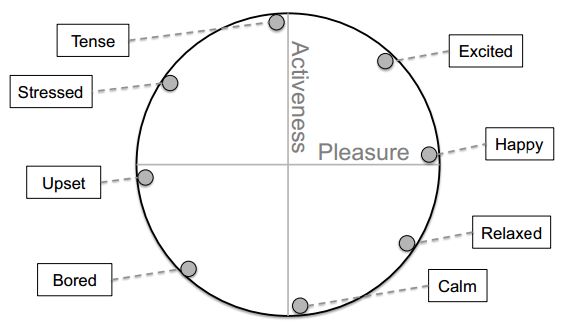
The circumplex mood model.
The circumplex mood model. Credit: Robert LiKamWa et al.

Most people realize that their smartphone has a lot of embedded technology in it that interacts with the world at large—GPS hardware, accelerometers, etc. all monitor activity and use that data to provide useful functions, such as automatically switching from landscape to portrait mode when a phone is rotated. In this new effort, the researchers sought to discover whether software that monitors phone activities could reveal the users' moods.

To find out, the team wrote code that monitored email, texting, app usage, phone calls, location information, and browsing history, then added algorithms to guess mood based on that data. Next, they enlisted the assistance of 32 volunteers to help them test the accuracy of their code. The volunteers were asked to use the system for two months while also completing mood assessments to provide data for comparison. With no training or tweaking, the software was found to provide answers of happy, tense, calm, upset, excited, stressed, or bored that matched the actual mood reported by the volunteers, on average 66 percent of the time. After optimizing the system for the individual habits of each of the volunteers, the rate increased to 93 percent.

The researchers suggest third party hooks could be added to the software to allow for automatically transmitting user moods to applications like Facebook. They also acknowledge that privacy concerns could arise if the software were to be delivered to the public, but suggest the benefits of such software would likely outweigh such concerns. They note that sites like Netflix or Spotify could use data from MoodScope to offer movies or other content based on specific users' moods.


The team presented their findings at MobiSys 2013 held in Taiwan last month.


More information: MoodScope Building a Mood Sensor from Smartphone Usage Patterns: research.microsoft.com/apps/pubs/default.aspx?id=194498
 

Research paper: www.ruf.rice.edu/~mobile/publications/likamwa2013mobisys2.pdf

Sunday, June 30, 2013

Imagination Can Change What We Hear and See


A study from Karolinska Institut in Sweden shows, that our imagination may affect how we experience the world more than we perhaps think. What we imagine hearing or seeing "in our head" can change our actual perception. The study, which is published in the scientific journal Current Biology, sheds new light on a classic question in psychology and neuroscience -- about how our brains combine information from the different senses.

Illusion of colliding objects.
Illusion of colliding objects. (Credit: Image courtesy of Karolinska Institutet)

"We often think about the things we imagine and the things we perceive as being clearly dissociable," says Christopher Berger, doctoral student at the Department of Neuroscience and lead author of the study. "However, what this study shows is that our imagination of a sound or a shape changes how we perceive the world around us in the same way actually hearing that sound or seeing that shape does. Specifically, we found that what we imagine hearing can change what we actually see, and what we imagine seeing can change what we actually hear."

The study consists of a series of experiments that make use of illusions in which sensory information from one sense changes or distorts one's perception of another sense. Ninety-six healthy volunteers participated in total.

In the first experiment, participants experienced the illusion that two passing objects collided rather than passed by one-another when they imagined a sound at the moment the two objects met. In a second experiment, the participants' spatial perception of a sound was biased towards a location where they imagined seeing the brief appearance of a white circle. In the third experiment, the participants' perception of what a person was saying was changed by their imagination of a particular sound.

According to the scientists, the results of the current study may be useful in understanding the mechanisms by which the brain fails to distinguish between thought and reality in certain psychiatric disorders such as schizophrenia. Another area of use could be research on brain computer interfaces, where paralyzed individuals' imagination is used to control virtual and artificial devices.

"This is the first set of experiments to definitively establish that the sensory signals generated by one's imagination are strong enough to change one's real-world perception of a different sensory modality" says Professor Henrik Ehrsson, the principle investigator behind the study.

Saturday, June 29, 2013

A Telescope for Your Eye: New Contact Lens Design May Improve Sight of Patients With Macular Degeneration


Contact lenses correct many people's eyesight but do nothing to improve the blurry vision of those suffering from age-related macular degeneration (AMD), the leading cause of blindness among older adults in the western world. That's because simply correcting the eye's focus cannot restore the central vision lost from a retina damaged by AMD. Now a team of researchers from the United States and Switzerland led by University of California San Diego Professor Joseph Ford has created a slim, telescopic contact lens that can switch between normal and magnified vision. With refinements, the system could offer AMD patients a relatively unobtrusive way to enhance their vision.

This image shows five views of the switchable telescopic contact lens. a) From front. b) From back. c) On the mechanical model eye. d) With liquid crystal glasses. Here, the glasses block the unmagnified central portion of the lens. e) With liquid crystal glasses. Here, the central portion is not blocked.
This image shows five views of the switchable telescopic contact lens. a) From front. b) From back. c) On the mechanical model eye. d) With liquid crystal glasses. Here, the glasses block the unmagnified central portion of the lens. e) With liquid crystal glasses. Here, the central portion is not blocked. (Credit: Optics Express)

The team reports its work in the Optical Society's (OSA) open-access journal Optics Express.

Visual aids that magnify incoming light help AMD patients see by spreading light around to undamaged parts of the retina. These optical magnifiers can assist patients with a variety of important everyday tasks such as reading, identification of faces, and self-care. But these aids have not gained widespread acceptance because they either use bulky spectacle-mounted telescopes that interfere with social interactions, or micro-telescopes that require surgery to implant into the patient's eye.

"For a visual aid to be accepted it needs to be highly convenient and unobtrusive," says co-author Eric Tremblay of the École Polytechnique Fédérale de Lausanne (EPFL) in Switzerland. A contact lens is an "attractive compromise" between the head-mounted telescopes and surgically implanted micro-telescopes, Tremblay says.

The new lens system developed by Ford's team uses tightly fitting mirror surfaces to make a telescope that has been integrated into a contact lens just over a millimeter thick. The lens has a dual modality: the center of the lens provides unmagnified vision, while the ring-shaped telescope located at the periphery of the regular contact lens magnifies the view 2.8 times.

To switch back and forth between the magnified view and normal vision, users would wear a pair of liquid crystal glasses originally made for viewing 3-D televisions. These glasses selectively block either the magnifying portion of the contact lens or its unmagnified center. The liquid crystals in the glasses electrically change the orientation of polarized light, allowing light with one orientation or the other to pass through the glasses to the contact lens.

The team tested their design both with computer modeling and by fabricating the lens. They also created a life-sized model eye that they used to capture images through their contact lens-eyeglasses system. In constructing the lens, researchers relied on a robust material commonly used in early contact lenses called polymethyl methacrylate (PMMA). The team needed that robustness because they had to place tiny grooves in the lens to correct for aberrant color caused by the lens' shape, which is designed to conform to the human eye.

Tests showed that the magnified image quality through the contact lens was clear and provided a much larger field of view than other magnification approaches, but refinements are necessary before this proof-of-concept system could be used by consumers. The researchers report that the grooves used to correct color had the side effect of degrading image quality and contrast. These grooves also made the lens unwearable unless it is surrounded by a smooth, soft "skirt," something commonly used with rigid contact lenses today. Finally, the robust material they used, PMMA, is not ideal for contact lenses because it is gas-impermeable and limits wear to short periods of time.

The team is currently pursuing a similar design that will still be switchable from normal to telescopic vision, but that will use gas-permeable materials and will correct aberrant color without the need for grooves to bend the light. They say they hope their design will offer improved performance and better sight for people with macular degeneration, at least until a more permanent remedy for AMD is available.

"In the future, it will hopefully be possible to go after the core of the problem with effective treatments or retinal prosthetics," Tremblay says. "The ideal is really for magnifiers to become unnecessary. Until we get there, however, contact lenses may provide a way to make AMD a little less debilitating."

Friday, June 28, 2013

Breaking habits before they start


Our daily routines can become so ingrained that we perform them automatically, such as taking the same route to work every day. Some behaviors, such as smoking or biting your fingernails, become so habitual that we can't stop even if we want to.


Although breaking habits can be hard, MIT neuroscientists have now shown that they can prevent them from taking root in the first place, in rats learning to run a maze to earn a reward. The researchers first demonstrated that activity in two distinct brain regions is necessary in order for habits to crystallize. Then, they were able to block habits from forming by interfering with activity in one of the brain regions—the infralimbic (IL) cortex, which is located in the prefrontal cortex.

The MIT researchers, led by Institute Professor Ann Graybiel, used a technique called optogenetics to block activity in the IL cortex. This allowed them to control cells of the IL cortex using light. When the cells were turned off during every maze training run, the rats still learned to run the maze correctly, but when the reward was made to taste bad, they stopped, showing that a habit had not formed. If it had, they would keep going back by habit.

"It's usually so difficult to break a habit," Graybiel says. "It's also difficult to have a habit not form when you get a reward for what you're doing. But with this manipulation, it's absolutely easy. You just turn the light on, and bingo."

Graybiel, a member of MIT's McGovern Institute for Brain Research, is the senior author of a paper describing the findings in the June 27 issue of the journal Neuron. Kyle Smith, a former MIT postdoc who is now an assistant professor at Dartmouth College, is the paper's lead author.

Patterns of habitual behavior

Previous studies of how habits are formed and controlled have implicated the IL cortex as well as the striatum, a part of the brain related to addiction and repetitive behavioral problems, as well as normal functions such as decision-making, planning and response to reward. It is believed that the motor patterns needed to execute a habitual behavior are stored in the striatum and its circuits.

Recent studies from Graybiel's lab have shown that disrupting activity in the IL cortex can block the expression of habits that have already been learned and stored in the striatum. Last year, Smith and Graybiel found that the IL cortex appears to decide which of two previously learned habits will be expressed.

"We have evidence that these two areas are important for habits, but they're not connected at all, and no one has much of an idea of what the cells are doing as a habit is formed, as the habit is lost, and as a new habit takes over," Smith says.

To investigate that, Smith recorded activity in cells of the IL cortex as rats learned to run a maze. He found activity patterns very similar to those that appear in the striatum during habit formation. Several years ago, Graybiel found that a distinctive "task-bracketing" pattern develops when habits are formed. This means that the cells are very active when the animal begins its run through the maze, are quiet during the run, and then fire up again when the task is finished.

This kind of pattern "chunks" habits into a large unit that the brain can simply turn on when the habitual behavior is triggered, without having to think about each individual action that goes into the habitual behavior.

The researchers found that this pattern took longer to appear in the IL cortex than in the striatum, and it was also less permanent. Unlike the pattern in the striatum, which remains stored even when a habit is broken, the IL cortex pattern appears and disappears as habits are formed and broken. This was the clue that the IL cortex, not the striatum, was tracking the development of the habit.

Multiple layers of control


The researchers' ability to optogenetically block the formation of new habits suggests that the IL cortex not only exerts real-time control over habits and compulsions, but is also needed for habits to form in the first place.

"The previous idea was that the habits were stored in the sensorimotor system and this cortical area was just selecting the habit to be expressed. Now we think it's a more fundamental contribution to habits, that the IL cortex is more actively making this happen," Smith says.

This arrangement offers multiple layers of control over habitual behavior, which could be advantageous in reining in automatic behavior, Graybiel says. It is also possible that the IL cortex is contributing specific pieces of the habitual behavior, in addition to exerting control over whether it occurs, according to the researchers. They are now trying to determine whether the IL cortex and the striatum are communicating with and influencing each other, or simply acting in parallel.

The study suggests a new way to look for abnormal activity that might cause disorders of repetitive behavior, Smith says. Now that the researchers have identified the neural signature of a normal habit, they can look for signs of habitual behavior that is learned too quickly or becomes too rigid. Finding such a signature could allow scientists to develop new ways to treat disorders of repetitive behavior by using deep brain stimulation, which uses electronic impulses delivered by a pacemaker to suppress abnormal brain activity.

Journal reference: Neuron

Provided by Massachusetts Institute of Technolog

Wednesday, June 26, 2013

Video Game Tech Used to Steer Cockroaches On Autopilot


North Carolina State University researchers are using video game technology to remotely control cockroaches on autopilot, with a computer steering the cockroach through a controlled environment. The researchers are using the technology to track how roaches respond to the remote control, with the goal of developing ways that roaches on autopilot can be used to map dynamic environments -- such as collapsed buildings.

North Carolina State University researchers are using video game technology to remotely control cockroaches on autopilot, with a computer steering the cockroach through a controlled environment.
North Carolina State University researchers are using video game technology to remotely control cockroaches on autopilot, with a computer steering the cockroach through a controlled environment. (Credit: Alper Bozkurt)

The researchers have incorporated Microsoft's motion-sensing Kinect system into an electronic interface developed at NC State that can remotely control cockroaches. The researchers plug in a digitally plotted path for the roach, and use Kinect to identify and track the insect's progress. The program then uses the Kinect tracking data to automatically steer the roach along the desired path.

The program also uses Kinect to collect data on how the roaches respond to the electrical impulses from the remote-control interface. This data will help the researchers fine-tune the steering parameters needed to control the roaches more precisely.

"Our goal is to be able to guide these roaches as efficiently as possible, and our work with Kinect is helping us do that," says Dr. Alper Bozkurt, an assistant professor of electrical and computer engineering at NC State and co-author of a paper on the work.

"We want to build on this program, incorporating mapping and radio frequency techniques that will allow us to use a small group of cockroaches to explore and map disaster sites," Bozkurt says. "The autopilot program would control the roaches, sending them on the most efficient routes to provide rescuers with a comprehensive view of the situation."

The roaches would also be equipped with sensors, such as microphones, to detect survivors in collapsed buildings or other disaster areas. "We may even be able to attach small speakers, which would allow rescuers to communicate with anyone who is trapped," Bozkurt says.

Bozkurt's team had previously developed the technology that would allow users to steer cockroaches remotely, but the use of Kinect to develop an autopilot program and track the precise response of roaches to electrical impulses is new.

The interface that controls the roach is wired to the roach's antennae and cerci. The cerci are sensory organs on the roach's abdomen, which are normally used to detect movement in the air that could indicate a predator is approaching -- causing the roach to scurry away. But the researchers use the wires attached to the cerci to spur the roach into motion. The wires attached to the antennae send small charges that trick the roach into thinking the antennae are in contact with a barrier and steering them in the opposite direction.

The paper, "Kinect-based System for Automated Control of Terrestrial Insect Biobots," will be presented at the Remote Controlled Insect Biobots Minisymposium at the 35th Annual International Conference of the IEEE Engineering in Medicine and Biology Society July 4 in Osaka, Japan. Lead author of the paper is NC State undergraduate Eric Whitmire. Co-authors are Bozkurt and NC State graduate student Tahmid Latif. The research was supported by the National Science Foundation.

Tuesday, June 25, 2013

Action needed to help tobacco users quit across the globe


More than half of the countries who signed the WHO 2005 Framework Convention on Tobacco Control have not formed plans to help tobacco users quit.


The World Health Organization Framework Convention on Tobacco Control (WHO FCTC) is a treaty developed to tackle the global tobacco epidemic that is killing 5 million people each year. It came into force in 2005 and is legally binding in 175 countries. The FCTC requires each country to develop plans to help tobacco users in their population to stop -- plans that should be based on strong scientific evidence for what works.

Two surveys of 121 countries just published in the scientific journal Addiction reveal that more than half of those countries have yet to develop these plans.

Just 53 of the 121 countries surveyed (44%) report having treatment guidelines: 75% of the high-income countries; 42% of upper-middle-income countries, 30% of lower-middle-income countries and only 11% of low-income countries.

Only one-fifth of the countries surveyed had a dedicated budget for treating tobacco dependence.

Commenting on the findings, Professor Robert West, Editor-in-Chief of Addiction, said: "Tobacco dependence treatment is a very inexpensive way of saving lives, much cheaper and more effective than many of the clinical services routinely provided by health systems worldwide. These reports map out for the first time the work that needs to be done to make this treatment accessible to those who could benefit from it. I hope they will be a spur to action."

Monday, June 24, 2013

Consider a Text for Teen Suicide Prevention and Intervention, Research Suggests


Adolescents Commonly Use Social Media to Reach Out When They are Depressed

"Obviously this is a place where adolescents are expressing their feelings. It leads me to believe that we need to think about using social media as an intervention and as a way to connect with people."

Teens and young adults are making use of social networking sites and mobile technology to express suicidal thoughts and intentions as well as to reach out for help, two studies suggest.

An analysis of about one month of public posts on MySpace revealed 64 comments in which adolescents expressed a wish to die. Researchers conducted a follow-up survey of young adults and found that text messages were the second-most common way for respondents to seek help when they felt depressed. Talking to a friend or family member ranked first.

These young adults also said they would be least likely to use suicide hotlines or online suicide support groups – the most prevalent strategy among existing suicide-prevention initiatives.

The findings of the two studies suggest that suicide prevention and intervention efforts geared at teens and young adults should employ social networking and other types of technology, researchers say.

“Obviously this is a place where adolescents are expressing their feelings,” said Scottye Cash, associate professor of social work at The Ohio State University and lead author of the studies. “It leads me to believe that we need to think about using social media as an intervention and as a way to connect with people.”

The research team is in the process conducting a study similar to the MySpace analysis by examining young people’s Twitter messages for suicidal content. The researchers would like to analyze Facebook, but too few of the profiles are public, Cash said.

Suicide is the third leading cause of death among youths between the ages of 10 and 24 years, according to the Centers for Disease Control and Prevention (CDC).

Cash and colleagues published the MySpace research in a recent issue of the journal Cyberpsychology, Behavior and Social Networking. They presented the survey findings at a meeting of the American Academy of Child and Adolescent Psychiatry.

Cash’s interest in this phenomenon was sparked in part by media reports about teenagers using social media to express suicidal thoughts and behaviors.

“We wanted to know: Is that accurate, or are these isolated incidents? We found that in a short period of time, there were dozens of examples of teens with suicidal thoughts using MySpace to talk to their friends,” she said.

The researchers performed a content analysis of public profiles on MySpace. They downloaded profile pages of a 41,000-member sample of 13- to 24-year-olds from March 3-4, 2008, and again in December 2008, this time with comments included. By developing a list of phrases to identify potential suicidal thoughts or behaviors, the researchers narrowed 2 million downloaded comments to 1,083 that contained suggestions of suicidality, and used a manual process to eventually arrive at 64 posts that were clear discussions of suicide.

“There’s a lot of drama and angst in teenagers so in a lot of cases, they might say something ‘will kill them’ but not really mean it. Teasing out that hyperbole was an intense process,” Cash said. Song lyrics also made up a surprising number of references to suicide, she added.

The three most common phrases within the final sample were “kill myself” (51.6 percent), “want to die” (15.6 percent) and “suicide” (14.1 percent). Though in more than half of the posts the context was unknown, Cash and colleagues determined that 42 percent of the posts referred to problems with family or other relationships – including 15.6 percent that were about break-ups – and 6.3 percent were attributable to mental health problems or substance abuse.

Very few of the posts identified the method the adolescents would consider in a suicide attempt, but 3 percent mentioned guns, 1.6 percent referred to a knife and 1.6 percent combined being hit by a car and a knife.

With this information in hand, Cash and co-investigator Jeffrey Bridge of the Research Institute at Nationwide Children’s Hospital surveyed young people to learn more about how they convey their depression and suicidal thoughts. Bridge also co-authored the MySpace paper.

Collaborating with Research Now, a social marketing firm, the researchers obtained a sample of survey participants through a company that collects consumer opinions. The final sample included 1,089 participants age 18-24 with an average age of almost 21, half male and half female, and 70.6 percent white.

They were asked about their history of suicidal thoughts and attempts, general Internet and technology use, social networking activity and whether they had symptoms of depression.

More than a third reported they have had suicidal thoughts; of those, 37.5 percent had attempted suicide, resulting in a 13 percent rate of suicide attempts among the entire sample. That figure compares to the 8 percent of U.S. high-school students who reported in a 2011 CDC national survey that they had attempted suicide at least once in the previous year. According to that survey, almost 16 percent of youths had seriously considered suicide and almost 13 percent had made a suicide plan in the previous 12 months.

Results of Cash’s survey showed that respondents would favor talking to a friend or family member when they were depressed, followed by sending texts, talking on the phone, using instant messaging and posting to a social networking site. Less common responses included talking to a health-care provider, posting to a blog, calling a suicide prevention hotline and posting to an online suicide support group.

Response trends suggested, though, that participants with suicidal thoughts or attempts were more willing to use technology – specifically the phone, instant messaging, texting and social networking – to reach out compared to those with no suicidal history. In light of this trend, the fact that the participants were active online consumers might have contributed to the relatively high percentage of suicide attempts among the study sample. In addition, the survey also asked about lifetime suicide history, not just recent history, Cash noted.

The survey also showed that this age group looks to the Internet for information on sensitive topics, and again suggested that young adults of both sexes with a history of suicidal thoughts or attempts consulted the Internet for information about topics that are difficult to discuss – specifically drug use, sex, depression, eating disorders or other mental health concerns. Females with past suicide attempts used social networking the most, according to the results.

“It appears that our methods of reaching out to adolescents and young adults is not actually meeting them where they are. If, as adults, we’re saying, ‘this is what we think you need’ and they tell us they’re not going to use it, should we keep pumping resources into suicide hotlines?” Cash said. “We need to find new ways to connect with them and help them with whatever they’re struggling with, or, in other words, meet them where they are in ways that make sense to them.”

A notable resource already available is www.reachout.com, a website geared toward adolescents who are struggling through a tough time. Some Internet-based resources exist that could serve as models for new suicide prevention interventions, she noted. They include teen.smokefree.gov and www.thatsnotcool.com

The survey research was supported by an Ohio State University College of Social Work Seed Grant.

Additional co-authors of the MySpace paper include Michael Thelwall of the University of Wolverhampton in the United Kingdom, Sydney Peck of Elmira College and Jared Ferrell of the University of Akron.

#

Contact: Scottye Cash, Cash.33@osu.edu (Email is the best way to reach Cash.)

Written by Emily Caldwell, (614) 292-8310; Caldwell.151@osu.edu