BTemplates.com

Powered by Blogger.

Pageviews past week

Quantum mechanics

Auto News

artificial intelligence

About Me

Recommend us on Google!

Information Technology

Popular Posts

Sunday, September 11, 2011

Innovative superconductor fibers carry 40 times more electricity


Wiring systems powered by highly-efficient superconductors have long been a dream of science, but researchers have faced such practical challenges such as finding pliable and cost-effective materials. Now researchers at Tel Aviv University have found a way to make an old idea new with the next generation of superconductors.
This is a demonstration of "quantum trapping"
in Dr. Almog's laboratory. Credit: AFTAU

Dr. Boaz Almog and Mishael Azoulay working in the group of Prof. Guy Deutscher at TAU's Raymond and Beverly Sackler School of Physics and Astronomy have developed superconducting wires using fibers made of single crystals of sapphire to be used in high powered cables. Factoring in temperature requirements, each tiny wire can carry approximately 40 times more electricity than a copper wire of the same size. They have the potential to revolutionize energy transfer, says Dr. Almog.

High power superconductor cables take up much less space and conduct energy more efficiently, making them ideal for deployment across grids of electricity throughout a city. They will also offer a more effective method for collecting energy from renewable sources, such as solar and wind energy. Superconducting wires can also be used for energy storage and enable devices which enhance grid stability.

The new superconductors were first presented at the Israel Vacuum Society Conference in June 2011, and will be shown at both the European Conference on Applied Superconductivity and the Association of Science Technology Centers Conference this fall.

Beating the heat

One of the things that make our copper wires inefficient is overheating, Dr. Almog explains. Due to electrical resistance found in the metal, some of the energy that flows through the cables is cast off and wasted, causing the wires to heat up. But with superconductors, there is no resistance. A self-contained cooling system, which requires a constant flow of liquid nitrogen, keeps the wire in its superconducting state. Readily available, non-toxic, and inexpensive — a gallon of the substance costs less than a gallon of milk — liquid nitrogen provides the perfect coolant.

Even with the benefit of liquid nitrogen, researchers were still hard pressed to find a material that would make the ideal superconductor. Superconductors coated on crystal wafers are effective but too brittle, says Dr. Almog, and although superconductors on metallic tapes had some success, the product is too expensive to manufacture in mass quantities.


To create their superconductors, the researchers turned to sapphire fibers, developed by Dr. Amit Goyal at the Oakridge National Lab in Tennessee and lent to the TAU team. Coated with a ceramic mixture using a special technique, these single-crystal fibers, slightly thicker than a human hair, have made innovative superconductors.

Going macro

Dr. Almog is currently working to produce better superconductors that could transport even larger amounts of electric current.

One area where such superconductors could lend a hand is in collecting renewable energy sources. "Sources such as wind turbines or solar panels are usually located in remote places such as deserts or offshore lines, and you need an efficient way to deliver the current," explains Dr. Almog. These superconductors can traverse the long distances without losing any of the energy to heat due to electrical resistance.

Superconducting cables could also be an efficient way to bring large amounts of power to big cities "If you want to supply current for a section of a city like New York, you will need electric cables with a total cross-section of more than one meter by one meter. Superconductors have larger current capacities using a fraction of the space," says Dr. Almog. Different parts of a city could be cross-wired, he adds, so that in the event of a blackout, power can be easily rerouted.

Inspiring young scientists

Developing a superior superconductor is only part of TAU's mission. Dr. Almog is also dedicated to making this technology accessible and exciting as a way to capture the imagination of aspiring scientists. TAU has manufactured superconductor wafers which, filled with liquid nitrogen like their cable cousins, can be locked in place by strong magnets and levitate. Placed on a magnetic track, the wafer zooms through the air like George Jetson's space-age car. It might look like magic, but it's actually a phenomenon called "quantum trapping." Kits that demonstrate this "magnetic levitation" have been distributed in science museums throughout Israel, and Dr. Almog hopes to expand their distribution internationally.

Friday, September 9, 2011

Invisible World Discovered: Planet Alternately Runs Late and Early in Its Orbit, Tugged by Second Hidden World


Usually, running five minutes late is a bad thing since you might lose your dinner reservation or miss out on tickets to the latest show. But when a planet runs five minutes late, astronomers get excited because it suggests that another world is nearby.
The "invisible" world Kepler-19c, seen in the foreground of this artist's conception, was discovered solely through its gravitational influence on the companion world Kepler-19b - the dot crossing the star's face. Kepler-19b is slightly more than twice the diameter of Earth, and is probably a "mini-Neptune." Nothing is known about Kepler-19c, other than that it exists. (Credit: David A. Aguilar (CfA))

NASA's Kepler spacecraft has spotted a planet that alternately runs late and early in its orbit because a second, "invisible" world is tugging on it. This is the first definite detection of a previously unknown planet using this method. No other technique could have found the unseen companion.

"This invisible planet makes itself known by its influence on the planet we can see," said astronomer Sarah Ballard of the Harvard-Smithsonian Center for Astrophysics (CfA). Ballard is lead author on the study, which has been accepted for publication in The Astrophysical Journal.

"It's like having someone play a prank on you by ringing your doorbell and running away. You know someone was there, even if you don't see them when you get outside," she added.

Both the seen and unseen worlds orbit the Sun-like star Kepler-19, which is located 650 light-years from Earth in the constellation Lyra. The 12th-magnitude star is well placed for viewing by backyard telescopes on September evenings.

Kepler locates planets by looking for a star that dims slightly as a planet transits the star, passing across the star's face from our point of view. Transits give one crucial piece of information -- the planet's physical size. The greater the dip in light, the larger the planet relative to its star. However, the planet and star must line up exactly for us to see a transit.


The first planet, Kepler-19b, transits its star every 9 days and 7 hours. It orbits the star at a distance of 8.4 million miles, where it is heated to a temperature of about 900 degrees Fahrenheit. Kepler-19b has a diameter of 18,000 miles, making it slightly more than twice the size of Earth. It may resemble a "mini-Neptune," however its mass and composition remain unknown.

If Kepler-19b were alone, each transit would follow the next like clockwork. Instead, the transits come up to five minutes early or five minutes late. Such transit timing variations show that another world's gravity is pulling on Kepler-19b, alternately speeding it up or slowing it down.

Historically, the planet Neptune was discovered similarly. Astronomers tracking Uranus noticed that its orbit didn't match predictions. They realized that a more distant planet might be nudging Uranus and calculated the expected location of the unseen world. Telescopes soon observed Neptune near its predicted position.

"This method holds great promise for finding planets that can't be found otherwise," stated Harvard astronomer and co-author David Charbonneau.

So far, astronomers don't know anything about the invisible world Kepler-19c, other than that it exists. It weighs too little to gravitationally tug the star enough for them to measure its mass. And Kepler hasn't detected it transiting the star, suggesting that its orbit is tilted relative to Kepler-19b.

"Kepler-19c has multiple personalities consistent with our data. For instance, it could be a rocky planet on a circular 5-day orbit, or a gas-giant planet on an oblong 100-day orbit," said co-author Daniel Fabrycky of the University of California, Santa Cruz (UCSC).

The Kepler spacecraft will continue to monitor Kepler-19 throughout its mission. Those additional data will help nail down the orbit of Kepler-19c. Future ground-based instruments like HARPS-North will attempt to measure the mass of Kepler-19c. Only then will we have a clue to the nature of this invisible world.

Tuesday, September 6, 2011

New Treatments for Baldness? Scientists Find Stem Cells That Tell Hair It's Time to Grow


Yale researchers have discovered the source of signals that trigger hair growth, an insight that may lead to new treatments for baldness.

Researchers have discovered the source of signalsthat 
trigger hair growth, an insight that may lead to new 
treatments for baldness. (Credit: © Tasosk / Fotolia)

The researchers identified stem cells within the skin's fatty layer and showed that molecular signals from these cells were necessary to spur hair growth in mice, according to research published in the Sept. 2 issue of the journal Cell.

"If we can get these fat cells in the skin to talk to the dormant stem cells at the base of hair follicles, we might be able to get hair to grow again," said Valerie Horsley, assistant professor of molecular, cellular and developmental biology and senior author of the paper.

Men with male pattern baldness still have stem cells in follicle roots but these stem cells lose the ability to jump-start hair regeneration. Scientists have known that these follicle stem cells need signals from within the skin to grow hair, but the source of those signals has been unclear.


Horsley's team observed that when hair dies, the layer of fat in the scalp that comprises most of the skin's thickness shrinks. When hair growth begins, the fat layer expands in a process called adipogenesis. Researchers found that a type of stem cell involved in creation of new fat cells -- adipose precursor cells -- was required for hair regeneration in mice. They also found these cells produce molecules called PDGF (platelet derived growth factors), which are necessary to produce hair growth.

Horsley's lab is trying to identify other signals produced by adipose precursor stem cells that may play a role in regulating hair growth. She also wants to know whether these same signals are required for human hair growth. Other authors from Yale are lead author Eric Festa, Jackie Fretz, Ryan Berry, Barbara Schmidt, Matthew Rodeheffer and Mark Horowitz.

The work was funded by the National Institutes of Health and the Connecticut Stem Cell Research Program.

Recommend this story on Facebook, Twitter,and Google +1:

Monday, September 5, 2011

NASA Web App Lets You Control Space & Time in 3D


NASA has released its “Eyes on the Solar System” 3D environment, a free web browser-based application that lets you navigate a 3D version of the solar system. The app uses video game technology to let you control your point of view from anywhere in our solar system, speeding up time so you can see the motion of the planets, their satellites and NASA spacecraft.


We tried the Eyes on the Solar System app (download here), which first requires a download of the Unity Web Player for Mac and PC. Once you’ve done that, you can fly around beautifully produced models of all the planets, asteroids and the Sun. Or you can enter custom modules created by NASA that highlight missions such as Juno, the recently launched probe that’s currently on a five-year mission to Jupiter.

According to NASA:
“This is the first time the public has been able to see the entire solar system and our missions moving together in real time,” said Jim Green, director of NASA’s Planetary Science Division at the agency’s Headquarters in Washington. “It demonstrates NASA’s continued commitment to share our science with everyone.”
You can even keep tabs on the current locations of NASA spacecraft, with the help of NASA’s actual mission data. Don’t forget to click the Full Screen button for the full effect. Fantastic stuff.


Get the app here.


Saturday, September 3, 2011

Artificial light-harvesting method achieves 100% energy transfer efficiency


In an attempt to mimic the photosynthetic systems found in plants and some bacteria, scientists have taken a step toward developing an artificial light-harvesting system (LHS) that meets one of the crucial requirements for such systems: an approximately 100% energy transfer efficiency. Although high energy transfer efficiency is just one component of the development of a useful artificial LHS, the achievement could lead to clean solar-fuel technology that turns sunlight into chemical fuel.

By arranging porphyrin dye molecules on a clay surface using the “Size-Matching Effect,” researchers have demonstrated an energy transfer efficiency of approximately 100%, which is an important requirement for designing efficient artificial light-harvesting systems. Image credit: Ishida, et al. ©2011 American Chemical Society

The researchers, led by Shinsuke Takagi from the Tokyo Metropolitan University and PRESTO of the Japan Science and Technology Agency, have published their study on their work toward an artificial LHS in a recent issue of the Journal of the American Chemical Society.

“In order to realize an artificial light-harvesting system, almost 100% efficiency is necessary,” Takagi told PhysOrg.com. “Since light-harvesting systems consist of many steps of energy transfer, the total energy transfer efficiency becomes low if the energy transfer efficiency of each step is 90%. For example, if there are five energy transfer steps, the total energy transfer is 0.9 x 0.9 x 0.9 x 0.9 x 0.9 = 0.59. In this way, an efficient energy transfer reaction plays an important role in realizing efficient sunlight collection for an artificial light-harvesting system.”

As the researchers explain in their study, a natural LHS (like those in purple bacteria or plant leaves) is composed of regularly arranged molecules that efficiently collect sunlight and carry the excitation energy to the system’s reaction center. An artificial LHS (or “artificial leaf”) attempts to do the same thing by using functional dye molecules.

Building on the results of previous research, the scientists chose to use two types of porphyrin dye molecules for this purpose, which they arranged on a clay surface. The molecules’ tendency to aggregate or segregate on the clay surface made it challenging for the researchers to arrange the molecules in a regular pattern like their natural counterparts.

“A molecular arrangement with an appropriate intermolecular distance is important to achieve nearly 100% energy transfer efficiency,” Takagi said. “If the intermolecular distance is too near, other reactions such as electron transfer and/or photochemical reactions would occur. If the intermolecular distance is too far, deactivation of excited dye surpasses the energy transfer reaction.”


In order to achieve the appropriate intermolecular distance, the scientists developed a novel preparation technique based on matching the distances between the charged sites in the porphyrin molecules and the distances between negatively charged (anionic) sites on the clay surface. This effect, which the researchers call the “Size-Matching Rule,” helped to suppress the major factors that contributed to the porphyrin molecules’ tendency to aggregate or segregate, and fixed the molecules in an appropriate uniform intermolecular distance. As Takagi explained, this strategy is significantly different than other attempts at achieving molecular patterns.

“The methodology is unique,” he said. “In the case of usual self-assembly systems, the arrangement is realized by guest-guest interactions. In our system, host-guest interactions play a crucial role for realizing the special arrangement of dyes. Thus, by changing the host material, it is possible to control the molecular arrangement of dyes on the clay surface.”

As the researchers demonstrated, the regular arrangement of the molecules leads to an excited energy transfer efficiency of up to 100%. The results indicate that porphyrin dye molecules and clay host materials look like promising candidates for an artificial LHS.

“At the present, our system includes only two dyes,” Takagi said. “As the next step, the combination of several dyes to adsorb all sunlight is necessary. One of the characteristic points of our system is that it is easy to use several dyes at once. Thus, our system is a promising candidate for a real light-harvesting system that can use all sunlight. We believe that even photochemical reaction parts can be combined on the same clay surface. If this system is realized and is combined with a photochemical reaction center, this system can be called an ‘inorganic leaf.’”

More information: Yohei Ishida, et al. “Efficient Excited Energy Transfer Reaction in Clay/Porphyrin Complex toward an Artificial Light-Harvesting System.” Journal of the American Chemical Society


Controlling self-renewal of stem cells


Scientists from the Friedrich Miescher Institute for Biomedical Research (FMI) are the first to establish a direct link between a conserved stem cell factor and the cell cycle regulation in adult stem cells. As published online in the EMBO Journal, they demonstrated that the self-renewal of C. elegans germline stem cells requires repression of a cell cycle inhibitor, CKI-2, by a conserved RNA-binding protein, FBF. 


The promise of stem cells is two-fold: On one hand, they can differentiate into all the specialised cells in the tissues of the body and thereby guarantee tissue repair; on the other hand, they can self-renew and form new stem cells ensuring -at least in theory- an inexhaustible supply of cells in demand. However, the molecular processes controlling these traits are still elusive. Thus, a better understanding of stem cell biology is in high demand to be able to deliver eventually on the promise of stem cells in therapy.

From observations scientists have know that stem cells that start to differentiate take longer to divide, their cell cycle is slowed down as if to give the cells enough time to change the program. At the same time, cells that self-renew are pushed through the cell cycle as if to give them no alternative. Despite the growing evidence for the importance of cell-cycle regulation in self-renewal and differentiation, linking critical stem cell factors to the cell cycle regulation in adult stem cells has so far never been possible.


The FMI group leader Rafal Ciosk and his colleagues have now been able to describe for the first time a direct link between proteins controlling stem cell traits and proteins directing the cell cycle. Their results have been published this month online in the EMBO Journal. In their experimental model, the nematode C. elegans, the RNA binding stem cell factor called FBF represses the cell cycle inhibitor CKI-2.This repression is achieved through a direct repression of cki-2 mRNA by FBF. They showed that this mechanism is necessary not only for the self-renewal of stem cells but also to prevent their untimely differentiation. Thus, in the absence of FBF, worms lose their germline stem cells. Once CKI-2 was no longer inhibited in these worms, the cells rushed through the cell cycle and the worms formed germline stem cells again.

"Understanding the processes that determine stem cell characteristics is absolutely critical if we ever want to make use of the full potential of stem cells in therapy. Several lines of evidence have suggested that the decision to self renew or differentiate is closely connected to the cell cycle. We have now been the first to demonstrate this link on a molecular level," comments Ciosk.

More information: Kalchhauser I, et al. (2011) FBF represses the Cip/Kip cell-cycle inhibitor CKI-2 to promote self-renewal of germline stem cells in C. elegans, EMBO J. 2011 Aug 5. doi: 10.1038/emboj.2011.263. [Epub ahead of print]

Provided by Friedrich Miescher Institute for Biomedical Research

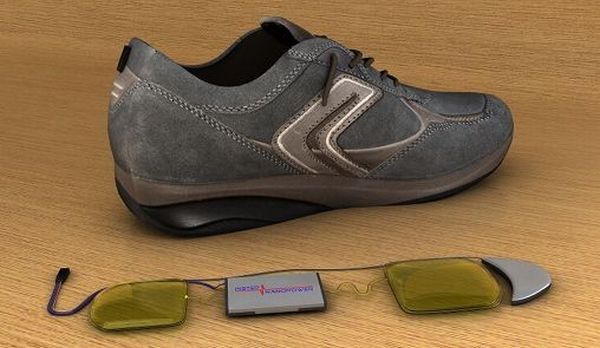
Powering Gadgets a Step at a Time


A microfluidics approach could be ideal for harnessing electricity from footsteps.

Power walk: An artist’s concept shows an energy-harvesting device based on a new microfluidics approach. The device could be embedded in ashoe sole.Credit: InStep NanoPower
A new way to harvest footfall energy could someday let shoes generate enough power to keep cell phones and laptops topped up.

University of Wisconsin-Madison researchers have come up with a microfluidics technique that scavenges considerably more energy from human footfalls and converts it into electric power. Previous attempts to make energy-harvesting shoes have yielded less than a watt of power, but the new approach could lead to a shoe-mounted generator that produces up to 10 watts, says Tom Krupenkin, a mechanical engineering professor who led the work.

"A lot of energy is simply wasted as heat while we walk," says Krupenkin. "If one can convert this into electrical energy, numbers come out to be up to 10 watts per foot." Cell phones and smart phones need about one to two watts, while small laptops need 10 to 12 watts. Power-generating shoes could be an important breakthrough for soldiers, who currently carry heavy batteries to power their radios, GPS units, and night-vision goggles.

Walking exerts a lot of force on the heel and toe, and cushioned soles can compress by about a centimeter with every step. Energy harvesters convert this force and displacement into electrical energy. The most promising approaches to tap into the human gait have involved piezoelectrics and electroactive polymers, materials that convert mechanical stress into electric power. But neither material works well with the relatively high displacements, but low frequency, of footfalls, Krupenkin says.


The new concept, presented in a Nature Communications paper, involves microscopic droplets of a conductive fluid flowing between electrodes coated with dielectric films. The droplets—the researchers used mercury or a gallium-based alloy called galistan—can be sandwiched between flat plates coated with the film or can be enclosed in a coated microchannel. When the area of overlap between the droplets and electrodes changes, an electric current is produced.

"It's a unique approach to energy harvesting," says Andrew Haughian, a partner at Vancouver, Canada-based venture capital firm Pangaea Ventures, which is evaluating the technology for potential investment. "The biggest opportunity I see would be in [developing countries], where the power grid is not reliable."

It might be years before you can buy a power-generating shoe, though. So far, the researchers have only made an array of 150 droplets that gives a few milliwatts of power. However, they calculate that a device with 1,000 droplets in a four-meter-long, one-millimeter-wide channel, which would cover an area of 40 square centimeters and fit in a shoe sole, could generate a few watts.

"The process is interesting, and the work itself is very good," says Paul Wright, a mechanical engineering professor at the University of California at Berkeley. However, he says, "to be useful to society, they would need to scale up the approach and show that it still works."

Krupenkin and his colleagues have established a startup, InStep NanoPower, to develop and possibly commercialize the technology. The company has a first-generation benchtop-sized prototype device. They expect the third generation harvester could be embedded in footwear. "This type of product will have to be a collaborative project between Instep and a shoe manufacturer," Krupenkin says. "We can't expect anything on the market earlier than two years."


Friday, September 2, 2011

Glowing, Blinking Bacteria Reveal How Cells Synchronize Biological Clocks


Biologists have long known that organisms from bacteria to humans use the 24 hour cycle of light and darkness to set their biological clocks. But exactly how these clocks are synchronized at the molecular level to perform the interactions within a population of cells that depend on the precise timing of circadian rhythms is less well understood.
Green fluorescent protein causes the E. coli to glow 
when the cells' clock is activated. (Credit: UC San Diego)

To better understand that process, biologists and bioengineers at UC San Diego created a model biological system consisting of glowing, blinking E. coli bacteria. This simple circadian system, the researchers report in the September 2 issue of Science, allowed them to study in detail how a population of cells synchronizes their biological clocks and enabled the researchers for the first time to describe this process mathematically.

"The cells in our bodies are entrained, or synchronized, by light and would drift out of phase if not for sunlight," said Jeff Hasty, a professor of biology and bioengineering at UC San Diego who headed the research team. "But understanding the phenomenon of entrainment has been difficult because it's difficult to make measurements. The dynamics of the process involve many components and it's tricky to precisely characterize how it works. Synthetic biology provides an excellent tool for reducing the complexity of such systems in order to quantitatively understand them from the ground up. It's reductionism at its finest."

To study the process of entrainment at the genetic level, Hasty and his team of researchers at UC San Diego's Biocircuits Institute combined techniques from synthetic biology, microfluidic technology and computational modeling to build a microfluidic chip with a series of chambers containing populations of E. coli bacteria. Within each bacterium, the genetic machinery responsible for the biological clock oscillations was tied to green fluorescent protein, which caused the bacteria to periodically fluoresce.


To simulate day and night cycles, the researchers modified the bacteria to glow and blink whenever arabinose -- a chemical that triggered the oscillatory clock mechanisms of the bacteria -- was flushed through the microfluidic chip. In this way, the scientists were able to simulate periodic day-night cycles over a period of only minutes instead of days to better understand how a population of cells synchronizes its biological clocks.

Hasty said a similar microfluidic system in principal could be constructed with mammalian cells to study how human cells synchronize with light and darkness. Such genetic model systems would have important future applications since scientists have discovered that problems with the biological clock can result in many common medical problems from diabetes to sleep disorders.

Other members of Hasty's team included Lev Tsimring, associate director of the BioCircuits Institute, and bioengineering graduate students Octavio Mondragon, Tal Danino and Jangir Selimkhanov. Their research was supported by grants from the National Institutes of Health and General Medicine and the San Diego Center for Systems Biology.

Story Source: The above story is reprinted (with editorial adaptations) from materials provided by University of California - San Diego.

From a Flat Mirror, Designer Light: Bizarre Optical Phenomena Defies Laws of Reflection and Refraction


Exploiting a novel technique called phase discontinuity, researchers at the Harvard School of Engineering and Applied Sciences (SEAS) have induced light rays to behave in a way that defies the centuries-old laws of reflection and refraction.
Top, clockwise from left: Patrice Genevet, Nanfang Yu, Federico Capasso, Zeno Gaburro, and Mikhail A. Kats. Bottom: A simulation of the image that would appear in a large mirror patterned with the team's new phase mirror technology. (Credit: Photos by Eliza Grinnell and Nanfang Yu)

The discovery, published this week in Science, has led to a reformulation of the mathematical laws that predict the path of a ray of light bouncing off a surface or traveling from one medium into another -- for example, from air into glass.

"Using designer surfaces, we've created the effects of a fun-house mirror on a flat plane," says co-principal investigator Federico Capasso, Robert L. Wallace Professor of Applied Physics and Vinton Hayes Senior Research Fellow in Electrical Engineering at SEAS. "Our discovery carries optics into new territory and opens the door to exciting developments in photonics technology."

It has been recognized since ancient times that light travels at different speeds through different media. Reflection and refraction occur whenever light encounters a material at an angle, because one side of the beam is able to race ahead of the other. As a result, the wavefront changes direction.

The conventional laws, taught in physics classrooms worldwide, predict the angles of reflection and refraction based only on the incident (incoming) angle and the properties of the two media.

While studying the behavior of light impinging on surfaces patterned with metallic nanostructures, the researchers realized that the usual equations were insufficient to describe the bizarre phenomena observed in the lab.

The new generalized laws, derived and experimentally demonstrated at Harvard, take into account the Capasso group's discovery that the boundary between two media, if specially patterned, can itself behave like a third medium.

"Ordinarily, a surface like the surface of a pond is simply a geometric boundary between two media, air and water," explains lead author Nanfang Yu (Ph.D. '09), a research associate in Capasso's lab at SEAS. "But now, in this special case, the boundary becomes an active interface that can bend the light by itself."

The key component is an array of tiny gold antennas etched into the surface of the silicon used in Capasso's lab. The array is structured on a scale much thinner than the wavelength of the light hitting it. This means that, unlike in a conventional optical system, the engineered boundary between the air and the silicon imparts an abrupt phase shift (dubbed "phase discontinuity") to the crests of the light wave crossing it.

Each antenna in the array is a tiny resonator that can trap the light, holding its energy for a given amount of time before releasing it. A gradient of different types of nanoscale resonators across the surface of the silicon can effectively bend the light before it even begins to propagate through the new medium.


The resulting phenomenon breaks the old rules, creating beams of light that reflect and refract in arbitrary ways, depending on the surface pattern.

In order to generalize the textbook laws of reflection and refraction, the Harvard researchers added a new term to the equations, representing the gradient of phase shifts imparted at the boundary. Importantly, in the absence of a surface gradient, the new laws reduce to the well-known ones.

"By incorporating a gradient of phase discontinuities across the interface, the laws of reflection and refraction become designer laws, and a panoply of new phenomena appear," says Zeno Gaburro, a visiting scholar in Capasso's group who was co-principal investigator for this work. "The reflected beam can bounce backward instead of forward. You can create negative refraction. There is a new angle of total internal reflection."

Moreover, the frequency (color), amplitude (brightness), and polarization of the light can also be controlled, meaning that the output is in essence a designer beam.

The researchers have already succeeded at producing a vortex beam (a helical, corkscrew-shaped stream of light) from a flat surface. They also envision flat lenses that could focus an image without aberrations.

Yu, Capasso, and Gaburro's co-authors included Patrice Genevet, Mikhail A. Kats, Francesco Aieta, and Jean-Philippe Tetienne.

Story Source: The above story is reprinted (with editorial adaptations) from materials provided by Harvard University, via EurekAlert!, a service of AAAS.

Word Association: Study Matches Brain Scans With Complex Thought


In an effort to understand what happens in the brain when a person reads or considers such abstract ideas as love or justice, Princeton researchers have for the first time matched images of brain activity with categories of words related to the concepts a person is thinking about. The results could lead to a better understanding of how people consider meaning and context when reading or thinking.


Princeton researchers developed a method to determine the
probability of various words being associated with the object a person
thought about during a brain scan. They produced color-coded figures
that illustrate the probability of words within the Wikipedia article
about the object the participant saw during the scan actually being
associated with the object. The more red a word is, the more likely a
person is to associate it, in this case, with "cow." On the other hand,
bright blue suggests a strong correlation with "carrot." Black and grey
"neutral" words had no specific association or were not considered at
all. (Credit: Illustration courtesy of Francisco Pereira)

The researchers report in the journal Frontiers in Human Neuroscience that they used functional magnetic resonance imaging (fMRI) to identify areas of the brain activated when study participants thought about physical objects such as a carrot, a horse or a house. The researchers then generated a list of topics related to those objects and used the fMRI images to determine the brain activity that words within each topic shared. For instance, thoughts about "eye" and "foot" produced similar neural stirrings as other words related to body parts.

Once the researchers knew the brain activity a topic sparked, they were able to use fMRI images alone to predict the subjects and words a person likely thought about during the scan. This capability to put people's brain activity into words provides an initial step toward further exploring themes the human brain touches upon during complex thought.

"The basic idea is that whatever subject matter is on someone's mind -- not just topics or concepts, but also, emotions, plans or socially oriented thoughts -- is ultimately reflected in the pattern of activity across all areas of his or her brain," said the team's senior researcher, Matthew Botvinick, an associate professor in Princeton's Department of Psychology and in the Princeton Neuroscience Institute.

"The long-term goal is to translate that brain-activity pattern into the words that likely describe the original mental 'subject matter,'" Botvinick said. "One can imagine doing this with any mental content that can be verbalized, not only about objects, but also about people, actions and abstract concepts and relationships. This study is a first step toward that more general goal.

"If we give way to unbridled speculation, one can imagine years from now being able to 'translate' brain activity into written output for people who are unable to communicate otherwise, which is an exciting thing to consider. In the short term, our technique could be used to learn more about the way that concepts are represented at the neural level -- how ideas relate to one another and how they are engaged or activated."

The research, which was published Aug. 23, was funded by a grant from the National Institute of Neurological Disease and Stroke, part of the National Institutes of Health.

Depicting a person's thoughts through text is a "promising and innovative method" that the Princeton project introduces to the larger goal of correlating brain activity with mental content, said Marcel Just, a professor of psychology at Carnegie Mellon University. The Princeton researchers worked from brain scans Just had previously collected in his lab, but he had no active role in the project.

"The general goal for the future is to understand the neural coding of any thought and any combination of concepts," Just said. "The significance of this work is that it points to a method for interpreting brain activation patterns that correspond to complex thoughts."

Tracking the brain's 'semantic threads'

Largely designed and conducted in Botvinick's lab by lead author and Princeton postdoctoral researcher Francisco Pereira, the study takes a currently popular approach to neuroscience research in a new direction, Botvinick said. He, Pereira and coauthor Greg Detre, who earned his Ph.D. from Princeton in 2010, based their work on various research endeavors during the past decade that used brain-activity patterns captured by fMRI to reconstruct pictures that participants viewed during the scan.

"This 'generative' approach -- actually synthesizing something, an artifact, from the brain-imaging data -- is what inspired us in our study, but we generated words rather than pictures," Botvinick said.

"The thought is that there are many things that can be expressed with language that are more difficult to capture in a picture. Our study dealt with concrete objects, things that are easy to put into a picture, but even then there was an interesting difference between generating a picture of a chair and generating a list of words that a person associates with 'chair.'"

Those word associations, lead author Pereira explained, can be thought of as "semantic threads" that can lead people to think of objects and concepts far from the original subject matter yet strangely related.

"Someone will start thinking of a chair and their mind wanders to the chair of a corporation then to Chairman Mao -- you'd be surprised," Pereira said. "The brain tends to drift, with multiple processes taking place at the same time. If a person thinks about a table, then a lot of related words will come to mind, too. And we thought that if we want to understand what is in a person's mind when they think about anything concrete, we can follow those words."

Pereira and his co-authors worked from fMRI images of brain activity that a team led by Just and fellow Carnegie Mellon researcher Tom Mitchell, a professor of computer science, published in the journal Science in 2008. For those scans, nine people were presented with the word and picture of five concrete objects from 12 categories. The drawing and word for the 60 total objects were displayed in random order until each had been shown six times. Each time an image and word appeared, participants were asked to visualize the object and its properties for three seconds as the fMRI scanner recorded their brain activity.

Matching words and brain activity with related topics

Separately, Pereira and Detre constructed a list of topics with which to categorize the fMRI data. They used a computer program developed by Princeton Associate Professor of Computer Science David Blei to condense 3,500 articles about concrete objects from the online encyclopedia Wikipedia into all the topics the articles covered. The articles included a broad array of subjects, such as an airplane, heroin, birds and manual transmission. The program came up with 40 possible topics -- such as aviation, drugs, animals or machinery -- with which the articles could relate. Each topic was defined by the words most associated with it.

The computer ultimately created a database of topics and associated words that were free from the researchers' biases, Pereira said.

"We let the software discern the factors that make up meaning rather than stipulating it ourselves," he said. "There is always a danger that we could impose our preconceived notions of the meaning words have. Plus, I can identify and describe, for instance, a bird, but I don't think I can list all the characteristics that make a bird a bird. So instead of postulating, we let the computer find semantic threads in an unsupervised manner."


The topic database let the researchers objectively arrange the fMRI images by subject matter, Pereira said. To do so, the team searched the brain scans of related objects for similar activity to determine common brain patterns for an entire subject, Pereira said. The neural response for thinking about "furniture," for example, was determined by the common patterns found in the fMRI images for "table," "chair," "bed," "desk" and "dresser." At the same time, the team established all the words associated with "furniture" by matching each fMRI image with related words from the Wikipedia-based list.

Based on the similar brain activity and related words, Pereira, Botvinick and Detre concluded that the same neural response would appear whenever a person thought of any of the words related to furniture, Pereira said. And a scientist analyzing that brain activity would know that person was thinking of furniture. The same would follow for any topic.

Using images to predict the words on a person's mind
Finally, to ensure their method was accurate, the researchers conducted a blind comparison of each of the 60 fMRI images against each of the others. Without knowing the objects the pair of scans pertained to, Pereira and his colleagues estimated the presence of certain topics on a participant's mind based solely on the fMRI data. Knowing the applicable Wikipedia topics for a given brain image, and the keywords for each topic, they could predict the most likely set of words associated with the brain image.

The researchers found that they could confidently determine from an fMRI image the general topic on a participant's mind, but that deciphering specific objects was trickier, Pereira said. For example, they could compare the fMRI scan for "carrot" against that for "cow" and safely say that at the time the participant had thought about vegetables in the first example instead of animals. In turn, they could say that the person most likely thought of other words related to vegetables, as opposed to words related to animals.

On the other hand, when the scan for "carrot" was compared to that for "celery," Pereira and his colleagues knew the participant had thought of vegetables, but they could not identify related words unique to either object.

One aim going forward, Pereira said, is to fine-tune the group's method to be more sensitive to such detail. In addition, he and Botvinick have begun performing fMRI scans on people as they read in an effort to observe the various topics the mind accesses.

"Essentially," Pereira said, "we have found a way to generally identify mental content through the text related to it. We can now expand that capability to even further open the door to describing thoughts that are not amenable to being depicted with pictures."

Story Source:
The above story is reprinted (with editorial adaptations) from materials provided by Princeton University.