BTemplates.com

Powered by Blogger.

Pageviews past week

Quantum mechanics

Auto News

artificial intelligence

About Me

Recommend us on Google!

Information Technology

Popular Posts

Showing posts sorted by date for query Microsoft. Sort by relevance Show all posts

Wednesday, July 3, 2013

Microsoft creates mood sensing software for smartphones


Microsoft Research Asia has been working on creating software called MoodScope that notes how a user uses his or her phone, and then uses that information to guess that user's mood. Initial testing of the device has shown it to be 66 percent accurate; when tailored to an individual user, the team reports that the accuracy rate jumped to 93 percent. The research team includes Nicholas Lane and Robert LiKamWa of Rice University, and Lin Zhong and Yunxin Liu from Microsoft Research Asia. They built a prototype and posted their test study results on Microsoft's website.
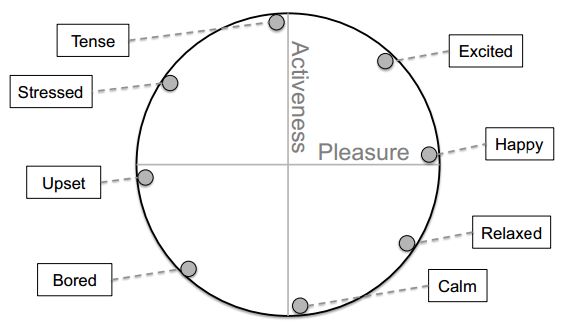
The circumplex mood model.
The circumplex mood model. Credit: Robert LiKamWa et al.

Most people realize that their smartphone has a lot of embedded technology in it that interacts with the world at large—GPS hardware, accelerometers, etc. all monitor activity and use that data to provide useful functions, such as automatically switching from landscape to portrait mode when a phone is rotated. In this new effort, the researchers sought to discover whether software that monitors phone activities could reveal the users' moods.

To find out, the team wrote code that monitored email, texting, app usage, phone calls, location information, and browsing history, then added algorithms to guess mood based on that data. Next, they enlisted the assistance of 32 volunteers to help them test the accuracy of their code. The volunteers were asked to use the system for two months while also completing mood assessments to provide data for comparison. With no training or tweaking, the software was found to provide answers of happy, tense, calm, upset, excited, stressed, or bored that matched the actual mood reported by the volunteers, on average 66 percent of the time. After optimizing the system for the individual habits of each of the volunteers, the rate increased to 93 percent.

The researchers suggest third party hooks could be added to the software to allow for automatically transmitting user moods to applications like Facebook. They also acknowledge that privacy concerns could arise if the software were to be delivered to the public, but suggest the benefits of such software would likely outweigh such concerns. They note that sites like Netflix or Spotify could use data from MoodScope to offer movies or other content based on specific users' moods.


The team presented their findings at MobiSys 2013 held in Taiwan last month.


More information: MoodScope Building a Mood Sensor from Smartphone Usage Patterns: research.microsoft.com/apps/pubs/default.aspx?id=194498
 

Research paper: www.ruf.rice.edu/~mobile/publications/likamwa2013mobisys2.pdf

Wednesday, June 26, 2013

Video Game Tech Used to Steer Cockroaches On Autopilot


North Carolina State University researchers are using video game technology to remotely control cockroaches on autopilot, with a computer steering the cockroach through a controlled environment. The researchers are using the technology to track how roaches respond to the remote control, with the goal of developing ways that roaches on autopilot can be used to map dynamic environments -- such as collapsed buildings.

North Carolina State University researchers are using video game technology to remotely control cockroaches on autopilot, with a computer steering the cockroach through a controlled environment.
North Carolina State University researchers are using video game technology to remotely control cockroaches on autopilot, with a computer steering the cockroach through a controlled environment. (Credit: Alper Bozkurt)

The researchers have incorporated Microsoft's motion-sensing Kinect system into an electronic interface developed at NC State that can remotely control cockroaches. The researchers plug in a digitally plotted path for the roach, and use Kinect to identify and track the insect's progress. The program then uses the Kinect tracking data to automatically steer the roach along the desired path.

The program also uses Kinect to collect data on how the roaches respond to the electrical impulses from the remote-control interface. This data will help the researchers fine-tune the steering parameters needed to control the roaches more precisely.

"Our goal is to be able to guide these roaches as efficiently as possible, and our work with Kinect is helping us do that," says Dr. Alper Bozkurt, an assistant professor of electrical and computer engineering at NC State and co-author of a paper on the work.

"We want to build on this program, incorporating mapping and radio frequency techniques that will allow us to use a small group of cockroaches to explore and map disaster sites," Bozkurt says. "The autopilot program would control the roaches, sending them on the most efficient routes to provide rescuers with a comprehensive view of the situation."

The roaches would also be equipped with sensors, such as microphones, to detect survivors in collapsed buildings or other disaster areas. "We may even be able to attach small speakers, which would allow rescuers to communicate with anyone who is trapped," Bozkurt says.

Bozkurt's team had previously developed the technology that would allow users to steer cockroaches remotely, but the use of Kinect to develop an autopilot program and track the precise response of roaches to electrical impulses is new.

The interface that controls the roach is wired to the roach's antennae and cerci. The cerci are sensory organs on the roach's abdomen, which are normally used to detect movement in the air that could indicate a predator is approaching -- causing the roach to scurry away. But the researchers use the wires attached to the cerci to spur the roach into motion. The wires attached to the antennae send small charges that trick the roach into thinking the antennae are in contact with a barrier and steering them in the opposite direction.

The paper, "Kinect-based System for Automated Control of Terrestrial Insect Biobots," will be presented at the Remote Controlled Insect Biobots Minisymposium at the 35th Annual International Conference of the IEEE Engineering in Medicine and Biology Society July 4 in Osaka, Japan. Lead author of the paper is NC State undergraduate Eric Whitmire. Co-authors are Bozkurt and NC State graduate student Tahmid Latif. The research was supported by the National Science Foundation.

Monday, July 23, 2012

'Minority Report' software hits the real world


The software behind the film "Minority Report" -- where Tom Cruise speeds through video on a large screen using only hand gestures -- is making its way into the real world.


The interface developed by scientist John Underkoffler has been commercialized by the Los Angeles firm Oblong Industries as a way to sift through massive amounts of video and other data.

And yes, the software can be used by law enforcement and intelligence services. But no, it is not the "pre-crime" detection program illustrated in the 2002 Steven Spielberg sci-fi film.

Kwin Kramer, chief executive of Oblong, said the software can help in searching through "big data" for information. It can also create souped-up video-conference capabilities where participants share data from multiple devices like smartphones and tablets, integrated into a large video display.

"We think the future of computing is multiuser, multiscreen, multidevice," Kramer told AFP.

"This system helps with big workflow problems."

A key part of the system is the gesture interface, which the company calls the "g-speak" spatial operating environment.

That grew out of a project by Underkoffler -- then a scientist at the prestigious Massachusetts Institute of Technology -- for "Minority Report," before he became chief scientist at startup Oblong.

"We have demo versions of this kind of software which show exactly the 'Minority Report' user experience, allowing you to move back and forth in time, or to zoom in to look at details," Kramer said.

He said the same software can help businesses to "allow better collaboration, visualization and analysis of large amounts of data.

"You can have a lot of data but it's hard to make use of that," Kramer said.

"It can be on different machines and hard to access. This allows multiple people to look at that."
An employee demonstrates the use of a data glove to navigate a map on a computer screen at Los Angeles-based software company Oblong Industries' offices in Washington in June 2012. The software behind the film "Minority Report" -- where Tom Cruise speeds through video on a large screen using only hand gestures -- is making its way into the real world.

Gestural interfaces have been developed for other firms including Microsoft's Kinect but Oblong says it has far more sophisticated systems which can use Kinect and more.

Some highly sensitive systems use a data glove which can be more precise than ordinary hand movements.

Oblong has contracts with firms such as Boeing, General Electric and Saudi Aramco to help in analyzing large amounts of data. It is also developing a gestural interface for onboard computers with automaker Audi.

It has raised an unspecified amount of venture capital from investors including Foundry Group, Energy Technology Ventures and Morgan Stanley Alternative Investment Partners.

Brad Feld, managing director at Foundry Group, said Oblong offers "a path to fundamentally change the way we interact with computers."

Yet the question Oblong often gets is how users can get the "Minority Report" software.

David Schwartz, the company's vice president for sales, said "We get calls from people in the military who say, 'I want the 'Minority Report' interface."

He said the systems could be used for a realistic version of high-tech software interfaces on TV shows like "CSI."

"They would like to get it for free," he added.

What makes the real-life version of the software different from the one seen on film is that Oblong does not supply the analytics of the futuristic "pre-crime" division.

That does not prevent a company or law enforcement agency from using the software and adding its own analytics.

"We think law enforcement and intelligence are big data users and we think our technology is the leader," Kramer said.

He said Oblong currently has no government customers in the United States or abroad but offers itself as "a core technology provider."

Still, Oblong leverages its role in the movies to get in the door, even if the software is not quite the same.

"I think most people look at those 'Minority Report' interfaces and imagine how they could use that flexible system in their own office or designs studio," Kramer said.

"It isn't science fiction, it's real."

Saturday, September 24, 2011

Taking Touch beyond the Touch Screen A prototype tablet can sense gestures, and objects placed next to it.


A tablet computer developed collaboratively by researchers at Intel, Microsoft, and the University of Washington can be controlled not only by swiping and pinching at the screen, but by touching any surface on which it is placed.
In touch: The spacecraft on this tablet's
screen can be controlled by maneuvering
the toy on the table next to it. Credit: Intel

Finding new ways to interact with computers has become an important area of research among computer scientists, especially now that touch-screen smart phones and tablets have grown so popular. The project that produced the new device, called Portico, could eventually result in smart phones or tablets that take touch beyond the physical confines of the device.

"The idea is to allow the interactive space to go beyond the display space or screen space," says Jacob Wobbrock, an assistant professor at the University of Washington's Information School, in Seattle, who helped develop the system. This is achieved with two foldout cameras that sit above the display on either side, detecting and tracking motion around the screen. The system detects the height of objects and determines whether they are touching the surrounding surface by comparing the two views captured by the cameras. The approach make it possible to detect hand gestures as well as physical objects so that they can interact with the display, says Wobbrock.

In one demonstration, software tracks a small ball as it moves across the surface the tablet sits on. As the ball strikes the side of the tablet, a virtual ball appears on-screen following the same trajectory, as if the physical ball had entered the device. In this way the ball can be used to score on-screen goals. In another demonstration, the angle of a toy spaceship placed on the table next to the tablet controls the angle of a virtual spaceship onscreen, allowing the user to shoot down "asteroids."


Wobbrock says the same approach would work on smart phones and other pocket-sized devices. "As devices continue to shrink, they compromise the screen space. But with Portico you can reclaim the surrounding area for interactivity," he says.

With the tablet, Portico increases the usable area sixfold, says Daniel Avrahami a senior researcher at Intel Labs Seattle, who came up with the idea for Portico, and led its development, with help from Shahram Izadi at Microsoft Research in Cambridge, UK. For a 12-inch tablet, "that's the equivalent of a 26-inch screen," says Avrahami, who will present the work in October at the ACM User Interface, Software and Technology Symposium in Santa Barbara, California.

Eventually, says Wobbrock, it may be more practical, especially from a commercial standpoint, to use clip-on cameras instead of foldout ones, which tend to break more easily. But he also notes that the entire display might be replaced with a fold-up frame containing both cameras and a pico projector to produce the image on the surface below.

Eva Hornecker, a lecturer specializing in human-computer interaction at the University of Strathclyde, in Glasgow, Scotland, says there is growing interest in using cameras to detect hand gestures and objects among researchers.

"The problem with touch screens is you can't detect anything that's happening over the surface," Hornecker says. However, she notes that allowing interaction beyond the screen could introduce new challenges such as how to provide feedback so the user knows where the interactive area starts and ends.

Friday, August 26, 2011

How Many Species On Earth? About 8.7 Million, New Estimate Says


Eight million, seven hundred thousand species (give or take 1.3 million).
Distribution of species by kingdom. (Credit: CoML)

That is a new, estimated total number of species on Earth -- the most precise calculation ever offered -- with 6.5 million species found on land and 2.2 million (about 25 percent of the total) dwelling in the ocean depths.

Announced today by Census of Marine Life scientists, the figure is based on an innovative, validated analytical technique that dramatically narrows the range of previous estimates. Until now, the number of species on Earth was said to fall somewhere between 3 million and 100 million.

Furthermore, the study, published by PLoS Biology, says a staggering 86% of all species on land and 91% of those in the seas have yet to be discovered, described and catalogued.

Says lead author Camilo Mora of the University of Hawaii and Dalhousie University in Halifax, Canada: "The question of how many species exist has intrigued scientists for centuries and the answer, coupled with research by others into species' distribution and abundance, is particularly important now because a host of human activities and influences are accelerating the rate of extinctions. Many species may vanish before we even know of their existence, of their unique niche and function in ecosystems, and of their potential contribution to improved human well-being."

"This work deduces the most basic number needed to describe our living biosphere," says co-author Boris Worm of Dalhousie University. "If we did not know -- even by an order of magnitude (1 million? 10 million? 100 million?) -- the number of people in a nation, how would we plan for the future?"

"It is the same with biodiversity. Humanity has committed itself to saving species from extinction, but until now we have had little real idea of even how many there are."

Dr. Worm notes that the recently-updated Red List issued by the International Union for the Conservation of Nature assessed 59,508 species, of which 19,625 are classified as threatened. This means the IUCN Red List, the most sophisticated ongoing study of its kind, monitors less than 1% of world species.

The research is published alongside a commentary by Lord Robert May of Oxford, past-president of the UK's Royal Society, who praises the researchers' "imaginative new approach."

"It is a remarkable testament to humanity's narcissism that we know the number of books in the US Library of Congress on 1 February 2011 was 22,194,656, but cannot tell you -- to within an order-of-magnitude -- how many distinct species of plants and animals we share our world with," Lord May writes.

"(W)e increasingly recognize that such knowledge is important for full understanding of the ecological and evolutionary processes which created, and which are struggling to maintain, the diverse biological riches we are heir to. Such biodiversity is much more than beauty and wonder, important though that is. It also underpins ecosystem services that -- although not counted in conventional GDP -- humanity is dependent upon."

Drawing conclusions from 253 years of taxonomy since Linnaeus

Swedish scientist Carl Linnaeus created and published in 1758 the system still used to formally name and describe species. In the 253 years since, about 1.25 million species -- roughly 1 million on land and 250,000 in the oceans -- have been described and entered into central databases (roughly 700,000 more are thought to have been described but have yet to reach the central databases).


To now, the best approximation of Earth's species total was based on the educated guesses and opinions of experts, who variously pegged the figure in a range from 3 to 100 million -- wildly differing numbers questioned because there is no way to validate them.

Drs. Mora and Worm, together with Dalhousie colleagues Derek P. Tittensor, Sina Adl and Alastair G.B. Simpson, refined the estimated species total to 8.7 million by identifying numerical patterns within the taxonomic classification system (which groups forms of life in a pyramid-like hierarchy, ranked upwards from species to genus, family, order, class, phylum, kingdom and domain).

Analyzing the taxonomic clustering of the 1.2 million species today in the Catalogue of Life and the World Register of Marine Species, the researchers discovered reliable numerical relationships between the more complete higher taxonomic levels and the species level.

Says Dr. Adl: "We discovered that, using numbers from the higher taxonomic groups, we can predict the number of species. The approach accurately predicted the number of species in several well-studied groups such as mammals, fishes and birds, providing confidence in the method."

When applied to all five known eukaryote* kingdoms of life on Earth, the approach predicted:
  1. ~7.77 million species of animals (of which 953,434 have been described and cataloged)
  2. ~298,000 species of plants (of which 215,644 have been described and cataloged)
  3. ~611,000 species of fungi (moulds, mushrooms) (of which 43,271 have been described and cataloged)
  4. ~36,400 species of protozoa (single-cell organisms with animal-like behavior, eg. movement, of which 8,118 have been described and cataloged)
  5. ~27,500 species of chromista (including, eg. brown algae, diatoms, water moulds, of which 13,033 have been described and cataloged)

Total: 8.74 million eukaryote species on Earth.

(* Notes: Organisms in the eukaryote domain have cells containing complex structures enclosed within membranes. The study looked only at forms of life accorded, or potentially accorded, the status of "species" by scientists. Not included: certain micro-organisms and virus "types," for example, which could be highly numerous.)

Within the 8.74 million total is an estimated 2.2 million (plus or minus 180,000) marine species of all kinds, about 250,000 (11%) of which have been described and catalogued. When it formally concluded in October 2010, the Census of Marine Life offered a conservative estimate of 1 million+ species in the seas.

"Like astronomers, marine scientists are using sophisticated new tools and techniques to peer into places never seen before," says Australian Ian Poiner, Chair of the Census' Scientific Steering Committee. "During the 10-year Census, hundreds of marine explorers had the unique human experience and privilege of encountering and naming animals new to science. We may clearly enjoy the Age of Discovery for many years to come."

"The immense effort entering all known species in taxonomic databases such as the Catalogue of Life and the World Register of Marine Species makes our analysis possible," says co-author Derek Tittensor, who also works with Microsoft Research and the UN Environment Programme's World Conservation Monitoring Centre. "As these databases grow and improve, our method can be refined and updated to provide an even more precise estimate."

"We have only begun to uncover the tremendous variety of life around us," says co-author Alastair Simpson. "The richest environments for prospecting new species are thought to be coral reefs, seafloor mud and moist tropical soils. But smaller life forms are not well known anywhere. Some unknown species are living in our own backyards -- literally."

"Awaiting our discovery are a half million fungi and moulds whose relatives gave humanity bread and cheese," says Jesse Ausubel, Vice-President of the Alfred P. Sloan Foundation and co-founder of the Census of Marine Life. "For species discovery, the 21st century may be a fungal century!"

Mr. Ausubel notes the enigma of why so much diversity exists, saying the answer may lie in the notions that nature fills every niche, and that rare species are poised to benefit from a change of conditions.

In his analysis, Lord May says the practical benefits of taxonomic discovery are many, citing the development in the 1970s of a new strain of rice based on a cross between conventional species and one discovered in the wild. The result: 30% more grain yield, followed by efforts ever since to protect all wild varieties of rice, "which obviously can only be done if we have the appropriate taxonomic knowledge."

"Given the looming problems of feeding a still-growing world population, the potential benefits of ramping up such exploration are clear."

Based on current costs and requirements, the study suggests that describing all remaining species using traditional approaches could require up to 1,200 years of work by more than 300,000 taxonomists at an approximate cost of $US 364 billion. Fortunately, new techniques such as DNA barcoding are radically reducing the cost and time involved in new species identification.

Concludes Dr. Mora: "With the clock of extinction now ticking faster for many species, I believe speeding the inventory of Earth's species merits high scientific and societal priority. Renewed interest in further exploration and taxonomy could allow us to fully answer this most basic question: What lives on Earth?"

Tuesday, July 12, 2011

Computer learns language by playing games


Computers are great at treating words as data: Word-processing programs let you rearrange and format text however you like, and search engines can quickly find a word anywhere on the Web. But what would it mean for a computer to actually understand the meaning of a sentence written in ordinary English -- or French, or Urdu, or Mandarin?
"Civilization" is a strategy game in which players build
empires by, among other things, deciding where to
found cities and deploy armies. Image courtesy of
Sid Meier's Civilization V

One test might be whether the computer could analyze and follow a set of instructions for an unfamiliar task. And indeed, in the last few years, researchers at MIT’s Computer Science and Artificial Intelligence Lab have begun designing artificial-intelligence systems that do exactly that, with surprisingly good results.

In 2009, at the annual meeting of the Association for Computational Linguistics (ACL), researchers in the lab of Regina Barzilay, associate professor of computer science and electrical engineering, took the best-paper award for a system that generated scripts for installing a piece of software on a Windows computer by reviewing instructions posted on Microsoft’s help site. At this year’s ACL meeting, Barzilay, her graduate student S. R. K. Branavan and David Silver of University College London applied a similar approach to a more complicated problem: learning to play “Civilization,” a computer game in which the player guides the development of a city into an empire across centuries of human history. When the researchers augmented an artificial-intelligence system so that it could use a player’s manual to guide the development of a game-playing strategy, its rate of victory jumped from 46 percent to 79 percent.

Starting from scratch

“Games are used as a test bed for artificial-intelligence techniques simply because of their complexity,” says Branavan, who was first author on both ACL papers. “Every action that you take in the game doesn’t have a predetermined outcome, because the game or the opponent can randomly react to what you do. So you need a technique that can handle very complex scenarios that react in potentially random ways.”

Moreover, Barzilay says, game manuals have “very open text. They don’t tell you how to win. They just give you very general advice and suggestions, and you have to figure out a lot of other things on your own.” Relative to an application like the software-installing program, Branavan explains, games are “another step closer to the real world.”


The extraordinary thing about Barzilay and Branavan’s system is that it begins with virtually no prior knowledge about the task it’s intended to perform or the language in which the instructions are written. It has a list of actions it can take, like right-clicks or left-clicks, or moving the cursor; it has access to the information displayed on-screen; and it has some way of gauging its success, like whether the software has been installed or whether it wins the game. But it doesn’t know what actions correspond to what words in the instruction set, and it doesn’t know what the objects in the game world represent.

So initially, its behavior is almost totally random. But as it takes various actions, different words appear on screen, and it can look for instances of those words in the instruction set. It can also search the surrounding text for associated words, and develop hypotheses about what actions those words correspond to. Hypotheses that consistently lead to good results are given greater credence, while those that consistently lead to bad results are discarded.

Proof of concept

In the case of software installation, the system was able to reproduce 80 percent of the steps that a human reading the same instructions would execute. In the case of the computer game, it won 72 percent more frequently than a version of the same system that didn’t use the written instructions as input, and 27 percent more frequently than a more sophisticated system that used additional artificial-intelligence techniques to improve its performance.

“If you’d asked me beforehand if I thought we could do this yet, I’d have said no,” says Eugene Charniak, University Professor of Computer Science at Brown University. “You are building something where you have very little information about the domain, but you get clues from the domain itself.”

Charniak points out that when the MIT researchers presented their work at the ACL meeting, some members of the audience argued that more sophisticated machine-learning systems would have performed better than the ones to which the researchers compared their system. But, Charniak adds, “it’s not completely clear to me that that’s really relevant. Who cares? The important point is that this was able to extract useful information from the manual, and that’s what we care about.”

Most computer games as complex as “Civilization” include algorithms that allow players to play against the computer, rather than against other people; the games’ programmers have to develop the strategies for the computer to follow and write the code that executes them. Barzilay and Branavan say that, in the near term, their system could make that job much easier, automatically creating algorithms that perform better than the hand-designed ones.

But the main purpose of the project, which was supported by the National Science Foundation, was to demonstrate that computer systems that learn the meanings of words through exploratory interaction with their environments are a promising subject for further research. And indeed, Barzilay and her students have begun to adapt their meaning-inferring algorithms to work with robotic systems. 

This story is republished courtesy of MIT News (http://web.mit.edu/newsoffice/), a popular site that covers news about MIT research, innovation and teaching.

More information: Research paper: http://people.csai … rs/civ11.pdf


Related articles

  • Genius of Einstein, Fourier key to new humanlike computer vision (sciencentechnologyupdates.com)


  • Artificial Grammar Reveals Inborn Language Sense, Study Shows (sciencentechnologyupdates.com)


  • Faster Computer Graphics: Digitally Mimicking Photographic Blur Caused by Moving Objects (sciencentechnologyupdates.com)


  • Ultimate Energy Efficiency:Computers to Use Million Times Less Energy? (sciencentechnologyupdates.com)


  • Study brings brain-like computing a step closer to reality (sciencentechnologyupdates.com)

  • Thursday, June 30, 2011

    Can Google Get Web Users Talking?


    Voice-driven search is a futuristic idea, and may take some getting used to.
    Credit: Google

    The notion of asking a computer for information out loud is familiar to most of us only from science fiction. Google is trying to change that by adding speech recognition to its search engine, and releasing technology that would allow any browser, website, or app to use the feature.

    But are you ready to give up your keyboards and talk to Google instead?

    Over the last two weeks, speech input for Google has gradually been rolled out to every person using Google's Chrome browser. A microphone icon appears at the right end of the iconic search box. If you have a microphone built-in or attached to your computer, clicking that icon creates a direct audio connection to Google's servers, which will convert your spoken words into text.

    It has been possible to speak Google search queries using a smart phone for almost three years; since last year, Android handsets have been able to take voice input in any situation where a keyboard would normally be used. "That was transformational, because people stopped worrying about when they could and couldn't speak to the phone," says Vincent Vanhoucke, who leads the voice search engineering team at Google. Over the last 12 months, the number of spoken inputs, search or otherwise, via Android devices has climbed six times, and every day, tens of thousands of hours of audio speech are fed into Google's servers. "On Android, a large fraction of the use is people dictating e-mail and SMS," says Vanhoucke.

    Vanhoucke's team now wants using voice on the Web to be as easy as it is on Android. "It's a big bet," he says. "Voice search for desktop is the flagship for this, [but] we want to take speech everywhere."

    Voice recognition is more technically challenging on a desktop or laptop computer, says Vanhoucke, because it requires noise suppression algorithms that are not needed for mobile speech recognition. These algorithms filter out sounds such as those of a computer's fan or air conditioners. "The quality of the audio is paramount for phone manufacturers, and you hold it close to your mouth," says Vanhoucke. "On a PC, the microphone is an afterthought, and you are further away. You don't get the best quality."


    Google asked thousands of people to read phrases aloud to their computers to gather data on the conditions its speech recognition technology would have to handle. As people use the service for real, it is trained further, says Vanhoucke, which should increase its popularity. Data from users of mobile voice search shows that people are much more likely to use the feature again when it is accurate for them the first time.

    A bigger challenge to getting users to embrace voice recognition on the desktop could be the existing tools for entering information, says Keith Vertanen, a lecturer at Princeton University who researches voice-recognition technology. "On the desktop, you're up against a very fast and efficient means of input in the keyboard," he says. "On a phone, you don't have that available, and you are often in hands- or eyes-free situations where voice input really helps."

    Vertanen says people are less tolerant of glitches when using speech recognition on a desktop computer because of the close proximity of a tried-and-true way of entering text. He says users might find voice recognition more compelling on on other Internet-connected devices in the home. "Nonconventional devices like a DVR, television, or game console don't usually have good text input," he points out. Google TV devices can already take voice input spoken into a connected Android phone.

    Vanhoucke acknowledges that speech recognition fulfills a more immediate need on phones, but argues that users are ready for it on conventional computers, too. "People will use it in ways that surprise us," he says. "At this point, it's still an experiment." Situations when people may have their hands full is one example, says Vanhoucke (although it should be noted that desktop voice search today still involves using the mouse to activate the feature).

    Google isn't performing this experiment alone. The company is pushing the Web standards body W3C to introduce a standard set of HTML markup that allows any website or app to call on voice recognition via the Web browser, and has already enabled a version of this markup in the Chrome browser. For now, Google is the only major company with a browser able to use the prototype feature, but Mozilla, Microsoft, and AT&T are all working with the W3C effort.

    "It's a collaborative effort that other browser makers are part of," says Vanhoucke. "Any designer can add it to their Web page. It's something anyone can use." Extensions for the Chrome browser that make use of voice input (like this one) have already appeared, and can be used to enter text on any website.

    However, those extensions reveal that although Google's desktop speech recognition is accurate for search queries, it's not much good for tasks like composing e-mail.

    Enabling the system to learn the personal quirks of each person's pronunciation, a feature already enabled on Android phones, could address that. Vertanen points out that the personalization learned through mobile search could easily be ported over to the desktop for people logged into their Google account. It could also make it possible for the technology to spring up elsewhere. "The advantage of Google's networked approach is that a [speech] model in the cloud can adapt to your voice in all these different places and follow you around, whether that's in your living room or in your car."


    A Browser that Speaks Your Language The latest version of Google's Chrome shows the potential of HTML5.

    Tuesday, June 28, 2011

    Facebook May Mobilize on Web Apps


    Developers are abuzz with a rumored project that could provide a new platform for mobile apps.

    Rumor has it that Facebook is trying to sidestep Apple's App Store and Google's Android Market with a neat technical trick: a Web-based platform for apps.

    Facebook has yet to confirm the existence of the effort, allegedly code-named "Project Spartan." But if the rumor is true, the effort could threaten Apple and Google's dominance in mobile software, and give a boost to Web applications over native apps, by appealing to Facebook's huge and captive user base and by leveraging the social connections between users.

    Facebook already lets developers build apps to run on top of its platform, and they've created thousands of games, utilities, and even business apps. But these are designed for the desktop, not the mobile or tablet platforms that are growing rapidly in popularity.

    Mobile Web apps built on top of Facebook, and that run entirely in the browser, using widely supported technologies like HTML5, JavaScript, and CSS, would free developers from the need to create several version of their software for different mobile platforms. Developers could also use Facebook Credits, which the company is hoping to expand into a universal micropayment system accessible across the Web. Facebook takes the same cut from Credits that Apple does from its App Store: 30 percent.

    "If the rumors are true, it means that Facebook is planning to use Web technologies to create a whole new app ecosystem for iOS-based and other mobile devices," says Ron Perry, chief technology officer at Worklight, a company that provides tools for building mobile applications.

    Facebook could also increase its influence in the mobile market by creating a platform for apps that Apple would never approve, or giving developers more favorable terms than the current 30 percent cut.

    All this might make it seem inevitable that Facebook would undertake something like Project Spartan. But to succeed at creating an alternate Web-only app ecosystem and payment platform that spans many devices, it will need to overcome a number of challenges.


    For one thing, Apple is now in the position that Microsoft was in 20 years ago: it controls the software on its devices and has little incentive to make the environment more hospitable to competing models of application delivery. Indeed, in March, some developers accused Apple of crippling native apps that use Web content on the iPhone and iPad by saddling them with a JavaScript engine only half as fast as the Nitro engine that runs in mobile Safari, the default browser on Apple's mobile devices. It's debatable whether or not this bug was intentional.

    Apple may ultimately be forced offer better support for applications that reside in the browser. "At the end of the day, for platforms to be successful, they have to give consumers what they want," says David Koretz, CEO of the Web-application security firm Mykonos Software. He argues that consumer demand will push mobile companies to offer the best Web experience possible.

    Another, potentially more significant issue hanging over the future of mobile apps is the fact that HTML is poorly suited to the kind of app that has so far made the most money for both Facebook and Apple: games. Long-time Apple observer John Gruber sees HTML's limitations as fundamental to the difference between Apple's App Store and Facebook's rumored effort.

    "Don't think of what Facebook is reportedly attempting as a would-be rival to the iOS App Store. Think of it as the mobile equivalent of Flash games for Macs and PCs. Obviously, there would be some competitive overlap, but there's a fundamental difference in scope and quality," Gruber said in an e-mail.

    Another truth that Facebook needs to confront is that previous efforts to create Web-based apps have fizzled. Apple, in fact, maintains a directory of Web apps—a holdover from the days before developers were able to create native apps for the iPhone. But it has little incentive to promote these. OpenAppMkt, another repository of mobile Web apps, has failed to make much of a dent in the App Store or Android Market. Google itself sells Web apps, through the Chrome Web Store, but these are primarily for desktops. A significant barrier each one of these efforts has run into is their lack of an easy-to-use payment system. Apple already has 200 million iTunes accounts, allowing its users a level of impulse purchasing unheard of in the history of commerce.

    Whatever challenges Facebook faces, if the most-visited website in the United States does start pushing mobile Web apps, this could be huge for the penetration of applications based on open Web-browser standards. "Facebook's reach can definitely bring Web apps to the limelight and make this an attractive option for app publishers," says Worklight's Perry.


    Tuesday, June 21, 2011

    British Library, Google in deal to digitize books


    A treatise on a stuffed hippopotamus, an 18th-century English primer for Danish sailors and a description of the first engine-driven submarine are among 250,000 books to be made available online in a deal between Google and the British Library.
    People work on laptops in a reading room at the British
    Library in London, Monday, June 20, 2011. A treatise on
    a stuffed hippopotamus, an 18th-century English primer for
    Danish sailors and a description of the first engine-driven
    submarine are among 250,000 books to be made available
    online in a deal between Google and the British Library.
    The agreement, announced Monday, will let Internet
    users read, search, download and copy thousands of
    texts published between 1700 and 1870.
    (AP Photo/Matt Dunham)

    The agreement, announced Monday, will let Internet users read, search, download and copy thousands of texts published between 1700 and 1870.

    It is a small step toward the library's goal of making the bulk of its 14 million books and 1 million periodicals available in digital form by 2020.

    "So far we have only been able to digitize quite a small fraction of the global collection," said the library's chief executive, Lynne Brindley. "There is a long way to go."


    The deal with Google, which will see 40 million pages digitized over the next three years, will offer online researchers a selection of rarely seen works from an era of social, political, scientific and technological change that took in the Enlightenment, the Industrial Revolution and the American war of independence.

    The books range from Georges Louis Leclerc's "Natural History of the Hippopotamus, or River-Horse" - which includes a description of a stuffed animal owned by the Prince of Orange - to the 1858 work "A Scheme for Underwater Seafaring," describing the first combustion engine-driven submarine.

    The books are more than scholarly curiosities. British Library curator Kristian Jensen said an 18th-century guide to English for Danish mariners shows "how English began to emerge from being the language spoken by people over there on that island" to become the world's dominant tongue.

    Google will pay to digitize the books, which are no longer covered by copyright restrictions. They will be available on the British Library and Google Books websites.

    Peter Barron, Google's European spokesman, declined to say how much the project would cost, beyond describing it as "a substantial sum."

    Google has digitized 13 million books in similar deals with more than 40 libraries around the world. But its plan to put millions of copyrighted titles online has been opposed by the publishing industry and is the subject of a legal battle in the United States.

    Barron said the company's goal "is to make as wide a range of items as possible" available online.

    "Having richer content means people around the world are searching more for it, and that is good for our business," he said.

    Last year, the British Library announced plans to digitize up to 40 million pages of newspapers dating back three-and-a-half centuries, and it recently made thousands of 19th-century books digitized in a deal with Microsoft available as an app for iPhone and iPad devices.

    More information:
    Google Books: http://books.google.com/ British Library: http://www.bl.uk/

    Friday, June 10, 2011

    The PC (As We Know It) Is Dead


    The rapid rise of cloud computing, coupled with a slew of increasingly powerful mobile computing devices, is killing the PC faster than analysts had predicted.

    In fact, some now say, the desktop PC is essentially dead – an immobile zombie that's already irrelevant to many consumers and soon will be to businesses, too.
    Lights out for today's personal computers.
    CREDIT: Dreamstime/BusinessNewsDaily illustration

    Yesterday's announcement of Apple's iCloud, which will store content online and synch all of a user's Apple devices wirelessly, is the latest in a series of nails being hammered into the PC coffin. Smart phones and tablets have given rise to a new consumer demand for immediate information at our fingertips, which John Quain, industry expert and longtime technology writer, said has made the desktop computer defunct.

    "We don’t need PCs anymore," Quain told BusinessNewsDaily. "They are dead."

    PC sales slide

    The two-stage death march is evident in surprisingly dim statistics released recently.

    Two of the world's largest manufactures of personal computers, HP and Dell, recently reported significant losses in sales to consumers. PC sales to individuals for quarter ending April 30 plunged 23 percent at HP and 7 percent at Dell.

    PC sales to businesses have fared better. But overall, a turning point has clearly passed.

    This spring, Gartner, Inc. released statistics showing PC sales overall dropped 1.1 percent compared to last year. Meanwhile, IMS Research has forecasted a whopping 213 percent growth for tablets.

    While the PC has long been considered a necessity in the workplace, Quain said mobile devices are now giving businesses the chance to break from that mold.

    "I see a lot of large enterprises and small businesses reconsidering the need for a desktop computer," Quain said. "The tablet computers are much cheaper, and give small and medium-size business another option so they don’t have to invest in a desktop computer."

    Meanwhile laptops, considered to be PC's, are changing rapidly. Apple's Mac Air has the instant-on capability of a tablet computer, and isn't much bigger than one. Intel recently announced Ultrabook, a thin, light tablet-like laptop with a touch screen. The company thinks it'll make up half the laptop market by the end of next year.

    And earlier this year, Motorola released the Atrix 4G, a smartphone that docks to a laptop-like device that's really just a screen, keyboard and giant battery. The smartphone is the brains of the operation.

    Gone from campuses

    Nowhere is the PC demise more stark than among the consumers of tomorrow.

    At Penn State University, Director of Education Technology Services Allan Gyorke said the former student staple is now rarely spotted in dorm rooms.

    "The desktop PC is dead," Gyorke said, estimating that 95 percent of students now bring a laptop or tablet media device to campus instead of using a traditional PC in their dorm room.

    Those newer devices, he said, are easier to store and easier to set up.

    While not ready to put the final nail in the PC's coffin, Roger Kay, an industry expert and president of Endpoint Technologies Associates, said the growing use of media tablets and smartphones is indeed pushing it out the door.

    "Death might be an over-exaggeration, but the wind has been taken out of the PC’s sails," Kay said. "There is a lot of momentum going the other way."

    With tablets and smartphones having as many computer capabilities as a desktop PC, Kay said it's only naturally for people to choose the handier option.

    "It is hugely more convenient," Kay said. "It immediately changed my lifestyle, in that it offered a type of mobile computing that wasn’t available before."

    The wireless connection

    The explosion of wireless networks is also linked to the PC's demise. You no longer need to be seated at a desktop computer that is plugged into the phone line next to it to access the Internet, Gyorke noted.

    "If there is a wireless connection somewhere, people want to access it," Gyorke said. "That is a real drawing force."

    Apple's new iCloud will help seal the desktop's fate by spurring the use of all cloud-based services, Quain said. "It is going to make everyone feel more confident in using those cloud services."

    Other analysts point out that the iCloud is mostly an Apple affair, but that Google, Microsoft and others who want a foothold in the cloud are already racing in that direction, and iCloud will only heat that race up.

    Evolve or die

    Still, even as he acknowledged that PC alternatives like the iPad and other media tablets are slowing personal computer sales, George Shiffler, research director at Gartner, Inc., said he expects the PC to survive by evolving into something else.

    "PCs are a very flexible platform," Shiffler said. “There will be something like a PC (in the future), but it won't be exactly what it is like today.”

    One scenario, he suggested, is to have a further merge of the television and computer.


    "I think we may see the desktop move to an all-in-one screen," Shiffler said. "Then it becomes a media center."

    Gyorke said he actually sees the future of personal computers headed in the same direction as tablets, with touch screens and app centers.

    "The interface will be very similar to the iPad," Gyorke said.

    Friday, June 3, 2011

    First Preview of Windows 8 Seamlessly Integrates Touch, Desktop, Web [Video]


    Windows pulls back the veil on its next OS, and it's a doozy.

    "This is the new version of Windows. It's going to run on laptops, it's going to run on desktops, it's going to run on PCs with a mouse and keyboard, it's going to run on touch slates, it's going to run on everything. Hundreds of millions of Windows PCs powered by this new interface  and new platform."


    Notable:

    * Windows 8 apps are a new class that will be built with HTML 5.

    * But existing Windows apps will continue to work in Windows 8.

    What does this tell us? That Microsoft recognizes the power of tapping Web developers directly. Through intermediaries like Appcelerator, Apple's iOS ecosystem has already benefitted from this trend. In the future, developers move seamlessly from the Web to the desktop, just like their apps.

    Read more: Previewing 'Windows 8'

    Thursday, April 21, 2011

    Microsoft Browser Would Offer Personalization along with Privacy Protection


    Today, many websites ask users to take a devil's deal: share personal information in exchange for receiving useful personalized services. New research from Microsoft, which will be presented at the IEEE Symposium on Security and Privacy in May, suggests the development of a Web browser and associated protocols that could strengthen the user's hand in this exchange. Called RePriv, the system mines a user's behavior via a Web browser but controls how the resulting information is released to websites that want to offer personalized services, such as a shopping site that automatically knows users' interests.
    An experimental system would tighten the
    limits on information provided to websites.

    Today, many websites ask users to take a devil's deal: share personal information in exchange for receiving useful personalized services. New research from Microsoft, which will be presented at the IEEE Symposium on Security and Privacy in May, suggests the development of a Web browser and associated protocols that could strengthen the user's hand in this exchange. Called RePriv, the system mines a user's behavior via a Web browser but controls how the resulting information is released to websites that want to offer personalized services, such as a shopping site that automatically knows users' interests.

    "The browser knows more about the user's behavior than any individual site," says Ben Livshits, a researcher at Microsoft who was involved with the work. He and colleagues realized that the browser could therefore offer a better way to track user behavior, while it also protects the information that is collected, because users won't have to give away as much of their data to every site they visit.

    The RePriv browser tracks a user's behavior to identify a list of his or her top interests, as well as the level of attention devoted to each. When the user visits a site that wants to offer personalization, a pop-up window will describe the type of information the site is asking for and give the user the option of allowing the exchange or not. Whatever the user decides, the site doesn't get specific information about what the user has been doing—instead, it sees the interest information RePriv has collected.

    Livshits explains that a news site could use RePriv to personalize a user's view of the front page. The researchers built a demonstration based on the New York Times website. It reorders the home page to reflect the user's top interests, also taking into account data collected from social sites such as Digg that suggests which stories are most popular within different categories.

    Livshits admits that RePriv still gives sites some data about users. But he maintains that the user remains aware and in control. He adds that cookies and other existing tracking techniques sites already collect far more user data than RePriv supplies.

    The researchers also developed a way for third parties to extend RePriv's capabilities. They built a demonstration browser extension that tracks a user's interactions with Netflix to collect more detailed data about that person's movie preferences. The extension could be used by a site such as Fandango to personalize the movie information it presents—again, with user permission.


    "There is a clear tension between privacy and personalized technologies, including recommendations and targeted ads," says Elie Bursztein, a researcher at the Stanford Security Laboratory, who is developing an extension for the Chrome Web browser that enables more private browsing. "Putting the user in control by moving personalization into the browser offers a new way forward," he says.

    "In the medium term, RePriv could provide an attractive interface for service providers that will dissuade them from taking more abusive approaches to customization," says Ari Juels, chief scientist and director of RSA Laboratories, a corporate research center.

    Juels says RePriv is generally well engineered and well thought out, but he worries that the tool goes against "the general migration of data and functionality to the cloud." Many services, such as Facebook, now store information in the cloud, and RePriv wouldn't be able to get at data there—an omission that could hobble the system, he points out.

    Juels is also concerned that most people would be permissive about the information they allow RePriv to release, and he believes many sites would exploit this. And he points out that websites with a substantial competitive advantage in the huge consumer-preference databases they maintain would likely resist such technology. "RePriv levels the playing field," he says. "This may be good for privacy, but it will leave service providers hungry." Therefore, he thinks, big players will be reluctant to cooperate with a system like this.

    Livshits argues that some companies could use these characteristics of RePriv to their advantage. He says the system could appeal to new services, which struggle to give users a personalized experience the first time they visit a site. And larger sites might welcome the opportunity to get user data from across a person's browsing experience, rather than only from when the user visits their site. Livshits believes they might be willing to use the system and protect user privacy in exchange.