BTemplates.com

Powered by Blogger.

Pageviews past week

Quantum mechanics

Auto News

artificial intelligence

About Me

Recommend us on Google!

Information Technology

Popular Posts

Showing posts sorted by relevance for query Microsoft. Sort by date Show all posts

Tuesday, February 23, 2010

Microsoft Threw Out the Playbook for Windows Phone 7


One of the biggest stories of the Mobile World Conference was the unveiling--finally--of Windows Mobile 7, rebranded as Windows Phone 7. The story within the story is how Microsoft abandoned the foundation established with the waning Windows Mobile platform, went back to the drawing board, and started from scratch for the latest incarnation of its mobile operating system.
The result is a completely new mobile platform from Microsoft which, at least from initial feedback and reviews, seems to be worthy of further consideration once Windows Phone 7 devices start hitting the streets.

Given the delays experienced by Microsoft in developing Windows Phone 7, expectations were high. Any minor, incremental improvement on the existing platform would have been virtually guaranteed to fail.

Microsoft's approach with Windows Phone 7 seems to borrow some from the Apple business model that has proven so successful with the iPhone. Like Google, with the Nexus One, Microsoft is reining in oversight of the hardware for Windows Phone 7 devices.

Microsoft has been accused of stealing a variety of design elements and features from Apple over the decades, but one thing it has steered clear of is emulating Apple's strict control of the end-to-end user experience. However, with Windows Phone 7, Microsoft seems to be embracing that philosophy to some degree.

Traditionally, the best Windows Mobile phones have been the devices built by HTC, and the reason they have been the best is because HTC took the Windows Mobile platform as a foundation, and branded it with its own unique design and interface elements. With Windows Phone 7, Microsoft has spelled out strict hardware and software design guidelines that will restrict such unique development by HTC, but hopefully deliver a more consistent experience for Windows Phone 7 users regardless of manufacturer.

By exerting more control over the hardware and software specifications, Microsoft can ensure that apps developed for Windows Phone 7 will not only work, but will work the same way, across all Windows Phone 7 devices. That level of consistency across Windows Phone 7 devices will help to increase adoption and improve perception of the Windows Phone 7 platform.

What Google seems to have learned from Apple--the same lesson that Microsoft appears to be grasping as well--is that maintaining control of the end-to-end user experience creates a more stable environment for developers to work with, and enables it (Google, Microsoft, or Apple as the case may be) to maximize the potential of the operating system without being handicapped by variations in capabilities from one handset to the next.

Of course, one of the things customers have come to expect from Microsoft is a more open and flexible platform than what Apple offers. Users want the ability to configure and customize their Windows devices--whether PC's or smartphones--and typically abhor the sort of "dummy-proof-our-way-or-the-highway" approach taken by Apple.

IT administrators enjoy the increased flexibility and capabilities of a more open platform like Windows Phone 7 or Android. One of the issues standing in the way of Apple iPhone adoption in the enterprise is the lack of control provided for IT administrators to be able to configure and manage the devices the way they would like to.

Businesses stand to benefit from the more consistent user experience of Windows Phone 7 as well, though. Rather than having to test and develop for each individual Windows Mobile handset in use, any configuration settings or custom apps will be able to function regardless of the Windows Phone 7 devices in use.

Windows Phone 7 appears to be a significant departure from previous Windows Mobile operating systems. At first glance it seems the Microsoft is heading in the right direction and could recapture some of the lost market share of the waning Windows Mobile platform. We'll have to wait until the Windows Phone 7 devices hit the streets to see how it really plays out.
Reblog this post [with Zemanta]

Sunday, July 15, 2007

`Red ring of death': What's wrong with Microsoft's Xbox?


There are seven stages of grief: shock, denial, anger, bargaining depression, testing and acceptance. But with the Xbox 360, which has been giving a significant number of its owners grief, Microsoft last week moved directly from the first stages to the last -- from denying any problems with it to admitting a US$1 billion problem that potentially affects all 11.6 million consoles sold so far.

Three weeks ago Todd Holmdahl, vice president of the gaming and Xbox products group, said repeated problems where people had to take back up to 11 consoles came from "a vocal minority" (tinyurl.com/yqtm4w) and dismissed suggestion of endemic problems.

Then last week Microsoft abruptly announced that it would set aside between US$1.05 billion and US$1.15 billion, charged against the just-finished 2007 fiscal year, to cover the costs of extending the warranty for every machine from one to three years, and to fix the many which show the "red ring of death" -- three red lights on the front panel control ring, indicating a general hardware failure.

How many? Unfortunately, Microsoft still isn't ready to deal with that issue.

PS3 surge

"When you look at the financial implication, obviously it's not a small number," said Robbie Bach, president of its entertainment and devices unit.

Sony, which last week had denied it would cut the price of its struggling PlayStation 3, saw an opening and snipped US$100 off the US retail price, prompting a surge in sales there.

Microsoft repeatedly declined to talk to me about precisely what problems the failed consoles suffer from. However, Peter Moore, head of the Xbox division, told Gamesindustry.biz: "There are a lot of different issues that eventually could all combine to create the three flashing red rings that appear on the power button on the console; no [one] specific issue."

He was repeatedly evasive in interviews, leaving the impression that the problems were either profound -- or embarrassingly simple.

The financial problems, though, are stark. The sum being set aside amounts to between US$90 and US$99 for every console sold -- extra loss on machines that are already sold at a loss. On its launch, analysts reckoned that each Xbox contained US$525 worth of components; but the machine sold for, at most, US$499, and more price cuts are rumored to be on the way to keep ahead of Sony. On average, Microsoft took a US$126 loss on each console sold at its starting price -- US$1.4 billion so far.

The billion-dollar figure also indicates that Microsoft's repeated insistence that the failure rate was about average for such hardware -- that is, between 3 percent and 5 percent -- cannot have been true. The real failure rate is probably about five times greater than the company has admitted, which would put repair costs at between US$330 and US$660 per console. At that upper limit, it would be cheaper for Microsoft simply to send a cheque for a brand new console. So what are the causes?

overheating

Owners and analysts have made their own investigations. The most obvious suggestion is that parts overheat; the Xbox 360 draws 160 watts, which has to be dissipated via two large heatsinks and two fans. One suggestion is that when the machine gets hot, the motherboard warps and pushes the graphics processing unit (GPU) off its board. Another is that some of the soldering is imperfect and so cracks at high temperature. A Microsoft support document (tinyurl.com/2qnefa) also suggests, improbably, that surge protectors and extension strips contribute to the problem by preventing the current surge needed for the fans to turn on; this seems unlikely, since that surge would be too small to trip them.

In desperation, some owners have turned to home-grown cures, including wrapping a towel around the machine, blocking the fan vents. This may -- depending who you believe -- either cause the solder to reflow or the GPU to reseat. (Microsoft has not commented.) The fixes sometimes work, at least temporarily.

We can deduce some of the reasons from the fact that Microsoft is declaring that the problems are sorted out -- just as it is moving from 90-nanometer to 65nm chips, which should reduce its power consumption significantly, and using a two-part heat sink in the new designs.

The key question though is whether these flaws will put off future customers, and how badly they have annoyed existing ones. The principal problem for the latter is that any content bought online must be re-enabled for a replacement console.

dream over?

Does the admission mean that Microsoft's dream that the Xbox will form the centerpiece of a strategy to put Microsoft software and hardware into everyone's living room has been permanently sunk?

A report this week from Jupiter Research suggests that there is now everything to play for.

"Jupiter Research anticipates the competitive field will be much closer than in the past; at the end of the current [console] cycle in 2012, the range in market shares is projected to be just under 10 percent compared with the 33 percent range in market shares at the end of the last cycle in 2005. Then, the PS2 dominated, and Nintendo was nowhere. Now, Nintendo's Wii is rocketing towards the Xbox 360 total; sales data suggests it is selling nearly three times faster than the Xbox 360 or PS3," the report said.

The optimistic forecast -- written before the Xbox's problems were admitted -- suggests that the Xbox will continue to sell. Moore repeated his insistence that the Xbox division will move into profit next year; having shovelled the billion-dollar faults back into the last fiscal year, it can look for profits from its online service, peripherals and games. The strategy remains untouched. All that has changed is the time it will take to pay back. But Microsoft is prepared to play the longest of games -- even when it has no chance of winning.

source : TAI PEI TIMES
Reblog this post [with Zemanta]

Friday, March 25, 2011

A Search Engine for the Human Body


Microsoft software recognizes organs and other structures in medical images.

A new search tool developed by researchers at Microsoft indexes medical images of the human body, rather than the Web. On CT scans, it automatically finds organs and other structures, to help doctors navigate in and work with 3-D medical imagery.

Inside out: A close up of a CT processed by new software from Microsoft.
Credit: Microsoft Research

CT scans use X-rays to capture many slices through the body that can be combined to create a 3-D representation. This is a powerful tool for diagnosis, but it's far from easy to navigate, says Antonio Criminisi, who leads a group at Microsoft Research Cambridge, U.K., that is attempting to change that. "It is very difficult even for someone very trained to get to the place they need to be to examine the source of a problem," he says.

When a scan is loaded into Criminisi's software, the program indexes the data and lists the organs it finds at the side of the screen, creating a table of hyperlinks for the body. A user can click on, say, the word "heart" and be presented with a clear view of the organ without having to navigate through the imagery manually.

Once an organ of interest has been found, a 2-D and an enhanced 3-D view of structures in the area are shown to the user, who can navigate by touching the screen on which the images are shown. A new scan can also be automatically and precisely matched up alongside a past one from the same patient, making it easy to see how a condition has progressed or regressed.

Criminisi's software uses the pattern of light and dark in the scan to identify particular structures; it was developed by training machine-learning algorithms to recognize features in hundreds of scans in which experts had marked the major organs. Indexing a new scan takes only a couple of seconds, says Criminisi. The system was developed in collaboration with doctors at Addenbrookes Hospital in Cambridge, U.K.

The Microsoft research group is exploring the use of gestures and voice to control the system. They can plug in the Kinect controller, ordinarily used by gamers to control an Xbox with body movements, so that surgeons can refer to imagery in mid-surgery without compromising their sterile gloves by touching a keyboard, mouse, or screen.

Body search: This CT image shows organs and other features identified by the Microsoft software. A list of these features appears at left.
Credit: Microsoft Research

Kenji Suzuki an assistant professor at the University of Chicago, whose research group works on similar tools, says the Microsoft software has the potential to improve patient care, providing it really does make scans easier to navigate. "As medical imaging has advanced, so many images are produced that there is a kind of information overload," he explains. "The workload has grown a lot."

Suzuki says Microsoft's approach is a good one, but that medical professionals might be more receptive to the design if it indexed signs of disease, not just organs. His own research group has developed software capable of recognizing potentially cancerous lung nodules; in trials, it made half as many mistakes as a human expert.

Criminisi sticks by the notion of using organs as a kind of navigation system but says that disease-spotting capability is also under development. He says, "We are working to train it to detect differences between different grades of glioma tumor"—a type of brain tumor.

The Microsoft group also intends the tool to be used at large scales. It could automatically index a collection of 3-D scans or other images, making possible new ways of tracking medical records, says Criminisi. Today, records are kept as text that describes scans and other information. A search tool that finds the word "heart", for example, would not know if that meant it appeared in a scan or was mentioned in another context. If a hospital's computer system indexed new scans, the Microsoft software could automatically record what was imaged in a person's records and when.

Monday, February 8, 2010

Windows Phone 7: No Multitasking, Stricter Microsoft QA


Later this month, Microsoft will most likely unveil Windows Mobile 7 Windows Phone 7 at the Mobile World Congress. Rumours abound, and the latest set of rumours paint a rather dramatic turnaround for Microsoft's mobile platform - no more multitasking, application distribution limited to official channels, and a whole lot more.

Saturday, July 19, 2008

Microsoft, Google fight over Yahoo


WASHINGTON: Google and Microsoft will spar today at a congressional hearing called to examine whether Google's revenue-sharing deal with No 2 search rival Yahoo will harm competition. Google, with more than 60 per cent of the Web search market, and Yahoo, with 16.6 per cent, announced a deal on June 12 that would allow Yahoo to place Google advertisements on its site and collect the revenue.

The deal, which the firms have said would garner Yahoo at least $250 million in the first year, was widely seen as an effort by Yahoo to fend off Microsoft's on-again, off-again efforts to buy all or part of Yahoo.

Microsoft's most recent offer to acquire Yahoo's search business was rejected by Yahoo. Google chief legal officer David Drummond, defending his company's deal with Yahoo in written testimony for Tuesday's hearing, took a shot at Microsoft's 90 per cent share of the personal computer operating system market.

"Dominance of the desktop can let one company favor its own products and services and obstruct the interoperability of competing products or services, overriding the desires of consumers," said Drummond in testimony prepared for the Senate Judiciary Committee's antitrust panel.

Microsoft General Counsel Brad Smith hit back, saying Google's deal would reduce Yahoo's incentive to compete against Google, would push Yahoo's search advertising platform into a downward spiral and establish an illegal price floor.

"When it comes to the issues before this subcommittee, Google should not be allowed to achieve an outcome through an agreement that it would not be permitted to achieve otherwise," said Smith in his written testimony.

The revenue-sharing deal has not been implemented by Google and Yahoo while they wait for an opinion from the Justice Department's Antitrust Division. Several state attorney generals have expressed concern about the arrangement.

"Microsoft believes the Google/Yahoo deal harms competition in several critical ways. Advertisers and online content providers would be harmed through price coordination that will establish higher prices and limit choice," said Smith. "Consumers would be put at risk as Google expands its ability to collect the personal information of users passing through its search gateway. On an even more fundamental level, Google's monopoly power would increase its ability to shape what people get to see and experience online."

The House Judiciary Committee's antitrust subcommittee will hold a similar hearing later on Tuesday.

Friday, October 15, 2010

Microsofts 3-D Strategy Microsoft's Craig Mundie describes how the company's vision of 3-D gaming could extend to all computer interactions.


Microsoft has joined the wave of companies betting that 3-D is the next big thing for computing. At a recent talk at MIT, chief research and strategy officer Craig Mundie said he sees the technology as an innovation that "will get people out of treating a computer as a tool" and into treating the device as a natural extension of how they interact with the world around them. Microsoft plans to introduce consumers to the change through its gaming products, but Mundie outlined a vision that would eventually have people shopping and searching in 3-D as well.
The future of 3-D: During a talk at MIT last week, Craig Mundie, Microsoft's chief research and strategy officer, showed how a natural 3-D interface could let users manipulate and examine products--like the disassembled motorcycle in the background.
Credit: Microsoft/Technology Review

The combination of better chips, better displays, and better sensors, Mundie said, is finally making it possible to move computing from today's graphical user interfaces to the "natural user interface," by allowing people to interact with 3-D content through the gestures they normally use. Today's interfaces require users to learn about menu bars and double-clicks, but Mundie believes natural user interfaces, which work through gesture and voice, will be faster and easier to learn, and will prove more flexible in the long run.

Mundie also argued that natural user interfaces would reduce the mental effort required for people to operate software. Even people who are good at using controllers, keyboards, and mouses might find that a natural interface frees up attention and concentration so that they can focus better on the task at hand, he said. He believes that natural interfaces will make it easier to introduce software to people unfamiliar with computers, as well as make software generally easier to use, and therefore more attractive to consumers.

He also noted that today many programs come with what is essentially "an application-specific prosthetic"--for example, some driving games come with a steering-wheel device. Natural user interfaces may require some peripherals, such as depth-sensing cameras that can detect users' movements, but Mundie sees these as ultimately having broader purpose than most of today's devices.

The first step in this strategy, Mundie said, is Microsoft's release next month of the Kinect sensor for the Xbox 360 gaming console; Kinect incorporates a depth-sensing camera and voice recognition and will cost about $150. It will allow users to play games by gesturing, without the need for a controller or additional equipment. This opens the way to 3-D interaction with games that Mundie hopes will lead to broader use of 3-D displays.

Mundie demonstrated how Kinect would allow a user to interact with 3-D game content through hand gestures, virtually picking up clues to examine them or show them to friends. "We're trying to create a genre of games where you don't have to think about how what you would do naturally would map to the controls," Mundie said.

He also showed a concept video for a real-time 3-D multiplayer game called "The Spy from the 2080s" that included a TV show and a game that players could interact with using multiple devices. For example, they might watch an episode in 3-D on TV, then log in through a gaming console to work with friends to solve clues from the show. Mobile devices might provide additional updates. In the video, the outcome of gameplay even influenced the course of the TV show.

But while the company may plan to start with gaming, Mundie envisions 3-D eventually becoming a key part of many computer interfaces and online content. In one example, he demonstrated shopping using a 3-D natural interface; his hand gestures spun a 3-D image of a product, displaying it from a variety of angles, and opened it up to look at the parts inside.

He acknowledged, however, that there are challenges that need to be solved before 3-D can become ubiquitous. "We need a lot more computer than we currently have," Mundie said, noting that processing high-definition, 3-D video in real time would strain the capabilities of most home computers today. He also admitted that companies still need to refine how users would interact with computers through gesture and voice--for example, distinguishing between when a gamer is issuing commands to the computer and when the same user is conversing with another player.

Microsoft is wise to focus on games initially, says Norbert Hildebrand, business development manager for Insight Media, a marketing research firm that covers emerging display technologies. With 3-D technologies, providing enough content is a huge issue today, he explains. Games are already created in 3-D and then rendered to work on a 2-D screen, which makes it easy to convert them for 3-D displays and other types of interfaces.

For other types of 3-D interaction, such as shopping or advertising, Hildebrand says content creators will need to be persuaded to invest the necessary money and resources. As far as Mundie's vision of 3-D shopping, Hildebrand says, "at this point, it's marketing talk only." He points out that today's 3-D displays don't display text well, so marketers would have to come up with a hybrid approach to display both product images and information.

For now, Hildebrand believes that the average person views 3-D technology as something used on special occasions, not as a day-to-day technology. Some people have interpreted sales figures for 3-D-enabled televisions as a sign that consumers are adopting the technology, he adds, but these can be misleading, since most high-end televisions today have 3-D capabilities. It's much harder to determine whether people are actually using 3-D and how often, he says.

3-D is on the way, Hildebrand says, but before Mundie's vision of day-to-day 3-D becomes viable, "a lot of things have to come together." This includes more 3-D content, better bandwidth for delivering it to users, faster processors to render it, and particularly, he believes, the next generation of display technology--one that doesn't require special glasses.

Wednesday, July 3, 2013

Microsoft creates mood sensing software for smartphones


Microsoft Research Asia has been working on creating software called MoodScope that notes how a user uses his or her phone, and then uses that information to guess that user's mood. Initial testing of the device has shown it to be 66 percent accurate; when tailored to an individual user, the team reports that the accuracy rate jumped to 93 percent. The research team includes Nicholas Lane and Robert LiKamWa of Rice University, and Lin Zhong and Yunxin Liu from Microsoft Research Asia. They built a prototype and posted their test study results on Microsoft's website.
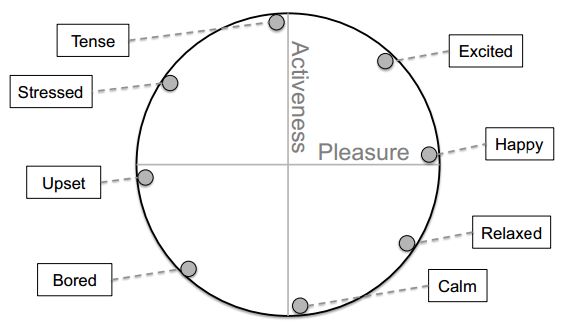
The circumplex mood model.
The circumplex mood model. Credit: Robert LiKamWa et al.

Most people realize that their smartphone has a lot of embedded technology in it that interacts with the world at large—GPS hardware, accelerometers, etc. all monitor activity and use that data to provide useful functions, such as automatically switching from landscape to portrait mode when a phone is rotated. In this new effort, the researchers sought to discover whether software that monitors phone activities could reveal the users' moods.

To find out, the team wrote code that monitored email, texting, app usage, phone calls, location information, and browsing history, then added algorithms to guess mood based on that data. Next, they enlisted the assistance of 32 volunteers to help them test the accuracy of their code. The volunteers were asked to use the system for two months while also completing mood assessments to provide data for comparison. With no training or tweaking, the software was found to provide answers of happy, tense, calm, upset, excited, stressed, or bored that matched the actual mood reported by the volunteers, on average 66 percent of the time. After optimizing the system for the individual habits of each of the volunteers, the rate increased to 93 percent.

The researchers suggest third party hooks could be added to the software to allow for automatically transmitting user moods to applications like Facebook. They also acknowledge that privacy concerns could arise if the software were to be delivered to the public, but suggest the benefits of such software would likely outweigh such concerns. They note that sites like Netflix or Spotify could use data from MoodScope to offer movies or other content based on specific users' moods.


The team presented their findings at MobiSys 2013 held in Taiwan last month.


More information: MoodScope Building a Mood Sensor from Smartphone Usage Patterns: research.microsoft.com/apps/pubs/default.aspx?id=194498
 

Research paper: www.ruf.rice.edu/~mobile/publications/likamwa2013mobisys2.pdf

Monday, August 25, 2008

How to boost your PC speed


Frustrated with slow computer speed? Hate it when your computer slows down while you access the Internet.

And you simply bang your head when your computer takes ages to search your files. You desperately wish that your PC could gain some speed.

Don't worry. You can easily overcome this.

Here are some easy-to-do tips which can boost up your PC speed.

Clean up disk errors

Whenever a programme crashes or you experience some power outage, your PC may create some errors on hard disk. This slows down computer speed.

For this, check and clean any errors on the computer hard disk.

To run Disk Check go to My Computer. Now, right-click on the drive you want to check for errors and click Properties.

In Properties dialogue box, click on the Tools tab. In the Error-Checking section, press the Check Now button. Access Check Disk to check for errors on your computer.

Depending on the errors, it may take up to an hour to check and clean. This must be followed at least once a week.

Remove temporary files

Your PC stores temporary files whenever you browse through the Web. Also, your PC stores temporary files when you work on programmes like Microsoft Word or Excel.

This ends up slowing down your PC speed. To overcome it you can use the Windows Disk Cleanup screen to rid your PC of these dead files.

To run Disk Cleanup go to My Computer. Right click on the drive you wish to check for errors and click Properties. In the Properties dialogue box, click Disk Cleanup. You can also use Disk Cleanup to clear unused files from your PC.

After scanning, the Disk Cleanup dialogue box lists the files you can remove from your computer.

Organise your data 

Often when you search files your PC takes a lot of time to track them. This is because computer breaks files into pieces to increase the speed of access and retrieval.

However, once updated, computer saves these files on the space available on the hard drive, which results in fragmented files. This makes your PC go slow because it then searches for all of the file's parts.

You need a Disk Defragmenter programme to needle all your files back together.

For this, go to My Computer and right click on the drive you want to check for error and click Properties.

In the Properties dialogue box, click the Tools tab, and then in the Defragmentation section, click Defragment. In the Disk Defragmenter dialog box, select the disk and then click Analyse.

After analysing your PC, the Disk Defragmenter pops up a message asking whether you need to defragment your computer or not. Once you defragement your PC, it will reorganise files by programme and size.

Install anti-virus 

Biggest culprits behind slow PC performance are viruses and spyware. Both end up reducing your PC speed. Not only this they can also destroy your data and tamper files.

Also, with the 24X7 online environment, it is important to have anti-virus and anti-spyware programmes installed for secure online experience.

These programmes need to be frequently updated to avoid any attack on your computer.

You can do a recee of the Net for popular anti-virus and anti-spyware solutions. There are also several paid options like McAfee, Norton Anti-virus and Trend Micro.

Reduce page history 

Is your PC giving you trouble while accessing the Internet? Don't worry. For Internet Explorer users, Microsoft has some rescue options for faster Web browsing.

To improve your PC speed, first reduce the size of your Web page history. For this go to Internet Explorer, and on the Tools menu click on Internet Options. Then go to the History section and type in the number of days you want to keep pages in history.

Preferably reduce the number of days as this will reduce the size of your Web page history.

Automate Microsoft updates 

For Windows users, Microsoft frequently release updates which may help boost up your PC speed. For this activate automate Microsoft Update so that your computer downloads and installs all the latest updates without giving you any trouble of finding any new releases.

Go to Start menu and click Control Panel. In the Automatic Updates dialog box, check the Automatic check box. If your PC finds any new updates, it will automatically download and install them. This will help you keep your computer up to date. 

Sunday, July 1, 2007

Microsoft plans job portal in India


NEW DELHI: Microsoft Corp yesterday announced that it was in talks with partners in government and industry for a job search portal.

The company said that it plans to launch a job search service this year for the country's nearly 400,000 engineers graduating every year. Microsoft's job portal will compete with Info Edge (India) www.naukri.com and Monster Worldwide’s www.monsterindia.com, among others. Its online portal www.msn.com will provide educational content to students.

The company has also entered into an agreement with Advanced Micro Devices and Zenith Computers to make and sell personal computers in India.

The computers, priced at Rs 21,000, would be sold in 10 retail outlets each in Bangalore and Pune from July on a test basis for three months and will be expanded later on the basis of response.

"We don't see any gain in the short term. Our perspective is long term," Microsoft India chairman Ravi Venkatesan told reporters.

In 2006/07 the total installed base of PCs in India was 22 million, that is, a PC for about every 50 Indians, industry tracking body IDC said in a recent report.

SOURCE : THE TIMES OF INDIA
Reblog this post [with Zemanta]

Thursday, February 4, 2010

Microsoft Office 2010 RC available for download


Microsoft just sent an e-mail stating that Office 2010 Release Candidate (RC) is now available for download to Connect users. Users beta-testing the suite can go ahead to Microsoft Connect and download the latest builds – v4734.1000 for 2010 client and build v4730.1010 for server products.

However, one important thing to know is that you’ll need to request new product key as beta keys won’t be allowed to activate the RC.

This probably will be the only RC as a RTM build is expected to hit this June.

Enhanced by Zemanta

Thursday, April 21, 2011

Microsoft Browser Would Offer Personalization along with Privacy Protection


Today, many websites ask users to take a devil's deal: share personal information in exchange for receiving useful personalized services. New research from Microsoft, which will be presented at the IEEE Symposium on Security and Privacy in May, suggests the development of a Web browser and associated protocols that could strengthen the user's hand in this exchange. Called RePriv, the system mines a user's behavior via a Web browser but controls how the resulting information is released to websites that want to offer personalized services, such as a shopping site that automatically knows users' interests.
An experimental system would tighten the
limits on information provided to websites.

Today, many websites ask users to take a devil's deal: share personal information in exchange for receiving useful personalized services. New research from Microsoft, which will be presented at the IEEE Symposium on Security and Privacy in May, suggests the development of a Web browser and associated protocols that could strengthen the user's hand in this exchange. Called RePriv, the system mines a user's behavior via a Web browser but controls how the resulting information is released to websites that want to offer personalized services, such as a shopping site that automatically knows users' interests.

"The browser knows more about the user's behavior than any individual site," says Ben Livshits, a researcher at Microsoft who was involved with the work. He and colleagues realized that the browser could therefore offer a better way to track user behavior, while it also protects the information that is collected, because users won't have to give away as much of their data to every site they visit.

The RePriv browser tracks a user's behavior to identify a list of his or her top interests, as well as the level of attention devoted to each. When the user visits a site that wants to offer personalization, a pop-up window will describe the type of information the site is asking for and give the user the option of allowing the exchange or not. Whatever the user decides, the site doesn't get specific information about what the user has been doing—instead, it sees the interest information RePriv has collected.

Livshits explains that a news site could use RePriv to personalize a user's view of the front page. The researchers built a demonstration based on the New York Times website. It reorders the home page to reflect the user's top interests, also taking into account data collected from social sites such as Digg that suggests which stories are most popular within different categories.

Livshits admits that RePriv still gives sites some data about users. But he maintains that the user remains aware and in control. He adds that cookies and other existing tracking techniques sites already collect far more user data than RePriv supplies.

The researchers also developed a way for third parties to extend RePriv's capabilities. They built a demonstration browser extension that tracks a user's interactions with Netflix to collect more detailed data about that person's movie preferences. The extension could be used by a site such as Fandango to personalize the movie information it presents—again, with user permission.


"There is a clear tension between privacy and personalized technologies, including recommendations and targeted ads," says Elie Bursztein, a researcher at the Stanford Security Laboratory, who is developing an extension for the Chrome Web browser that enables more private browsing. "Putting the user in control by moving personalization into the browser offers a new way forward," he says.

"In the medium term, RePriv could provide an attractive interface for service providers that will dissuade them from taking more abusive approaches to customization," says Ari Juels, chief scientist and director of RSA Laboratories, a corporate research center.

Juels says RePriv is generally well engineered and well thought out, but he worries that the tool goes against "the general migration of data and functionality to the cloud." Many services, such as Facebook, now store information in the cloud, and RePriv wouldn't be able to get at data there—an omission that could hobble the system, he points out.

Juels is also concerned that most people would be permissive about the information they allow RePriv to release, and he believes many sites would exploit this. And he points out that websites with a substantial competitive advantage in the huge consumer-preference databases they maintain would likely resist such technology. "RePriv levels the playing field," he says. "This may be good for privacy, but it will leave service providers hungry." Therefore, he thinks, big players will be reluctant to cooperate with a system like this.

Livshits argues that some companies could use these characteristics of RePriv to their advantage. He says the system could appeal to new services, which struggle to give users a personalized experience the first time they visit a site. And larger sites might welcome the opportunity to get user data from across a person's browsing experience, rather than only from when the user visits their site. Livshits believes they might be willing to use the system and protect user privacy in exchange.

Saturday, February 21, 2009

Fone-Tastic!


The Mobile World Congress 2009 expo in Barcelona – being held from February 16 to 19 – has thrown up quite a few surprises: The beginnings of a war between different operating systems for cellphones; the world’s first phone that acts as a projector; and a stylish handset with a transparent keypad.

INTERFACE TIME

Rival developers are battling to create the dominant operating system (OS) for mobile phones, with Google’s open-source Android system competing against Microsoft’s new Windows Mobile 6.5,Nokia’s Symbian, a Linux-based project, and RIM’s Blackberry OS.

The biggest event on Tuesday was Taiwanese manufacturer HTC unveiling the Android-based ‘Magic’ – a slim, tablet-shaped device with a 3.2-inch touchscreen that bears a resemblance to the Apple iPhone.

Equipped with a 3-megapixel camera, GPS, Wi-Fi, and other
connectivity options, the gadget will be available exclusively through Vodafone in Britain, France, Germany and Italy; however, no plans were announced for an India release.

On Monday, Chinese manufacturer Huawei had revealed its first cellphone to run on Android, meaning there are at least three ‘Google’ phones now developed.

Australian firm Kogan had previously announced the ‘Agora’ handset in December, but its launch has been postponed indefinitely. LG and Samsung have also promised their versions this year.

“For a new, open-source platform, I am impressed with the momentum growing behind Android,” said Gavin Byrne, an analyst at telecom research group Informa.

He said that he still expected Nokia’s Symbian to remain dominant in the next five years, but that Android would soon establish itself as an alternative.

Also on Tuesday, Microsoft CEO Steve Ballmer unveiled the latest version of the company’s mobile OS,Windows Mobile 6.5,promising an improved touch-screen inter-face as well as a dashboard-like experience to items such as new emails, texts, missed calls, and calendar appointments.

“We’re going to work with the guys who build phones that are exciting... that are hot and tell the story of their Windows phone,” Ballmer said, announcing tie-ups with phone makers HTC, LG and Samsung.

The N95 should be shipping next quarter in the...Image via Wikipedia


TINY PHONE, BIG SCREEN

Meanwhile, Samsung – in association with US-based technology firm Texas Instruments – showed off a new mobile phone with a built-in projector that turns any surface into a screen.

Dubbed the ‘i7410’, the handset is fitted with the DLP Pico chipset, which lets users project images in excess of 50 inches, depending on the ambient light conditions, the company said.

“These Samsung mobile phones instantly turn any situation into a media-viewing opportunity,” said Frank Moizio, Manager, DLP Emerging Markets business.

Equipped with audio speakers, the i7410 is a touchscreen phone that comes with a 5-megapixel camera.

The projection feature can be used to share Powerpoint slides, view emails and pictures, watch videos, and even act as a flashlight.

The device will hit Korean markets this month, and international markets shortly thereafter.

Texas Instruments also showed off a newer iteration of the DLP Pico chipset, which boosts the current HVGA (480x320 pixels) resolution to a higher WVGA (800x480 pixels).

A SEE-THROUGH CELLPHONE!


The LG GD900 ‘Crystal’ see-through phone and the Android-powered HTC Magic (top) were launched at MWC

Adding oomph to the proceedings was LG’s GD900 ‘Crystal’ phone, which is billed as “the world’s first transparent design phone”.

When opened, its sliding, translucent keypad illuminates a cool glow that reflects the phone’s sleek and polished silver body.

“This crystal, glass-like phone proves that stylish design can be achieved not only with the use of vivid colours, but also by revealing the handset in its purest form,” the company said.

Packaged with a Bluetooth headset for music playback, the GD900 will be released internationally later this year.

Saturday, September 24, 2011

Taking Touch beyond the Touch Screen A prototype tablet can sense gestures, and objects placed next to it.


A tablet computer developed collaboratively by researchers at Intel, Microsoft, and the University of Washington can be controlled not only by swiping and pinching at the screen, but by touching any surface on which it is placed.
In touch: The spacecraft on this tablet's
screen can be controlled by maneuvering
the toy on the table next to it. Credit: Intel

Finding new ways to interact with computers has become an important area of research among computer scientists, especially now that touch-screen smart phones and tablets have grown so popular. The project that produced the new device, called Portico, could eventually result in smart phones or tablets that take touch beyond the physical confines of the device.

"The idea is to allow the interactive space to go beyond the display space or screen space," says Jacob Wobbrock, an assistant professor at the University of Washington's Information School, in Seattle, who helped develop the system. This is achieved with two foldout cameras that sit above the display on either side, detecting and tracking motion around the screen. The system detects the height of objects and determines whether they are touching the surrounding surface by comparing the two views captured by the cameras. The approach make it possible to detect hand gestures as well as physical objects so that they can interact with the display, says Wobbrock.

In one demonstration, software tracks a small ball as it moves across the surface the tablet sits on. As the ball strikes the side of the tablet, a virtual ball appears on-screen following the same trajectory, as if the physical ball had entered the device. In this way the ball can be used to score on-screen goals. In another demonstration, the angle of a toy spaceship placed on the table next to the tablet controls the angle of a virtual spaceship onscreen, allowing the user to shoot down "asteroids."


Wobbrock says the same approach would work on smart phones and other pocket-sized devices. "As devices continue to shrink, they compromise the screen space. But with Portico you can reclaim the surrounding area for interactivity," he says.

With the tablet, Portico increases the usable area sixfold, says Daniel Avrahami a senior researcher at Intel Labs Seattle, who came up with the idea for Portico, and led its development, with help from Shahram Izadi at Microsoft Research in Cambridge, UK. For a 12-inch tablet, "that's the equivalent of a 26-inch screen," says Avrahami, who will present the work in October at the ACM User Interface, Software and Technology Symposium in Santa Barbara, California.

Eventually, says Wobbrock, it may be more practical, especially from a commercial standpoint, to use clip-on cameras instead of foldout ones, which tend to break more easily. But he also notes that the entire display might be replaced with a fold-up frame containing both cameras and a pico projector to produce the image on the surface below.

Eva Hornecker, a lecturer specializing in human-computer interaction at the University of Strathclyde, in Glasgow, Scotland, says there is growing interest in using cameras to detect hand gestures and objects among researchers.

"The problem with touch screens is you can't detect anything that's happening over the surface," Hornecker says. However, she notes that allowing interaction beyond the screen could introduce new challenges such as how to provide feedback so the user knows where the interactive area starts and ends.

Wednesday, May 19, 2010

Software that Learns by Watching


KarDo learns how to perform common IT support tests by observing what the experts do.

Overworked and much in demand, IT support staff can't be in two places at once. But software designed to watch and learn as they carry out common tasks could soon help--by automatically performing the same jobs across different computers.
Me
Task manager: A screenshot 
shows KarDo performing administrative jobs 
via a graphical interface.
Credit: KarDo


The new software system, called KarDo, was developed by researchers at MIT. It can automatically configure an e-mail account, install a virus scanner, or set up access to a virtual private network, says MIT's Dina Katabi, an associate professor at MIT.

Crucially, the software just needs to watch an administrator perform this task once before being able to carry out the same job on computers running different software. Businesses spend billions of dollars each year on simple and repetitive IT tasks, according to reports from the analyst groups Forrester and Gartner. KarDo could reduce these costs by as much as 20 percent, Katabi says.

In some respects, KarDo resembles software that can be used to record macros--a set sequence of user actions on a computer. But KarDo attempts to learn the goal of each action in the sequence so it can be applied more generally later, says MIT post-graduate Hariharan Rahul, who codeveloped the system.

When IT staff want KarDo to learn a new task, they press a "start" button beforehand and a "stop" button afterwards. During a "learning phase," KarDo will attempt to map each of the actions performed in the graphical user interface, such as clicking on particular icons or buttons, with system-level actions, such as starting or closing a program, or opening a Web page. This allows a task to be applied across machines running different software, says Katabi. "I can go to my desktop, click on the Internet Explorer icon, go to a website, and then click on a particular link to download a file," she says. The same actions could then be applied by KarDo on a machine running a different Web browser like FireFox or Chrome. KarDo compares actions performed during the learning phase with a database of other tasks.

KarDo is able to reliably infer how to reproduce each of the subtasks after watching it being performed just once, says Rahul. For example, after watching an e-mail account being set up using Microsoft Outlook, it can do the same on other computers running different e-mail software. KarDo has been tested on hundreds of combinations of real tasks by IT staff at MIT and was found to get tasks right 82 percent of the time. When KarDo doesn't perform a task correctly, the results aren't serious, Katabi says.

The ultimate goal is for KarDo to intervene completely automatically, although this has not yet been tested. The idea is that when a user sends a request to the IT department , KarDo would perform the task automatically.

This sort of "programming by demonstration" is not a new idea, says Stephen Muggleton, an expert in machine learning at Imperial College London. But the approach has remained very much a research curiosity, he says. "An obvious concern from a user point of view will be the accuracy of the learned model," says Muggleton. Normally it takes relatively large amounts of data to generate error-free machine learning models, he notes.

"There's a great deal of promise in learning procedures and plans by watching," says Eric Horvitz of Microsoft Research in Redmond, WA. However, in general, this is very challenging to pull off. It is usually hard to do anything useful without constraining the nature of the task, says Horvitz.

KarDo was announced last week as the winner of the Web/IT track of MIT's $100K Entrepreneur Competition.

Saturday, August 15, 2009

World Record In Packing Puzzle Set In Tetrahedra Jam: Better Understanding Of Matter Itself?


Finding the best way to pack the greatest quantity of a specifically shaped object into a confined space may sound simple, yet it consistently has led to deep mathematical concepts and practical applications, such as improved computer security codes.


Princeton researchers have beaten the present world record for packing the most tetrahedra into a volume. Research into these so-called packing problems have produced deep mathematical ideas and led to practical applications as well.
(Credit: Princeton University/Torquato Lab)


When mathematicians solved a famed sphere-packing problem in 2005, one that first had been posed by renowned mathematician and astronomer Johannes Kepler in 1611, it made worldwide headlines.


Now, two Princeton University researchers have made a major advance in addressing a twist in the packing problem, jamming more tetrahedra -- solid figures with four triangular faces -- and other polyhedral solid objects than ever before into a space. The work could result in better ways to store data on compact discs as well as a better understanding of matter itself.


In the cover story of the Aug. 13 issue of Nature, Salvatore Torquato, a professor in the Department of Chemistry and the Princeton Institute for the Science and Technology of Materials, and Yang Jiao, a graduate student in the Department of Mechanical and Aerospace Engineering, report that they have bested the world record, set last year by Elizabeth Chen, a graduate student at the University of Michigan.


Using computer simulations, Torquato and Jiao were able to fill a volume to 78.2 percent of capacity with tetrahedra. Chen, before them, had filled 77.8 percent of the space. The previous world record was set in 2006 by Torquato and John Conway, a Princeton professor of mathematics. They succeeded in filling the space to 72 percent of capacity.


Beyond making a new world record, Torquato and Jiao have devised an approach that involves placing pairs of tetrahedra face-to-face, forming a "kissing" pattern that, viewed from the outside of the container, looks strangely jumbled and irregular.


"We wanted to know this: What's the densest way to pack space?" said Torquato, who is also a senior faculty fellow at the Princeton Center for Theoretical Science. "It's a notoriously difficult problem to solve, and it involves complex objects that, at the time, we simply did not know how to handle."


Henry Cohn, a mathematician with Microsoft Research New England in Cambridge, Mass., said, "What's exciting about Torquato and Jiao's paper is that they give compelling evidence for what happens in more complicated cases than just spheres." The Princeton researchers, he said, employ solid figures as a "wonderful test case for understanding the effects of corners and edges on the packing problem."


Studying shapes and how they fit together is not just an academic exercise. The world is filled with such solids, whether they are spherical oranges or polyhedral grains of sand, and it often matters how they are organized. Real-life specks of matter resembling these solids arise at ultra-low temperatures when materials, especially complex molecular compounds, pass through various chemical phases. How atoms clump can determine their most fundamental properties.


"From a scientific perspective, to know about the packing problem is to know something about the low-temperature phases of matter itself," said Torquato, whose interests are interdisciplinary, spanning physics, applied and computational mathematics, chemistry, chemical engineering, materials science, and mechanical and aerospace engineering.


And the whole topic of the efficient packing of solids is a key part of the mathematics that lies behind the error-detecting and error-correcting codes that are widely used to store information on compact discs and to compress information for efficient transmission around the world.


Beyond solving the practical aspects of the packing problem, the work contributes insight to a field that has fascinated mathematicians and thinkers for thousands of years. The Greek philosopher Plato theorized that the classical elements -- earth, wind, fire and water -- were constructed from polyhedra. Models of them have been found among carved stone balls created by the late Neolithic people of Scotland.


The tetrahedron, which is part of the family of geometric objects known as the Platonic solids, must be packed in the face-to-face fashion for maximum effect. But, for significant mathematical reasons, all other members of the Platonic solids, the researchers found, must be packed as lattices to cram in the largest quantity, much the way a grocer stacks oranges in staggered rows, with successive layers nestled in the dimples formed by lower levels. Lattices have great regularity because they are composed of single units that repeat themselves in exactly the same way.


Mathematicians define the five shapes composing the Platonic solids as being convex polyhedra that are regular. For non-mathematicians, this simply means that these solids have many flat faces, which are plane figures, such as triangles, squares or pentagons. Being regular figures, all angles and faces' sides are equal. The group includes the tetrahedron (with four faces), the cube (six faces), the octahedron (eight faces), the dodecahedron (12 faces) and the icosahedron (20 faces).


There's a good reason why tetrahedra must be packed differently from other Platonic solids, according to the authors. Tetrahedra lack a quality known as central symmetry. To possess this quality, an object must have a center that will bisect any line drawn to connect any two points on separate planes on its surface. The researchers also found this trait absent in 12 out of 13 of an even more complex family of shapes known as the Archimedean solids.


The conclusions of the Princeton scientists are not at all obvious, and it took the development of a complex computer program and theoretical analysis to achieve their groundbreaking results. Previous computer simulations had taken virtual piles of polyhedra and stuffed them in a virtual box and allowed them to "grow."


The algorithm designed by Torquato and Jiao, called "an adaptive shrinking cell optimization technique," did it the other way. It placed virtual polyhedra of a fixed size in a "box" and caused the box to shrink and change shape.


There are tremendous advantages to controlling the size of the box instead of blowing up polyhedra, Torquato said. "When you 'grow' the particles, it's easy for them to get stuck, so you have to wiggle them around to improve the density," he said. "Such programs get bogged down easily; there are all kinds of subtleties. It's much easier and productive, we found, thinking about it in the opposite way."


Cohn, of Microsoft, called the results remarkable. It took four centuries, he noted, for mathematician Tom Hales to prove Kepler's conjecture that the best way to pack spheres is to stack them like cannonballs in a war memorial. Now, the Princeton researchers, he said, have thrown out a new challenge to the math world. "Their results could be considered a 21st Century analogue of Kepler's conjecture about spheres," Cohn said. "And, as with that conjecture, I'm sure their work will inspire many future advances."


Many researchers have pointed to various assemblies of densely packed objects and described them as optimal. The difference with this work, Torquato said, is that the algorithm and analysis developed by the Princeton team most probably shows, in the case of the centrally symmetric Platonic and Archimedean solids, "the best packings, period."


Their simulation results are also supported by theoretical arguments that the densest packings of these objects are likely to be their best lattice arrangements. "This is now a strong conjecture that people can try to prove," Torquato said.


If you like this post, buy me a beer at $3!
Reblog this post [with Zemanta]