BTemplates.com

Powered by Blogger.

Pageviews past week

Quantum mechanics

Auto News

artificial intelligence

About Me

Recommend us on Google!

Information Technology

Popular Posts

Showing posts sorted by relevance for query search. Sort by date Show all posts

Wednesday, July 18, 2012

Visual Searches: Human Brain Beats Computers


You're headed out the door and you realize you don't have your car keys. After a few minutes of rifling through pockets, checking the seat cushions and scanning the coffee table, you find the familiar key ring and off you go. Easy enough, right? What you might not know is that the task that took you a couple seconds to complete is a task that computers -- despite decades of advancement and intricate calculations -- still can't perform as efficiently as humans: the visual search.

Part of the research team in front of the Magnetic Resonance Imaging (MRI) device at the UCSB Brain Imaging Center From left to right : Researcher Tim Preston; Associate Professor of Psychological & Brain Sciences Barry Giesbrecht; and Professor of Psychological & Brain Sciences Miguel P. Eckstein. Not pictured: Koel Das, now a faculty member at the Indian Institute of Science in Bangalore, Karnatka, India; and lead author Fei Guo, now in the software industry.
Part of the research team in front of the Magnetic Resonance Imaging (MRI) device at the UCSB Brain Imaging Center From left to right : Researcher Tim Preston; Associate Professor of Psychological & Brain Sciences Barry Giesbrecht; and Professor of Psychological & Brain Sciences Miguel P. Eckstein. Not pictured: Koel Das, now a faculty member at the Indian Institute of Science in Bangalore, Karnatka, India; and lead author Fei Guo, now in the software industry. (Credit: Image courtesy of University of California - Santa Barbara)


"Our daily lives are composed of little searches that are constantly changing, depending on what we need to do," said Miguel Eckstein, UC Santa Barbara professor of psychological and brain sciences and co-author of the recently released paper "Feature-Independent Neural Coding of Target Detection during Search of Natural Scenes," published in the Journal of Neuroscience. "So the idea is, where does that take place in the brain?"

A large part of the human brain is dedicated to vision, with different parts involved in processing the many visual properties of the world. Some parts are stimulated by color, others by motion, yet others by shape.

However, those parts of the brain tell only a part of the story. What Eckstein and co-authors wanted to determine was how we decide whether the target object we are looking for is actually in the scene, how difficult the search is, and how we know we've found what we wanted.

They found their answers in the dorsal frontoparietal network, a region of the brain that roughly corresponds to the top of one's head, and is also associated with properties such as attention and eye movements. In the parts of the human brain used earlier in the processing stream, regions stimulated by specific features like color, motion, and direction are a major part of the search. However, in the dorsal frontoparietal network, activity is not confined to any specific features of the object.

"It's flexible," said Eckstein. Using 18 observers, an MRI machine, and hundreds of photos of scenes flashed before the observers with instructions to look for certain items, the scientists monitored their subjects' brain activity. By watching the intraparietal sulcus (IPS), located within the dorsal frontoparietal network, the researchers were able to note not only whether their subjects found the objects, but also how confident they were in their finds.

The IPS region would be stimulated even if the object was not there, said Eckstein, but the pattern of activity would not be the same as it would had the object actually existed in the scene. The pattern of activity was consistent, even though the 368 different objects the subjects searched for were defined by very different visual features. This, Eckstein said, indicates that IPS did not rely on the presence of any fixed feature to determine the presence or absence of various objects. Other visual regions did not show this consistent pattern of activity across objects.

"As you go further up in processing, the neurons are less interested in a specific feature, but they're more interested in whatever is behaviorally relevant to you at the moment," said Eckstein. Thus, a search for an apple, for instance, would make red, green, and rounded shapes relevant. If the search was for your car keys, the interparietal sulcus would now be interested in gold, silver, and key-type shapes and not interested in green, red, and rounded shapes.

"For visual search to be efficient, we want those visual features related to what we are looking for to elicit strong responses in our brain and not others that are not related to our search, and are distracting," Eckstein added. "Our results suggest that this is what is achieved in the intraparietal sulcus, and allows for efficient visual search."

For Eckstein and colleagues, these findings are just the tip of the iceberg. Future research will dig more deeply into the seemingly simple yet essential ability of humans to do a visual search and how they can use the layout of a scene to guide their search.

"What we're trying to really understand is what other mechanisms or strategies the brain has to make searches efficient and easy," said Eckstein. "What part of the brain is doing that?"

Research on this study was also conducted by Tim Preston, Koel Das, Barry Giesbrecht, and first author Fei Guo, all from UC Santa Barbara.

Thursday, June 30, 2011

Can Google Get Web Users Talking?


Voice-driven search is a futuristic idea, and may take some getting used to.
Credit: Google

The notion of asking a computer for information out loud is familiar to most of us only from science fiction. Google is trying to change that by adding speech recognition to its search engine, and releasing technology that would allow any browser, website, or app to use the feature.

But are you ready to give up your keyboards and talk to Google instead?

Over the last two weeks, speech input for Google has gradually been rolled out to every person using Google's Chrome browser. A microphone icon appears at the right end of the iconic search box. If you have a microphone built-in or attached to your computer, clicking that icon creates a direct audio connection to Google's servers, which will convert your spoken words into text.

It has been possible to speak Google search queries using a smart phone for almost three years; since last year, Android handsets have been able to take voice input in any situation where a keyboard would normally be used. "That was transformational, because people stopped worrying about when they could and couldn't speak to the phone," says Vincent Vanhoucke, who leads the voice search engineering team at Google. Over the last 12 months, the number of spoken inputs, search or otherwise, via Android devices has climbed six times, and every day, tens of thousands of hours of audio speech are fed into Google's servers. "On Android, a large fraction of the use is people dictating e-mail and SMS," says Vanhoucke.

Vanhoucke's team now wants using voice on the Web to be as easy as it is on Android. "It's a big bet," he says. "Voice search for desktop is the flagship for this, [but] we want to take speech everywhere."

Voice recognition is more technically challenging on a desktop or laptop computer, says Vanhoucke, because it requires noise suppression algorithms that are not needed for mobile speech recognition. These algorithms filter out sounds such as those of a computer's fan or air conditioners. "The quality of the audio is paramount for phone manufacturers, and you hold it close to your mouth," says Vanhoucke. "On a PC, the microphone is an afterthought, and you are further away. You don't get the best quality."


Google asked thousands of people to read phrases aloud to their computers to gather data on the conditions its speech recognition technology would have to handle. As people use the service for real, it is trained further, says Vanhoucke, which should increase its popularity. Data from users of mobile voice search shows that people are much more likely to use the feature again when it is accurate for them the first time.

A bigger challenge to getting users to embrace voice recognition on the desktop could be the existing tools for entering information, says Keith Vertanen, a lecturer at Princeton University who researches voice-recognition technology. "On the desktop, you're up against a very fast and efficient means of input in the keyboard," he says. "On a phone, you don't have that available, and you are often in hands- or eyes-free situations where voice input really helps."

Vertanen says people are less tolerant of glitches when using speech recognition on a desktop computer because of the close proximity of a tried-and-true way of entering text. He says users might find voice recognition more compelling on on other Internet-connected devices in the home. "Nonconventional devices like a DVR, television, or game console don't usually have good text input," he points out. Google TV devices can already take voice input spoken into a connected Android phone.

Vanhoucke acknowledges that speech recognition fulfills a more immediate need on phones, but argues that users are ready for it on conventional computers, too. "People will use it in ways that surprise us," he says. "At this point, it's still an experiment." Situations when people may have their hands full is one example, says Vanhoucke (although it should be noted that desktop voice search today still involves using the mouse to activate the feature).

Google isn't performing this experiment alone. The company is pushing the Web standards body W3C to introduce a standard set of HTML markup that allows any website or app to call on voice recognition via the Web browser, and has already enabled a version of this markup in the Chrome browser. For now, Google is the only major company with a browser able to use the prototype feature, but Mozilla, Microsoft, and AT&T are all working with the W3C effort.

"It's a collaborative effort that other browser makers are part of," says Vanhoucke. "Any designer can add it to their Web page. It's something anyone can use." Extensions for the Chrome browser that make use of voice input (like this one) have already appeared, and can be used to enter text on any website.

However, those extensions reveal that although Google's desktop speech recognition is accurate for search queries, it's not much good for tasks like composing e-mail.

Enabling the system to learn the personal quirks of each person's pronunciation, a feature already enabled on Android phones, could address that. Vertanen points out that the personalization learned through mobile search could easily be ported over to the desktop for people logged into their Google account. It could also make it possible for the technology to spring up elsewhere. "The advantage of Google's networked approach is that a [speech] model in the cloud can adapt to your voice in all these different places and follow you around, whether that's in your living room or in your car."


A Browser that Speaks Your Language The latest version of Google's Chrome shows the potential of HTML5.

Wednesday, March 24, 2010

TalkTalk - the Search Engine of the Future


After a lot of hush-hush for several years the much longed for search engine TalkTalk was presented to the press this week. One day talking basically made me speechless; the future has never looked brighter in finding information.

TalkTalk will open to the public next week and this service will be something that you will use more than you can imagine. For the first time you can not only talk to the search engine, you can discuss with it what you are looking for.

If you want to know more about the oil price, TalkTalk asks if you want to know the current oil price, the development of the oil price, or news related to the oil price. You say that you want to read news about it and TalkTalk asks you if you prefer a certain source (information that is stored for you if you want). TalkTalk then direct you to your source, or let you have the latest news related to the oil price in order from the most respected sources.

If you are looking for a certain person, you say his name, and TalkTalk will ask you what you know about him, is he alive, where is he working, is he publicly known etc. Then it asks you what you want to know and easily guide you to a website to find the information. This has made the search possible for a person named Gary Smith which has been impossible through previous search services.

Compared to other search services that uses a certain algorithm to provide data from a search, the artificial intelligence behind TalkTalk is said to easily spot if a certain source is aiming to deceive the searcher. TalkTalk also evaluates and stores every given reply and discussion, to learn how to give even more precise answers. How well this will work in the long run is yet to be seen, but thousands of people have challenged TalkTalk to tune it in before the launch, and the quality is remarkably good.

The first talking search engine saw the light of day more than 30 years ago and was called Speegle. It could read you the results from a written search on the Internet, and was more for the visually handicapped. TalkTalk is there for you 24/7 just a phone call away and on the Internet.

So far, TalkTalk can not read the information from a certain source to you by phone, if it is not in the public domain or freely available. There are currently negotiations to find an arrangment for this, but it would most likely be difficult due to copyright, and to secure an income for the publisher.

TalkTalk is also set to answer questions directly where there is a definite answer. So I called the phone service and it replied "TalkTalk, how may I help you?" I said "Which is the most populous nation in the world?" and before I was ready to take down the answer, it replied "India...anything else?"

Several new features are in the works, licensed from the same artificial intelligence technology. It is more detailed services like how to repair your car, a joker that have thousands of jokes to cheer you up, and the giant project to let everyone have access to a therapist with the same knowledge about the human mind as any experienced therapist.

TalkTalk is accessible over Internet and also by phone for all major territories, even though it only talks English. There are no plans to add other languages in the near future, most likely beacuse the giant investments needed. When you are tired of asking TalkTalk all your questions, just ask, "Where is TalkTalk?" and you will get an answer that will make you leave it with a smile on your lips.

Argument: Artificial intelligence will develop during year 2020-2030 and by then the computers are at the same level as the human brain. Today search engines are used frequently all over the world, and combined with artificial intelligence you will have a friend to talk to that can either give you answers to all the questions you have, or direct you to them.

Questions: What other services can use artificial intelligence? How will education change in the future if basically all knowledge is just a phone call away?

This news Publish in future : Year 2035

Wednesday, February 11, 2009

Google Phone Search


Google Phone Search - Voice Search for Hyderabad, Delhi, Mumbai New! and Bangalore New!, India

Google Phone Search is a new pilot service making local business information, movie times and real time flight status accessible from any phone.
Google Phone Search gives you the power of Google Search while you are on the go. This service is completely free of charge, bringing you the information you need, right when you need it the most. It can be reached from any phone number - landline or mobile.
Dial from any phone 1-800-41-999-999 (toll free)
Once you find the information you're looking for, you can:
Get the information sent to you for free via SMS
Have the information read to you
To give you the information you need quickly and efficiently, we are using a combination of advanced speech recognition technology and local experts - ensuring that you always find the best answers to your questions in the fastest way possible.
To find out more about getting other Google products on your mobile device, visit Google Mobile web site.
Note: Google Phone Search is still in its pilot stage and is available to users in Hyderabad, Delhi, Mumbai and Bangalore, India only. It may not be available at all times and may not work for all users. We're fine-tuning the service to serve you better. It is currently only available in English, Hindi and Telugu.

Monday, April 17, 2023

Google Project Magi: The Future of Search


  • Google's New AI Search Engine Will Change the Way You Search

Magi is designed to be more personalized and helpful than ever before, using artificial intelligence to anticipate your needs and provide you with the information you need, when you need it.

Some of the features that Magi will offer include:

  • Personalized search results: Magi will learn your preferences and interests over time, and use that information to deliver more relevant results.
  • Natural language processing: Magi will be able to understand your natural language queries, even if they are incomplete or ambiguous.
  • Smart answers: Magi will be able to provide you with smart answers to your questions, even if they are open ended or challenging.
  • Transactional search: Magi will allow you to complete transactions directly from the search results, such as booking flights or buying products.

Magi is still in development, but it has the potential to revolutionize the way we search the web. Stay tuned for more information as it becomes available!

Sunday, October 10, 2010

See the Future with a Search A Web startup demos a "predictive" search engine.


A startup called Recorded Future has developed a tool that scrapes real-time data from the Internet to find hints of what will happen in the future. The company's search tool spits out results on a timeline that stretches into the future as well as the past.
Eye candy: This visualization shows the connections between different places, companies, and people, following a search using Recorded Future.
Credit: Recorded Future

The 18-month-old company gained attention earlier this year after receiving money from the venture capital arms of both Google and the CIA. Now the company has offered a glimpse of how its technology works.

Conventional search engines like Google use links to rank and connect different Web pages. Recorded Future's software goes a level deeper by analyzing the content of pages to track the "invisible" connections between people, places, and events described online.

"That makes it possible for me to look for specific patterns, like product releases expected from Apple in the near future, or to identify when a company plans to invest or expand into India," says Christopher Ahlberg, founder of the Boston-based firm.

A search for information about drug company Merck, for example, generates a timeline showing not only recent news on earnings but also when various drug trials registered with the website clinicaltrials.gov will end in coming years. Another search revealed when various news outlets predict that Facebook will make its initial public offering.

That is done using a constantly updated index of what Ahlberg calls "streaming data," including news articles, filings with government regulators, Twitter updates, and transcripts from earnings calls or political and economic speeches. Recorded Future uses linguistic algorithms to identify specific types of events, such as product releases, mergers, or natural disasters, the date when those events will happen, and related entities such as people, companies, and countries. The tool can also track the sentiment of news coverage about companies, classifying it as either good or bad.

Recorded Future's customer base is currently "sub-100," says Ahlberg. It includes a mix of financial firms, government analysts, and media analysts, who pay a monthly fee to access the online tools. "Government analysts are interested in tracking people and places, while financial services may want to reveal events coming up around particular companies," says Ahlberg.

As well as providing a slick online interface to perform searches that spit out timelines showing the results (see video), Recorded Future offers free e-mail newsletters that tip users off to predictions in specific areas. It also makes it possible for customers to write software that draws on the tool's data and analysis through application programming interfaces, or APIS.

In time, this may lead to the development of apps targeted at consumers, says Ahlberg. "If I'm about to buy an iPhone, I might want to know if I am going to look stupid because they'll launch a new one next week, or how long it usually takes for competitors to launch competing products after a new Apple launch." Financial analysts are already using the company's APIs to overlay or even integrate Recorded Future's data into their own models, he says.
Future gazing: A Recorded Future timeline shows the dates of future product launches, as well as previous releases.
Credit: Recorded Future

"We have proven out that our data can make strong predictions," says Ahlberg, citing studies that compared Recorded Future's output with changes in the volume of activity around particular financial stocks. "We found that our momentum metric, which indicates the strength of activity around an event or entity, and our future events correlate with the volume of market activity," says Ahlberg.

His company's tools can also be used to work out which sources of information give the best clues as to future events. A recent analysis showed that the posts on one of the Financial Times's blogs were better than other news sources at predicting the performance of companies on the S&P 500 share index. Negative posts about a company correlated with below-market performance a week later, while positive ones correlated with above-market performance.

"What they're really doing here is identifying and collating statements that have been made about the future," says Steven Skiena at the State University of New York at Stony Brook. Skiena developed similar technology used by another startup, General Sentiment, to mine material from news and blogs. "An analyst can use those to inform their own predictions, less risky than Recorded Future actually making predictions themselves."

Various tools are capable of extracting events, people, and companies from text, but aligning that information in time is a trickier task, says Panagiotis Ipeirotis, at New York University's Leonard Stern School of Business. Ipeirotis researches how economically important data can be mined from online news sources and social media. "Analysis of sequences of events is very interesting, and underexploited in the research literature," he says. "Even getting decently timed data of news articles in order to properly generate event sequences is a hard problem."

This focus on the timeline sets Recorded Future apart from other firms trying to gain insights by mining news and other data, says Ipeirotis. "I'm curious to see when other text analytics firms will jump into the trend."

Recorded Future is about to expand its service to cover Arabic and Chinese sources. Making its indexes bigger is a major priority. "I'd like to be able to get in front of every piece of streaming data on the planet," says Ahlberg.

As the databases covered by Recorded Future, General Sentiment, and others grow, more powerful types of analysis will become possible, says Skiena. "I'm currently working with social scientists on models to predict what the probability is that a person that gets few mentions today suddenly becomes very famous in the future, by looking back at years of past data," he says.

Saturday, February 28, 2009

Apple announces Safari 4


Apple announces the launch of the world’s fastest and most innovative browser – Safari 4


Apple announced the public beta of Safari 4, the world’s fastest and most innovative web browser for Mac and Windows PCs. The Nitro engine in Safari 4 runs JavaScript 4.2 times faster than Safari 3. Innovative new features that include top sites, for a stunning visual preview of frequently visited pages; full history search, to search through titles, etc, make browsing more intuitive and enjoyable. Mistake

“Apple created Safari to bring innovation, speed and open standards back into web browsers, and today it takes another big step forward,” said Philip Schiller, Apple’s senior vice president of Worldwide Product Marketing. “Safari 4 is the fastest and most efficient browser for Mac and Windows, with great integration of HTML 5 and CSS 3 web standards that enables the next generation of interactive web applications.”

Safari 4 is built on the world’s most advanced browser technologies including the new Nitro JavaScript engine that executes JavaScript up to 30 times faster than IE 7 and more than three times faster than Firefox 3. Safari quickly loads HTML web pages three times faster than IE 7 and almost three times faster than Firefox 3.

Safari 4 includes HTML 5 support for offline technologies so web-based applications can store information locally without an Internet connection, and is the first browser to support advanced CSS Effects that enable highly polished web graphics using reflections, gradients and precision masks. Safari 4 is the first browser to pass the Web Standards Project’s Acid3 test, which examines how well a browser adheres to CSS, JavaScript, XML and SVG web standards that are specifically designed for dynamic web applications.

Safari for Mac, Windows, iPhone and iPod touch are all built on Apple’s WebKit, the world’s fastest and most advanced browser engine. Apple developed WebKit as an open source project to create the world’s best browser engine and to advance the adoption of modern web standards. Recently, WebKit led the introduction of HTML 5 and CSS 3 web standards and is known for its fast, modern code-base. The industry’s newest browsers are based on WebKit including Google Chrome, the Google Android browser, the Nokia Series 60 browser and Palm webOS.

New features in Safari 4 include:

• Top Sites, a display of frequently visited pages in a stunning wall of previews so users can jump to their favorite sites with a single click;

• Full History Search, where users search through titles, web addresses and the complete text of recently viewed pages to easily return to sites they’ve seen before;

• Cover Flow, to make searching web history or bookmarks as fun and easy as paging through album art in iTunes®;

• Tabs on Top, for better tabbed browsing with easy drag-and-drop tab management tools and an intuitive button for opening new ones;

• Smart Address Field, that automatically completes web addresses by displaying an easy-to-read list of suggestions from Top Sites, bookmarks and browsing history;

• Smart Search Field, where users fine-tune searches with recommendations from Google Suggest or a list of recent searches;

• Full Page Zoom, for a closer look at any website without degrading the quality of the site’s layout and text;

• built-in web developer tools to debug, tweak and optimize a website for peak performance and compatibility; and

• a new Windows-native look in Safari for Windows, that uses standard Windows font rendering and native title bar, borders and toolbars so Safari fits the look and feel of other Windows XP and Windows Vista applications.

Pricing and Availability

Safari 4 is a public beta for both Mac OS X and Windows and is available immediately as a free download at www.apple.com/safari.

Safari 4 for Mac OS X requires Mac OS X Leopard version 10.5.6 and Security Update 2009-001 or Mac OS X Tiger version 10.4.11, a minimum 256MB of memory, and is designed to run on any Intel-based Mac or a Mac with a PowerPC G5, G4 or G3 processor and built-in FireWire. Safari 4 for Windows requires Windows XP SP2 or Windows Vista, a minimum 256MB of memory and a system with at least a 500 MHz Intel Pentium processor. Full system requirements and more information on Safari 4 can be found at www.apple.com/safari

Reblog this post [with Zemanta]

Saturday, July 19, 2008

Microsoft, Google fight over Yahoo


WASHINGTON: Google and Microsoft will spar today at a congressional hearing called to examine whether Google's revenue-sharing deal with No 2 search rival Yahoo will harm competition. Google, with more than 60 per cent of the Web search market, and Yahoo, with 16.6 per cent, announced a deal on June 12 that would allow Yahoo to place Google advertisements on its site and collect the revenue.

The deal, which the firms have said would garner Yahoo at least $250 million in the first year, was widely seen as an effort by Yahoo to fend off Microsoft's on-again, off-again efforts to buy all or part of Yahoo.

Microsoft's most recent offer to acquire Yahoo's search business was rejected by Yahoo. Google chief legal officer David Drummond, defending his company's deal with Yahoo in written testimony for Tuesday's hearing, took a shot at Microsoft's 90 per cent share of the personal computer operating system market.

"Dominance of the desktop can let one company favor its own products and services and obstruct the interoperability of competing products or services, overriding the desires of consumers," said Drummond in testimony prepared for the Senate Judiciary Committee's antitrust panel.

Microsoft General Counsel Brad Smith hit back, saying Google's deal would reduce Yahoo's incentive to compete against Google, would push Yahoo's search advertising platform into a downward spiral and establish an illegal price floor.

"When it comes to the issues before this subcommittee, Google should not be allowed to achieve an outcome through an agreement that it would not be permitted to achieve otherwise," said Smith in his written testimony.

The revenue-sharing deal has not been implemented by Google and Yahoo while they wait for an opinion from the Justice Department's Antitrust Division. Several state attorney generals have expressed concern about the arrangement.

"Microsoft believes the Google/Yahoo deal harms competition in several critical ways. Advertisers and online content providers would be harmed through price coordination that will establish higher prices and limit choice," said Smith. "Consumers would be put at risk as Google expands its ability to collect the personal information of users passing through its search gateway. On an even more fundamental level, Google's monopoly power would increase its ability to shape what people get to see and experience online."

The House Judiciary Committee's antitrust subcommittee will hold a similar hearing later on Tuesday.

Monday, September 28, 2009

Happy Birthday Google! ... Or Is it Goog11e?


Giant Search Engine Celebrates 'When People Feel Like Having Cake'
Why does "Google" have two "l"s in its name today?

Mousing over the altered logo "Googlle" -- or is it "Goog11e"? -- reveals the alt text, "Google's 11th Birthday," a milestone Google is celebrating this month.


So is today the actual birthday? That may not be quite so simple to nail down.

The corporate history says Google has sometimes marked both Sept. 7 and Sept. 27 -- today -- as its birthday.

Friday, March 25, 2011

A Search Engine for the Human Body


Microsoft software recognizes organs and other structures in medical images.

A new search tool developed by researchers at Microsoft indexes medical images of the human body, rather than the Web. On CT scans, it automatically finds organs and other structures, to help doctors navigate in and work with 3-D medical imagery.

Inside out: A close up of a CT processed by new software from Microsoft.
Credit: Microsoft Research

CT scans use X-rays to capture many slices through the body that can be combined to create a 3-D representation. This is a powerful tool for diagnosis, but it's far from easy to navigate, says Antonio Criminisi, who leads a group at Microsoft Research Cambridge, U.K., that is attempting to change that. "It is very difficult even for someone very trained to get to the place they need to be to examine the source of a problem," he says.

When a scan is loaded into Criminisi's software, the program indexes the data and lists the organs it finds at the side of the screen, creating a table of hyperlinks for the body. A user can click on, say, the word "heart" and be presented with a clear view of the organ without having to navigate through the imagery manually.

Once an organ of interest has been found, a 2-D and an enhanced 3-D view of structures in the area are shown to the user, who can navigate by touching the screen on which the images are shown. A new scan can also be automatically and precisely matched up alongside a past one from the same patient, making it easy to see how a condition has progressed or regressed.

Criminisi's software uses the pattern of light and dark in the scan to identify particular structures; it was developed by training machine-learning algorithms to recognize features in hundreds of scans in which experts had marked the major organs. Indexing a new scan takes only a couple of seconds, says Criminisi. The system was developed in collaboration with doctors at Addenbrookes Hospital in Cambridge, U.K.

The Microsoft research group is exploring the use of gestures and voice to control the system. They can plug in the Kinect controller, ordinarily used by gamers to control an Xbox with body movements, so that surgeons can refer to imagery in mid-surgery without compromising their sterile gloves by touching a keyboard, mouse, or screen.

Body search: This CT image shows organs and other features identified by the Microsoft software. A list of these features appears at left.
Credit: Microsoft Research

Kenji Suzuki an assistant professor at the University of Chicago, whose research group works on similar tools, says the Microsoft software has the potential to improve patient care, providing it really does make scans easier to navigate. "As medical imaging has advanced, so many images are produced that there is a kind of information overload," he explains. "The workload has grown a lot."

Suzuki says Microsoft's approach is a good one, but that medical professionals might be more receptive to the design if it indexed signs of disease, not just organs. His own research group has developed software capable of recognizing potentially cancerous lung nodules; in trials, it made half as many mistakes as a human expert.

Criminisi sticks by the notion of using organs as a kind of navigation system but says that disease-spotting capability is also under development. He says, "We are working to train it to detect differences between different grades of glioma tumor"—a type of brain tumor.

The Microsoft group also intends the tool to be used at large scales. It could automatically index a collection of 3-D scans or other images, making possible new ways of tracking medical records, says Criminisi. Today, records are kept as text that describes scans and other information. A search tool that finds the word "heart", for example, would not know if that meant it appeared in a scan or was mentioned in another context. If a hospital's computer system indexed new scans, the Microsoft software could automatically record what was imaged in a person's records and when.

Wednesday, June 9, 2010

How the Brain Recognizes Objects


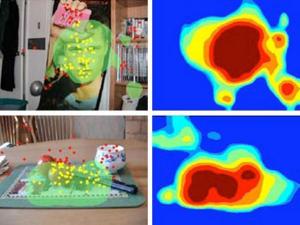
Researchers at MIT's McGovern Institute for Brain Research have developed a new mathematical model to describe how the human brain visually identifies objects. The model accurately predicts human performance on certain visual-perception tasks, which suggests that it's a good indication of what actually happens in the brain, and it could also help improve computer object-recognition systems.
Image
A new computational model of how the primate brain 
recognizes objects creates a map of "interesting" features 
(right) for a given image. The model's predictions of which 
parts of the image will attract a viewer's attention 
(green clouds, left) accord well with experimental data 
(yellow and red dots). 
(Credit: Images courtesy of Sharat Chikkerur)

The model was designed to reflect neurological evidence that in the primate brain, object identification -- deciding what an object is -- and object location -- deciding where it is -- are handled separately. "Although what and where are processed in two separate parts of the brain, they are integrated during perception to analyze the image," says Sharat Chikkerur, lead author on a paper appearing this week in the journal Vision Research, which describes the work. "The model that we have tries to explain how this information is integrated."

The mechanism of integration, the researchers argue, is attention. According to their model, when the brain is confronted by a scene containing a number of different objects, it can't keep track of all of them at once. So instead it creates a rough map of the scene that simply identifies some regions as being more visually interesting than others. If it's then called upon to determine whether the scene contains an object of a particular type, it begins by searching -- turning its attention toward -- the regions of greatest interest.

Chikkerur and Tomaso Poggio, the Eugene McDermott Professor in the Department of Brain and Cognitive Sciences and at the Computer Science and Artificial Intelligence Laboratory, together with graduate student Cheston Tan and former postdoc Thomas Serre, implemented the model in software, then tested its predictions against data from experiments with human subjects. The subjects were asked first to simply regard a street scene depicted on a computer screen, then to count the cars in the scene, and then to count the pedestrians, while an eye-tracking system recorded their eye movements. The software predicted with great accuracy which regions of the image the subjects would attend to during each task.

The software's analysis of an image begins with the identification of interesting features -- rudimentary shapes common to a wide variety of images. It then creates a map that depicts which features are found in which parts of the image. But thereafter, shape information and location information are processed separately, as they are in the brain.

The software creates a list of all the interesting features in the feature map, and from that, it creates another list, of all the objects that contain those features. But it doesn't record any information about where or how frequently the features occur.

At the same time, it creates a spatial map of the image that indicates where interesting features are to be found, but not what sorts of features they are.

It does, however, interpret the "interestingness" of the features probabilistically. If a feature occurs more than once, its interestingness is spread out across all the locations at which it occurs. If another feature occurs at only one location, its interestingness is concentrated at that one location.

Mathematically, this is a natural consequence of separating information about objects' identity and location and interpreting the results probabilistically. But it ends up predicting another aspect of human perception, a phenomenon called "pop out." A human subject presented with an image of, say, one square and one star will attend to both objects about equally. But a human subject presented an image of one square and a dozen stars will tend to focus on the square.

Like a human asked to perform a visual-perception task, the software can adjust its object and location models on the fly. If the software is asked to identify only the objects at a particular location in the image, it will cross off its list of possible objects any that don't contain the features found at that location.

By the same token, if it's asked to search the image for a particular kind of object, the interestingness of features not found in that object will go to zero, and the interestingness of features found in the object will increase proportionally. This is what allows the system to predict the eye movements of humans viewing a digital image, but it's also the aspect of the system that could aid the design of computer object-recognition systems. A typical object-recognition system, when asked to search an image for multiple types of objects, will search through the entire image looking for features characteristic of the first object, then search through the entire image looking for features characteristic of the second object, and so on. A system like Poggio and Chikkerur's, however, could limit successive searches to just those regions of the image that are likely to have features of interest.

Funding: DARPA, the Honda Research Institute USA, NEC, Sony and the Eugene McDermott Foundation

Friday, August 13, 2010

Dark-Matter Search Plunges Physicists to New Depths


This month physicist Juan Collar and his associates are taking their attempt to unmask the secret identity of dark matter into a Canadian mine more than a mile underground.
Pictured here is the 1-liter bubble chamber during 
testing at MINOS Hall, 350 feet underneath Fermi 
National Accelerator Laboratory. Physicists installed 
a similar but larger bubble chamber for detecting 
dark matter this summer in a laboratory more than 
a mile underground in Sudbury, Canada. 
(Credit: Reidar Hahn/Fermilab)

The team is deploying a 4-kilogram bubble chamber at SNOLab, which is part of the Sudbury Neutrino Observatory in Ontario, Canada. A second 60-kilogram chamber will follow later this year. Scientists anticipate that dark matter particles will leave bubbles in their tracks when passing through the liquid in one of these chambers.

Dark matter accounts for nearly 90 percent of all matter in the universe. Although invisible to telescopes, scientists can observe the gravitational influence that dark matter exerts over galaxies. "There is a lot more mass than literally meets the eye," said Collar, Associate Professor in Physics at the University of Chicago. "When you look at the matter budget of the universe, we have a big void there that we can't explain."

Likely suspects for what constitutes dark matter include Weakly Interacting Massive Particles (WIMPS) and axions. Theorists originally proposed the existence of both these groups of subatomic particles to address issues unrelated to dark matter. "These seem to be perfect to explain all of these observations that give us this evidence for dark matter, and that makes them very appealing," Collar said.

SNOLab will be the most ambitious in a series of underground locations where Collar and his colleagues have searched for dark matter. In 2004, they established the Chicagoland Observatory for Underground Particle Physics (COUPP) at Fermi National Accelerator Laboratory.

"We started with a detector the size of a test tube and now have increased the mass by a factor of more than a thousand," said Fermilab physicist Andrew Sonnenschein. "It's exciting to see the first bubble chamber being sent off to SNOLab, because the low level of interference we can expect from the cosmic rays there will make our search for dark matter enormously more sensitive."

The COUPP collaboration consists of scientists from UChicago, Fermilab and Indiana University at South Bend. In 2008 the collaboration released its first results that established an old technology of particle physics -- the bubble chamber -- as a potential dark-matter detector.

COUPP extends to the city of Chicago's flood-control infrastructure, called the Tunnel and Reservoir Project. The city has granted COUPP scientists access to the tunnels, 330 feet underground, to test prototypes of their instruments. The collaboration also tested instruments in a chamber 350 feet below Fermilab, and in a sub-basement of the Laboratory for Astrophysics and Space Research on the UChicago campus.

Collar continually seeks underground venues for his research in order to screen out false signals from various natural radiation sources, including cosmic rays from deep space. "It's an interesting lifestyle," Collar said.

The troublesome underground radiation sources consist of charged particles that lose energy as they traverse through a mile or more of rock. But rock has no impact on particles that interact weakly with matter, such as WIMPS, thus the move to Sudbury.

"SNOLab is a very special, spectacular place, because the infrastructure that the Canadians have developed down there is nothing short of amazing," Collar said. Even though SNOLab sits atop a working nickel mine, conditions there are pristinely antiseptic.

"As you walk in, you have to shower to remove any trace of dust," he said. "It's a clean-room atmosphere, meaning that there's essentially no specks of dust anywhere. We have to worry about such things, sources of radiation associated with dust."

Collar also is a member of the Coherent Germanium Neutrino Technology (CoGeNT) collaboration, which operates a detector that sits nearly half a mile deep at the Soudan Underground Mine State Park in northern Minnesota. The 60-kilogram detector that Collar and colleagues will install at SNOLab later this year, meanwhile, undergoes testing in a tunnel 350 feet beneath Fermilab.

Linking the two sites is an invisible beam of neutrinos that stretches 450 miles from Fermi to Soudan. The beam is part of the Main Injector Neutrino Oscillation Search (MINOS), a particle-physics experiment that is unrelated to the search for dark matter.

The two detectors rely on entirely different techniques. CoGeNT uses a new type of germanium detector that targets the detection of light WIMPS.

"Most of us have been concentrating on intermediate-mass WIMPS for decades," Collar said. "In the last few years the theoreticians have been telling us more and more, look, under these other sets of assumptions, it could be a lighter WIMP. This device is actually the first of its kind in the sense that it's targeted specifically for light WIMPS. We're seeing interesting things with it that we don't fully understand yet."

Collar estimates that it'll take a decade or more for physicists to become completely convinced that they've seen dark-matter particles.

"It's going to take a lot of information from very many different points of view and entirely independent techniques," he said. "One day we'll figure it out."

Tuesday, May 10, 2011

Brain Performs Near Optimal Visual Search


In the wild, mammals survive because they can see and evade predators lurking in the shadowy bushes.
Transportation Security Administration screeners can 
pick out dangerous objects in an image of our messy 
and stuffed suitcases. This ability to recognize target 
objects surrounded by distracters is one of the 
remarkable functions of our nervous system
(Credit: © Daniel Schmid / Fotolia)

That ability translates to the human world. Transportation Security Administration screeners can pick out dangerous objects in an image of our messy and stuffed suitcases. We get out of the house every morning because we find our car keys on that cluttered shelf next to the door.

This ability to recognize target objects surrounded by distracters is one of the remarkable functions of our nervous system.

"Visual search is an important task for the brain. Surprisingly, even in a complex task like detecting an object in a scene with distracters, we find that people's performance is near optimal. That means that the brain manages to do the best possible job given the available information," said Dr. Wei Ji Ma, assistant professor of neuroscience at Baylor College of Medicine. A report on research by him and colleagues from other institutions appears online in the journal Nature Neuroscience.

Recognizing the target is more than figuring out each individual object.

"Target detection involves integrating information from multiple locations," said Ma. "Many objects might look like the target for which you are searching. It is a cognitive judgment as well as a visual one."

One factor that must be taken into account is reliability of the information.

"We study that in particular," said Ma. "If you are a detective, you weight different pieces of information based on the reliability of the source. Similarly, the brain has to weight different pieces of visual information."

In his study, he and his colleagues used computer screens to show subjects sets of lines that might or might not contain a line oriented in a particular way. To manipulate reliability, they randomly varied the contrast of each line, making the target easier or more difficult to detect. Each screen was shown for only a fraction of a second, making the search task very difficult.

"We found that even in this complex task, people came close to being optimal in detecting the target," he said. "That means that humans can in a split second integrate information across space while taking into account the reliability of that information. That is important in our daily lives."

The task was deliberately made very hard so that people made mistakes, he said, but their answers were as good as they could be given the noise that is inherent to visual observations.

In the second part of their study, they determined that this ability might rely on groups (populations) of neurons that respond differently to different line orientations. Using such populations, they were able to construct a neural network that could weight information by the appropriate reliability.

They simulated this task on the computer and reproduced the behavior of human subjects, giving credence to their argument that the task requires populations of neurons.

"The visual system is automatically and subconsciously doing complex tasks," said Ma. "People see objects and how they relate to one another. We don't just see with our eyes. We see with our brains. Our eyes are the camera, but the process of interpreting the image in our brains is seeing."

The next question is when does a visual task become so complex that the human brain fails to be optimal?

Others who took part in this research include Ronald van den Berg, a postdoc in Ma's lab, Vidhya Navalpakkam of the California Institute of Technology in Pasadena, Jeffrey M. Beck of University College London, and Alexandre Pouget of the University of Rochester in Rochester, New York.

Funding for this work came from the National Eye Institute, the National Science Foundation, the Gatsby Charitable Foundation, the Netherlands Organisation for Scientific Research, the U.S. Department of Defense's Multidisciplinary University Research Initiative (MURI), the National Institute on Drug Abuse and the James S. McDonnell Foundation.

Friday, March 5, 2010

Hydrothermal Vents Discovered Off Antarctica


Scientists at Columbia's Lamont-Doherty Earth Observatory have found evidence of hydrothermal vents on the seafloor near Antarctica, formerly a blank spot on the map for researchers wanting to learn more about seafloor formation and the bizarre life forms drawn to these extreme environments.

A vent spews chemical fluids from the East Pacific Rise, about 5,600 miles from newly suspected vents on the Pacific Antarctic Ridge. (Credit: Woods Hole Oceanographic Institution.)

Hydrothermal vents spew volcanically heated seawater from the planet's underwater mountain ranges -- the vast mid-ocean ridge system, where lava erupts and new crust forms. Chemicals dissolved in those vents influence ocean chemistry and sustain a complex web of organisms, much as sunlight does on land. In recent decades more than 220 vents have been discovered worldwide, but so far no one has looked for them in the rough and frigid waters off Antarctica.

From her lab in Palisades, N.Y., geochemist Gisela Winckler recently took up the search. By analyzing thousands of oceanographic measurements, she and her Lamont colleagues pinpointed six spots on the remote Pacific Antarctic Ridge, about 2,000 miles from New Zealand, the closest inhabited country, and 1,000 miles from the west coast of Antarctica, where they think vents are likely to be found. The sites are described in a paper published in the journal Geophysical Research Letters.

"Most of the deep ocean is like a desert, but these vents are oases of life and weirdness," said Winckler. "The Pacific Antarctic ridge is one of the ridges we know least about. It would be fantastic if researchers were to dive to the seafloor to study the vents we believe are there."

Two important facts helped the scientists isolate the hidden vents. First, the ocean is stratified with layers of lighter water sitting on top of layers of denser water. Second, when a seafloor vent erupts, it spews gases rich in rare helium-3, an isotope found in earth's mantle and in the magma bubbling below the vent. As helium-3 disperses through the ocean, it mixes into a density layer and stays there, forming a plume that can stretch over thousands of kilometers.

The Lamont scientists were analyzing ocean-helium measurements to study how the deep ocean exchanges dissolved gases with the atmosphere when they came across a helium plume that looked out of place. It was in a southern portion of the Pacific Ocean, below a large and well-known helium plume coming off the East Pacific Rise, one of the best-studied vent regions on earth. But this mystery plume appeared too deep to have the same source.

Suspecting that it was coming from the Pacific Antarctic Ridge instead, the researchers compiled a detailed map of ocean-density layers in that region, using some 25,000 salinity, temperature and depth measurements. After locating the helium plume along a single density layer, they compared the layer to topographic maps of the Pacific Antarctic Ridge to figure out where the plume would intersect.

The sites they identified cover 340 miles of ridge line--the approximate distance between Manhattan and Richmond, Va.--or about 7 percent of the total 4,300 mile-ridge. This chain of volcanic mountains lies about three miles below the ocean surface, and its mile-high peaks are cut by steep canyons and fracture zones created as the sea floor spreads apart. It is a cold and lonely stretch of ocean, far from land or commercial shipping lanes.

"They haven't found vents, but they've narrowed the places to look by quite a bit," said Edward Baker, a vent expert at the National Oceanic and Atmospheric Administration.

Of course, finding vents in polar waters is not easy, even with a rough idea where to look. In 2007, Woods Hole Oceanographic Institution geophysicist Rob Reves-Sohn led a team of scientists to the Gakkel Ridge between Greenland and Siberia to look for vents detected six years earlier. Although they discovered regions where warm fluids appeared to be seeping from the seafloor, they failed to find the high-temperature, black smoker vents they had come for. In a pending paper, Sohn now says he has narrowed down the search to a 400-kilometer-square area where he expects to find seven new vents, including at least one black smoker.

The search for vents off Antarctica may be equally unpredictable, but the map produced by the Lamont scientists should greatly improve the odds of success, said Robert Newton, a Lamont oceanographer and study co-author. "You don't have to land right on top of a vent to know it's there," he said. "You get a rich mineral soup coming out of these smokers -- methane, iron, manganese, sulphur and many other minerals. Once you get within a few tens of kilometers, you can detect these other tracers."

Since the discovery of the first hydrothermal vents in the late 1970s, scientists have searched for far-flung sites, in the hunt for new species and adaptive patterns that can shed light on how species evolved in different spots. Cindy Van Dover, a deep sea biologist and director of the Duke University Marine Laboratory, says she expects that new species will be found on the Pacific Antarctic Ridge, and that this region may hold important clues about how creatures vary between the Indian and Pacific Oceans, on either end.

"These vents are living laboratories," said Van Dover, who was not involved in the study. "When we went to the Indian Ocean, we discovered the scaly-foot gastropod, a deep-sea snail whose foot is covered in armor made of iron sulfides. The military may be interested in studying the snail to develop a better armor. The adaptations found in these animals may have many other applications."

Other study authors include Peter Schlosser, head of Lamont's Environmental Tracer Group and Lamont marine geologist Timothy Crone.

Reblog this post [with Zemanta]